

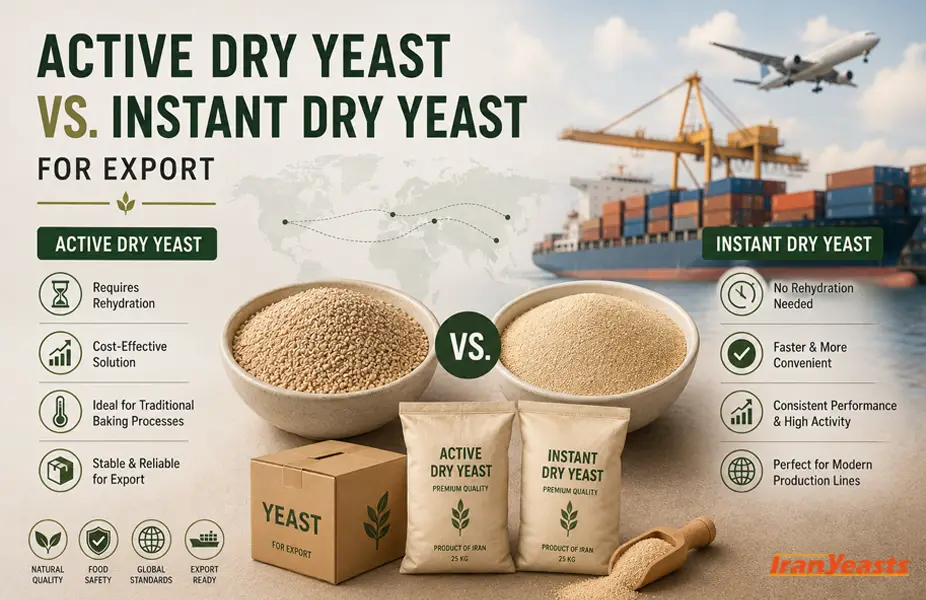
You are about to place a bulk yeast order, possibly dozens or hundreds of metric tons, and your supplier asks you to choose: active dry yeast or instant dry yeast. Both ferment dough. Both ship in bulk. But the wrong choice for your end-market can mean added rehydration equipment on the factory floor, shorter shelf life surviving the voyage, or slower production lines at your customers’ bakeries.
For yeast for bakery importers sourcing at commercial scale, this is a decision worth getting right before the container ships. The debate over instant dry yeast vs active dry yeast bulk procurement is not just technical. It touches on shelf life across long trade routes, cold-chain tolerance, activation requirements, packaging options, and total landed cost.
This guide delivers a complete, side-by-side comparison of active dry yeast (ADY) and instant dry yeast (IDY), drawing on Iran Yeast’s nine years of export experience across 16 countries, so you can confidently select the right yeast type for your market.
What Are Active Dry Yeast and Instant Dry Yeast? A Technical Overview
Both active dry yeast and instant dry yeast are derived from the same organism, Saccharomyces cerevisiae, but they are produced through different drying processes that result in distinct physical and functional properties. Understanding these differences is the foundation of every sound bulk procurement decision for yeast for bakery importers.
Active Dry Yeast (ADY)
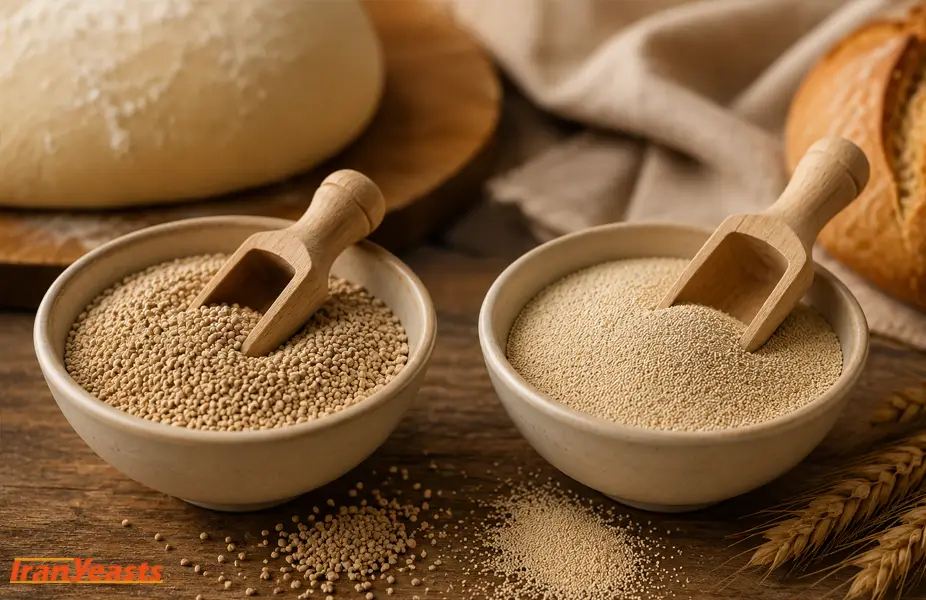
ADY is produced through a drum-drying or extrusion process at relatively high temperatures. The result is a coarser granule (approximately 0.5-1.0 mm diameter) with a dormant outer shell of dead yeast cells surrounding a viable inner core. Moisture content typically ranges from 6-8%.
The outer dead-cell layer means ADY must be rehydrated (proofed) in warm water (38-43°C) for 5-10 minutes before use. Skipping this step can result in up to 50% lower fermentation activity (Hui et al., 2006).
Instant Dry Yeast (IDY)
IDY is produced using a gentler, low-temperature vacuum or fluidized-bed drying process. The granules are finer (0.3-0.5 mm), uniformly porous, and almost fully composed of viable yeast cells. Moisture content is much lower, typically 3-5%.
Because of this structure, IDY does not require proofing and can be added directly to flour. It dissolves and activates rapidly upon contact with moisture in the dough. Fermentation speed is typically 25-50% faster than equivalent quantities of ADY.
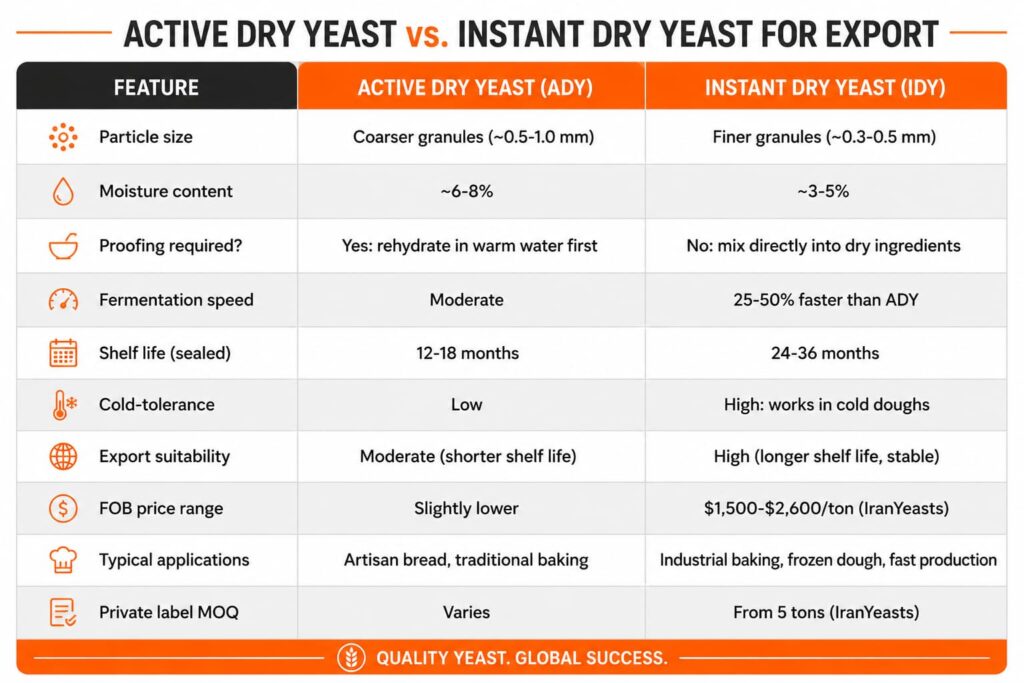
Instant Dry Yeast vs Active Dry Yeast Bulk Comparison: Side-by-Side Parameters
The table below summarizes the key differences relevant to importers, distributors, and industrial bakers making bulk procurement decisions.
Shelf Life, Packaging, and Export Logistics: Where IDY Has a Decisive Edge
For international trade, particularly along routes spanning the Middle East, Central Asia, South Asia, or Sub-Saharan Africa, shelf life is not just a quality metric. It is a logistics constraint that affects insurance costs, spoilage rates, and the viability of your distribution model.
Active dry yeast typically carries a sealed shelf life of 12-18 months. In warm-climate markets with slower distribution networks, this window narrows significantly once packaging reaches the importer’s warehouse.
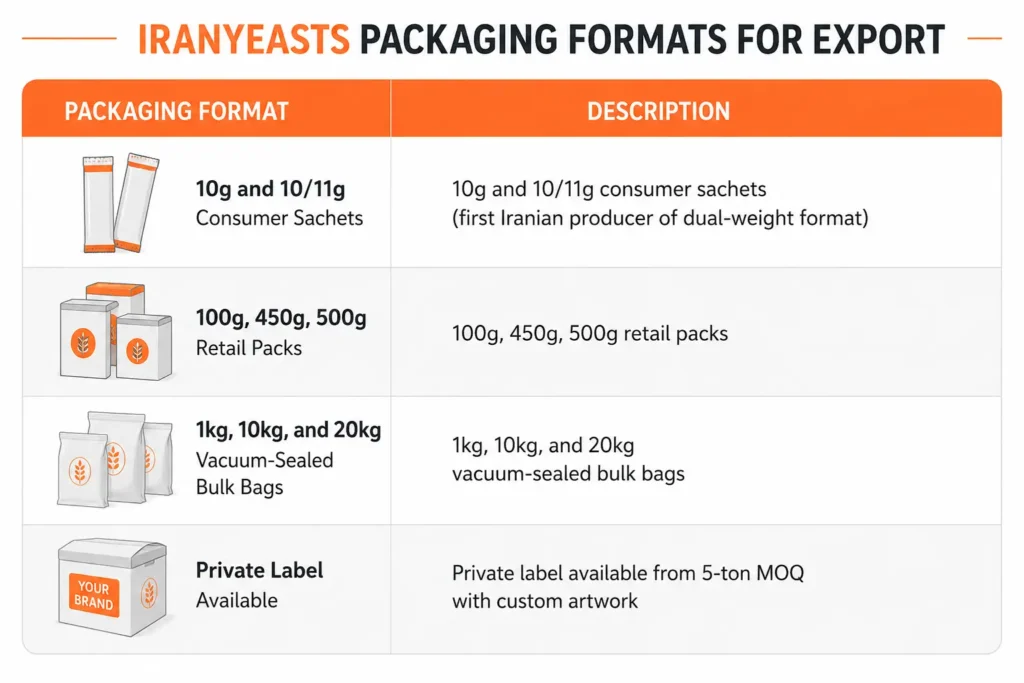
Instant dry yeast routinely achieves 24-36 months under vacuum or nitrogen-flush packaging. Iran Yeast’s IDY is packed in vacuum-sealed formats ranging from 10-gram sachets to 20-kilogram bags, maintaining viability from Bandar Abbas to end-users in Karachi, Lagos, or Melbourne
The extended shelf life of IDY also reduces insurance and spoilage risk for distributors who hold stock for multiple downstream clients. For yeast for bakery importers managing multi-country distribution networks, this alone often justifies the switch to IDY.
Which Yeast Type Is Right for Your End-Market? A Use-Case Guide
Matching yeast type to end-use application is critical for distributors advising bakery customers. The wrong type does not simply underperform. It can cause production line disruptions, inconsistent batch results, and customer attrition. This is particularly important in the context of instant dry yeast vs active dry yeast bulk sourcing decisions, where a single contract may supply dozens of bakeries.
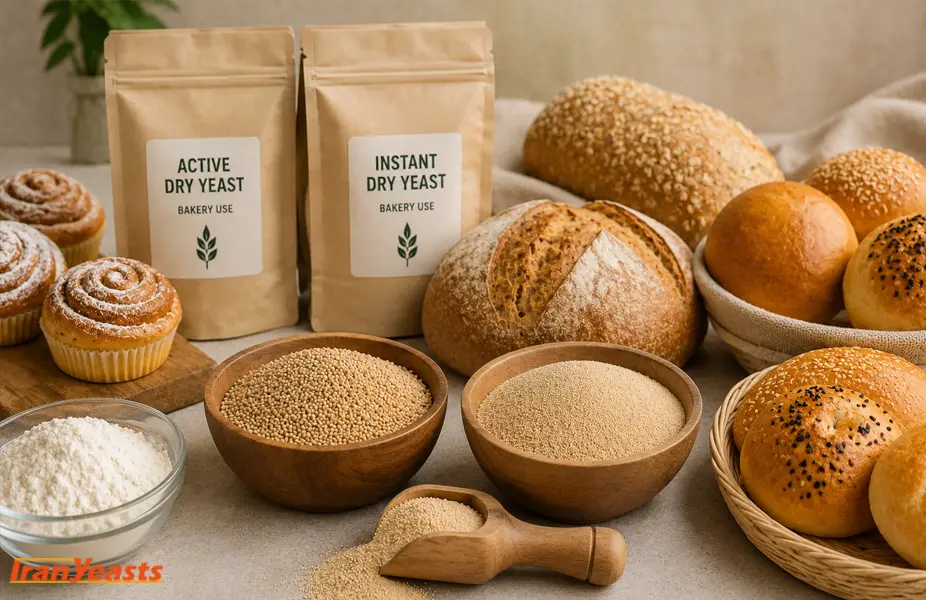
Instant Dry Yeast Is the Superior Choice For:
- Industrial and automated bakeries: continuous mixing lines have no time or equipment for proofing steps.
- Frozen and retarded dough production: IDY’s cold-tolerance preserves cell viability through freeze-thaw cycles (Lund & Hansen, 2019).
- High-speed production environments: faster fermentation reduces proof times and increases throughput.
- Humid tropical markets: IDY’s lower moisture content resists clumping and moisture ingress better than ADY during storage.
- Private label and foodservice: consistent, predictable performance from batch to batch.
Active Dry Yeast Retains an Advantage For:
- Artisan and craft bakeries: slower, more controllable fermentation for complex flavour development.
- Traditional baking applications in markets where consumers and bakers are accustomed to the proofing ritual.
- Price-sensitive markets where the marginal cost saving justifies the added processing step.
In export markets across the Middle East, Central Asia, and Africa, which collectively account for the majority of Iran Yeast’s 150-250 MT monthly output, instant dry yeast consistently dominates commercial procurement decisions among yeast for bakery importers and distributors.
Manufacturing Process Differences and Their Impact on Quality
Understanding how each yeast type is produced explains why IDY consistently outperforms ADY on the metrics that matter for industrial buyers.
ADY Manufacturing
Yeast biomass is propagated in molasses-based media, then extruded or drum-dried at relatively high temperatures (above 50 degrees Celsius). The thermal stress kills the outer cell layer, creating the characteristic dormant granule structure. This outer shell prolongs survival in storage but requires time and warm water to dissolve before the viable inner cells become active.
IDY Manufacturing
Yeast biomass undergoes a gentler drying process, typically fluidized-bed drying below 45 degrees Celsius, preserving cell membrane integrity throughout the granule. The result is a highly porous, uniformly viable particle with near-instant rehydration capability. Iran Yeast’s production facility in Mashhad operates under HACCP and Iran National Standard protocols, with each batch tested for moisture content, cell viability, and fermentation activity before release.
Research published in Food Innovation and Advances (Que et al., 2024) confirms that lower-temperature drying is the primary factor in achieving the higher specific fermentation activity that characterizes premium IDY products and that yeast for bakery importers should look for when evaluating suppliers.
Pricing, Payment Terms, and Cost Implications for Importers
The price differential between ADY and IDY is narrower than many buyers expect. When total landed cost is factored in, IDY often offers better value per unit of fermentation activity, particularly when reduced spoilage and longer shelf life are taken into account.
FOB Price Benchmarks (IranYeasts, 2025)
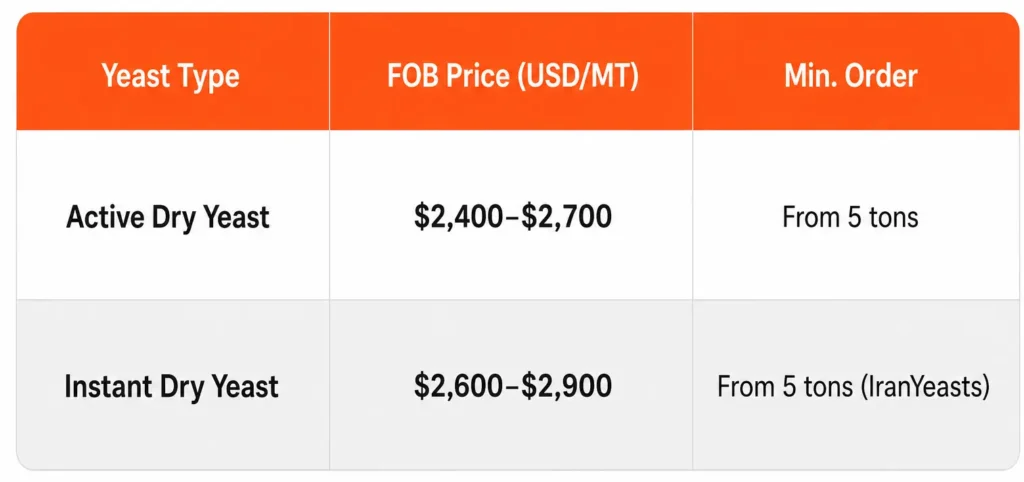
Standard payment terms are 30% deposit with the balance settled before container loading. For verified returning clients, flexible terms are available.
Certifications, Compliance, and Regulatory Considerations
Regulatory acceptance is the gatekeeping question for yeast imports in most markets. IranYeasts products carry the following certifications applicable to both ADY and IDY:
- Halal Certification: ISIRI-approved, essential for Middle East, Southeast Asia, and Muslim-majority African markets.
- HACCP: hazard analysis and critical control points certification, required by most institutional food buyers.
- Iran National Standard (ISIRI): aligns with Codex Alimentarius FAO/WHO (1997, rev. 2020) specifications for dried yeast.
- ISO-aligned quality management: internal quality protocols traceable to international benchmarks.
Importers in the EU, Australia, and regulated Asian markets should request a full Certificate of Analysis (CoA) and SGS or equivalent third-party inspection reports, which IranYeasts provides on request for all shipments.
Navigating Iran-Origin Procurement: A Practical Guide for New Importers
The most common question new buyers ask IranYeasts is direct: how do we handle sanctions? It is a legitimate question, and one that deserves a practical answer rather than evasion.
Food and agricultural products, including yeast, are generally exempt from US and EU sanctions on Iran under humanitarian trade provisions. Most buyers in the UAE, Turkey, Pakistan, Iraq, Central Asian CIS states, and Oman conduct regular, compliant trade with Iranian food exporters without issue.
Iran Yeast’s recommended process for new importers is:
- Request a sample shipment (1-5 kg): this establishes a working relationship and verifies product quality without financial exposure.
- Consult your compliance officer regarding applicable exemptions in your jurisdiction.
- Review payment routing options: IranYeasts works with buyers to identify viable banking and transfer channels.
- Proceed with the first commercial order: most buyers find the process straightforward after the sample stage.
Over 90% of Iran Yeast’s current clients were initially hesitant about Iran-origin sourcing and became repeat customers after the first successful shipment.
Iran Yeast’s Expertise: Nine Years of Dual-Product Export Experience
IranYeasts has been supplying both active dry yeast and instant dry yeast to international buyers since 2017. Operating from Mashhad, Iran’s second-largest city and a major agro-industrial hub, the company exports 150-250 metric tons per month across 16 countries in the Middle East, Central Asia, South Asia, Europe, and Australia.
Key differentiators that yeast for bakery importers and distributors consistently cite when choosing IranYeasts :
- Dual-product capability: the ability to supply both ADY and IDY allows importers to consolidate sourcing with a single vetted supplier, simplifying procurement and reducing administrative overhead.
- Private label from 5 MT MOQ: one of the lowest private label minimums among Iranian exporters, enabling distributors to launch custom-branded yeast lines without committing to large initial volumes.
- Pioneer of the 10/11g dual-weight sachet: IranYeasts was the first Iranian producer to develop this format, now widely adopted across retail markets in the region.
- End-to-end logistics: the company manages customs documentation, phytosanitary certificates, and freight coordination from factory gate to destination port.
- Transparent communication: each shipment is accompanied by full CoA documentation, and buyers receive proactive updates throughout the export process.
The dried yeast market is projected to exceed USD 1.1 billion by 2029 at a CAGR of approximately 8.9% (Coherent Market Insights, 2026), with instant dry yeast commanding the fastest-growing segment driven by industrial bakery expansion across Asia and Africa.
Conclusion
The choice between active dry yeast and instant dry yeast is not merely technical. It is a strategic procurement decision with direct consequences for supply chain reliability, end-user satisfaction, and distributor margins. For yeast for bakery importers supplying industrial clients across warm-climate or long-route markets, instant dry yeast’s superior shelf life, direct-addition convenience, cold-dough tolerance, and faster fermentation consistently make it the dominant commercial choice.
When evaluating the instant dry yeast vs active dry yeast bulk procurement question for your next order cycle, the data points clearly in one direction for most export markets. IranYeasts has supplied both yeast types to buyers in 16 countries since 2017, with full certification, private label capability from 5 MT, and end-to-end logistics support. Importers seeking a reliable, Halal-certified, competitively priced source of Iranian instant dry yeast or active dry yeast are welcome to request a product sample or FOB quotation at iranyeasts.