The word “vanilla” on a food label rarely means what most consumers imagine. In commercial bakeries, ice cream factories, confectionery lines, and beverage production across the Middle East, Central Asia, and beyond, the vanilla flavor in the product almost certainly comes from food-grade vanillin powder , not from vanilla beans grown in Madagascar or Indonesia.
For distributors and food manufacturers sourcing bulk premium vanilla flavoring for industrial use, this distinction matters. It changes what specifications you should be asking for, which suppliers are relevant, and how to evaluate quality and price on equal terms.
This article explains what Iranian food-grade vanillin powder is, how it compares to alternatives from China and Turkey, what the regional market opportunity looks like, and what bulk importers should know before placing a first order with an Iranian supplier.
Vanillin vs. Natural Vanilla: What the Food Industry Actually Buys in Bulk
Before evaluating any supplier of Iranian vanilla or vanillin products, it helps to understand what the commercial food industry actually purchases , and why.
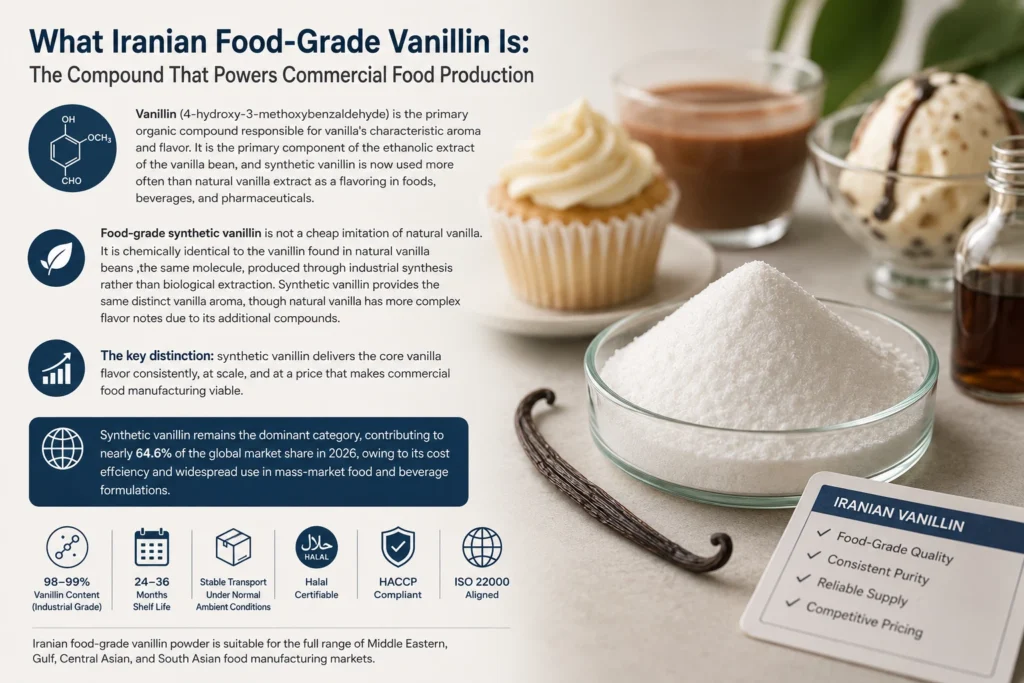
Synthetic vanillin remains the dominant category in the global vanillin market, contributing to nearly 64.6% of global market share in 2026, owing to its cost efficiency and widespread use in mass-market food and beverage formulations. The reason is straightforward: natural vanilla extract from real vanilla beans is one of the most expensive food flavorings in the world. Natural vanillin prices typically range between $1,200 to $1,500 per kilogram, making it commercially impractical for industrial bakeries, ice cream manufacturers, and confectionery producers operating at scale.
Food-grade synthetic vanillin , chemically identical to the primary flavor compound found in natural vanilla beans (4-hydroxy-3-methoxybenzaldehyde) , delivers the same characteristic vanilla aroma and taste at a fraction of the cost. Bulk pricing for food-grade vanillin from major suppliers ranges from approximately $8–$35 per kilogram, depending on purity, order volume, and packaging format.
Powder and crystal vanillin represent the leading subcategory, commanding more than 68.2% of total market volume in 2026, driven by superior stability, long shelf life, and compatibility with a wide range of food manufacturing processes. For bulk importers, this means powder format is the standard , and the format most relevant when evaluating wholesale vanilla suppliers.
The Global Vanillin Market in 2026: Why Regional Sourcing Is Becoming More Strategic
The vanillin market size was valued at USD 1.12 billion in 2026 and is estimated to grow from USD 1.21 billion in 2026 to reach USD 1.79 billion by 2031, at a CAGR of 8.09% during the forecast period. Strong demand from food and beverage manufacturers anchors current volume, while rising consumption of processed and packaged foods in emerging markets continues to drive growth.
The Middle East and Africa are estimated to grow at the highest CAGR over the forecast period among all regions , a direct reflection of expanding food manufacturing capacity, rising consumer purchasing power, and growing demand for certified Halal food ingredients across the region.
For distributors supplying the Middle East, Iraq, the Gulf states, or Central Asian markets, this growth trajectory has a practical implication: the demand from downstream customers , bakeries, confectionery producers, ice cream manufacturers , for consistent, Halal-certified vanillin is increasing. The question is where you source it.
China dominates over 80% of global vanillin production, making Chinese suppliers the default option for most bulk buyers. But long shipping routes, minimum order quantities, documentation complexity, and certification requirements for Halal-specific markets create friction , particularly for distributors in Iraq, the UAE, Afghanistan, and neighboring countries where Iranian-origin food products move through established, shorter trade routes.
What Iranian Food-Grade Vanillin Powder Actually Delivers: Specifications That Matter
Not all vanillin powder is equal , and the specification that matters most for food manufacturers is purity.
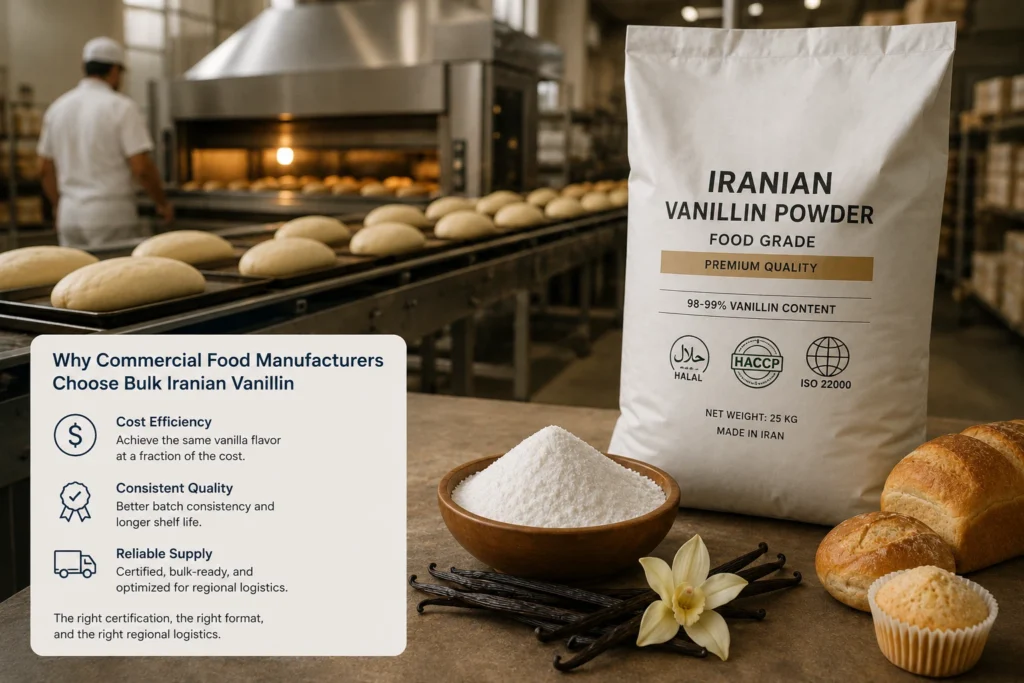
Our Iranian vanilla powder products are supplied at 98–99% vanillin content, the standard industrial specification for food-grade applications. At this purity level, the product is suitable for direct use in:
- Commercial bakeries and artisan bread production
- Confectionery and chocolate manufacturing
- Ice cream and dairy flavoring
- Biscuit, cake, and pastry production
- Beverage flavoring (hot and cold drink applications)
- Industrial food additives and compound flavoring systems
Full technical profile:Laboratory documentation available for every batch includes Certificate of Analysis (CoA), Technical Data Sheet (TDS), and Safety Data Sheet (SDS/MSDS). Quality testing conducted covers purity, microbial load, moisture content, stability, flavor and aroma profile, and solubility.
| Specification | Standard |
|---|---|
| Vanillin Content | 98–99% minimum |
| Appearance | White to off-white crystalline powder |
| Food Grade Status | Certified Food Grade (Industrial & FMCG Use) |
| Shelf Life | 24–36 months under controlled storage conditions |
| Storage Conditions | Cool, dry environment; away from sunlight; sealed airtight packaging |
| Recommended Transit Temperature | Ambient temperature (stable under standard export logistics) |