

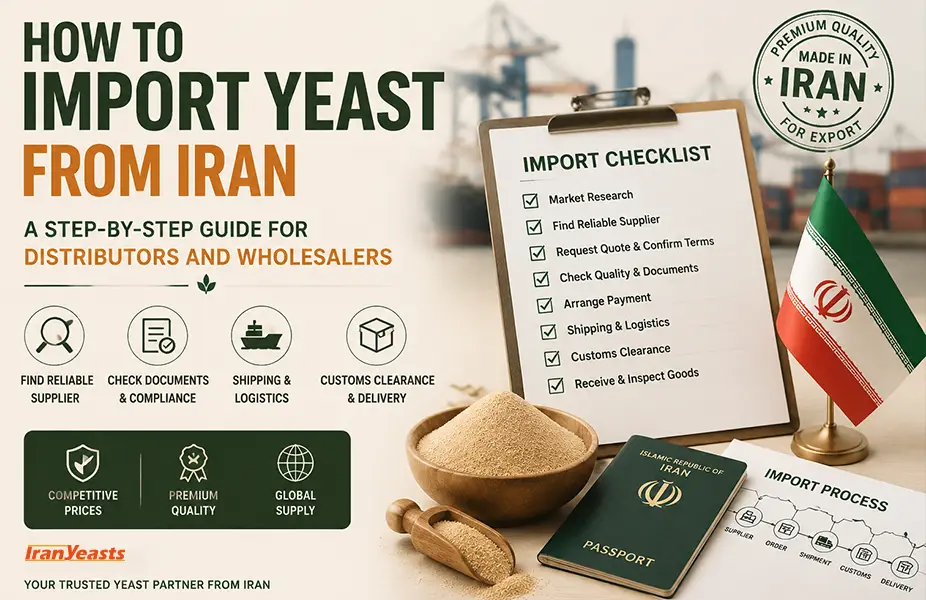
Most distributors and wholesalers who import yeast from Iran for the first time have the same experience: the product performs well, the price is competitive, but the first shipment takes longer than expected because the paperwork wasn’t quite right on the first attempt.
That’s not a problem unique to Iranian suppliers. It’s the reality of sourcing food ingredients across international borders for the first time with any new supply chain partner. Documentation requirements vary by destination market, HS codes matter for customs clearance, and the difference between FOB and CIF terms affects who carries which costs.
This guide of Iranyeasts walks through the complete process , from initial supplier contact to goods arriving at your destination port , so your first import goes smoothly and every subsequent one goes faster.
Looking to Import Iranian Instant Dry Yeast at Wholesale Scale?
Get expert guidance on product selection, packaging, export documentation, pricing, and international shipping directly from our export team.
What You Need to Know Before You Start: Product, Certification, and Price Basics
Before reaching out to any supplier, there are three things worth having clear in your own mind. These will shape every conversation you have and every document you’ll eventually need.
Which Product Format Does Your Market Actually Need?
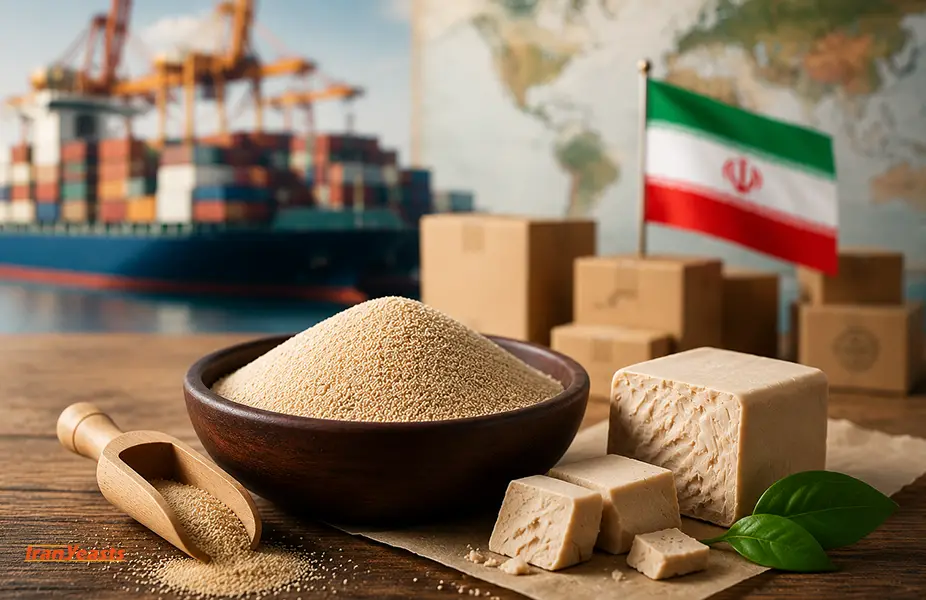
Iranian instant dry yeast is available in a wide range of packaging formats , from 10g consumer sachets through to 20kg industrial vacuum bags. The right format for your business depends entirely on who your end customers are and how yeast is bought and sold in your market.
Consumer-facing distributors selling into retail or foodservice typically source 500g vacuum packs or 10–11g sachet multipacks , the sachet format being dominant in markets across Iraq, Afghanistan, Pakistan, and much of Central Asia. Industrial buyers and commercial bakeries typically work with 5kg, 10kg, or 20kg vacuum bags. Getting this right before your first inquiry saves multiple rounds of back-and-forth.
For a full breakdown of available packaging formats and their shelf life ranges, see our post on Iranian instant dry yeast and what it offers bulk importers worldwide.
Does Your Market Require Halal Certification?
If you’re importing into the Middle East, Central Asia, South Asia, or any Muslim-majority market , or supplying distributors who serve those markets , Halal certification is a baseline requirement, not a nice-to-have. Iranian yeast exported by IranYeasts carries Halal certification issued by ISIRI (Iran’s National Standards Organization), alongside HACCP and Iran National Standard documentation.
Before placing an order, confirm whether your destination market’s customs authority or your end buyers require any documentation beyond standard ISIRI Halal. Some markets , Malaysia and Indonesia in particular , operate their own national Halal accreditation systems with specific requirements. We’ve covered this in detail in our guide to Halal-certified yeast export from Iran, which is worth reading before your first inquiry if Halal compliance is relevant to your market.
What Should You Expect to Pay?
Having a realistic landed cost estimate before you start negotiating puts you in a much stronger position. Iranian instant dry yeast is priced at $1,500–$2,600 per metric ton FOB Bandar Abbas, depending on packaging, volume, and brand. Once you add ocean freight, insurance, destination port handling, and import duties, the landed cost will be higher , and how much higher depends on your specific route and market.
Our post on bulk dry yeast price from Iran in 2026 includes a worked landed cost example for a Dubai-bound shipment that gives you a realistic baseline for budgeting before you request a formal quote.
Step 1 , Identify and Qualify Your Supplier
Not every company presenting itself as an Iranian yeast exporter has the production relationships, logistics experience, and documentation infrastructure to deliver consistently on a commercial order. Here is what to look for when evaluating a supplier before your first conversation.
- Active export track record: Ask specifically which countries they currently export to, through which ports or border crossings, and how frequently. A supplier with active relationships in 10+ countries handles documentation scenarios you’ll encounter more competently than one who only exports to neighboring markets.
- Certifications on file: Request copies of current Halal, HACCP, and ISIRI certificates before committing to anything. Check the issue and expiry dates on the documents themselves. A certificate that expired six months ago is not a current certification.
- Private label capability: If you intend to sell yeast under your own brand rather than a third-party Iranian brand, confirm that the supplier offers private label production and that their Halal certification covers private label runs. Not all suppliers maintain this coverage for OEM production.
- Logistics infrastructure: Find out whether the supplier manages their own export logistics or outsources entirely to a freight forwarder. Suppliers who coordinate shipping, customs documentation, and cargo insurance directly , rather than passing everything to a forwarder and stepping back , resolve problems faster when they arise.
IranYeasts exports to 16 countries across the Middle East, Central Asia, South Asia, Europe, and Oceania, manages full logistics coordination including customs documentation, and carries cargo insurance with a 100% money-back guarantee to destination. These are not aspirational claims , they are the baseline for any serious commercial relationship.
Step 2 , Request Samples and Run Your Own Quality Test
Not every company presenting itself as an Iranian yeast exporter has the production relationships, logistics experience, and documentation infrastructure to deliver consistently on a commercial order. Here is what to look for when evaluating a supplier before your first conversation.
- Active export track record: Ask specifically which countries they currently export to, through which ports or border crossings, and how frequently. A supplier with active relationships in 10+ countries handles documentation scenarios you’ll encounter more competently than one who only exports to neighboring markets.
- Certifications on file: Request copies of current Halal, HACCP, and ISIRI certificates before committing to anything. Check the issue and expiry dates on the documents themselves. A certificate that expired six months ago is not a current certification.
- Private label capability: If you intend to sell yeast under your own brand rather than a third-party Iranian brand, confirm that the supplier offers private label production and that their Halal certification covers private label runs. Not all suppliers maintain this coverage for OEM production.
- Logistics infrastructure: Find out whether the supplier manages their own export logistics or outsources entirely to a freight forwarder. Suppliers who coordinate shipping, customs documentation, and cargo insurance directly , rather than passing everything to a forwarder and stepping back , resolve problems faster when they arise.
IranYeasts exports to 16 countries across the Middle East, Central Asia, South Asia, Europe, and Oceania, manages full logistics coordination including customs documentation, and carries cargo insurance with a 100% money-back guarantee to destination. These are not aspirational claims , they are the baseline for any serious commercial relationship.
Step 3 , Agree on Product Specifications, Incoterms, and Payment Terms
Once samples have been tested and approved, the commercial conversation begins in earnest. Three things need to be agreed before a pro-forma invoice is issued.
Product specification: Confirm packaging format, brand (or private label), quantity per shipment, and any specific labeling requirements for your market (language, nutritional declarations, Halal logo placement).
Incoterms: The most common options for Iranian yeast exports are FOB Bandar Abbas and CIF destination port. Under FOB, you take responsibility for freight and insurance from the moment goods are loaded at Bandar Abbas. Under CIF, the supplier covers freight and insurance to the named destination port. Which one suits you depends on whether you have an established freight forwarder relationship and whether you want to control that part of the supply chain.
If you’re new to importing from Iran and don’t yet have a freight partner for this route, CIF simplifies the process considerably for your first shipment. Once you have a working relationship with a forwarder experienced in Iranian export routes, FOB often becomes more cost-effective.
Payment terms: Standard terms are 30% upfront and the balance before loading. For first-time buyers this is non-negotiable. For buyers with an established order history, terms are open to discussion.
Step 4 , Understand the HS Code and Your Destination Country's Import Requirements
This step is one importers most commonly underestimate on a first order , and it’s where delays most often happen.
Instant dry yeast is classified under HS Code 2102.10 internationally , covering active yeasts used in baking, brewing, and food production. This six-digit code is consistent across World Customs Organization member countries, though national tariff schedules extend it to 8–12 digits depending on the destination.
Why this matters: The HS code determines the import duty rate in your destination country, which directly affects landed cost. It also triggers any specific import regulations , health certificates, food safety inspection requirements, phytosanitary documentation , that apply to this product category in your market.
Import duty rates for yeast (HS 2102.10) vary significantly by destination:
| Destination Market | Typical Import Duty Rate | Notes |
|---|---|---|
| UAE | 5% on CIF value | Standard GCC tariff |
| Iraq | 0–5% depending on packaging | Verify with customs agent |
| Pakistan | 11–16% depending on import category | Subject to local FTA provisions |
| India | 30–100% (varies by product presentation) | Consult a licensed customs broker |
| Russia | 12–15% | Subject to EAEU tariff schedule |
| Germany / EU | 0–8.3% depending on sub-classification | EU Common External Tariff |
| Australia | 0% | Duty-free for this HS code |
These rates are indicative and subject to change. Always verify the current duty rate with a licensed customs broker or your country’s official customs tariff portal before finalizing your landed cost calculation.
For buyers in markets new to Iranian food imports: work with a local customs agent who has handled Iranian-origin food products before. Documentation requirements at Iranian customs (export side) and at your destination customs (import side) each have their own specific requirements, and an experienced agent on each side of the transaction prevents avoidable delays.
Step 5 , Review and Sign the Pro-Forma Invoice
After the initial 30% payment is confirmed, production and packaging begins. Lead time from order confirmation to loading is 2–10 working days, depending on packaging format and order volume.
During this period, the following documentation is prepared in parallel with production:
- Commercial Invoice (final version, matching the PI)
- Packing List (itemized carton/bag count, weights, dimensions)
- Certificate of Origin (issued by the relevant Iranian trade authority , required by customs in most destination markets)
- Halal Certificate (ISIRI-issued, current validity)
- HACCP Certificate
- Certificate of Analysis (CoA) for the specific production batch
- Bill of Lading (sea freight) or CMR (land freight) , issued by the carrier after loading
All of these documents are prepared as standard on every IranYeasts shipment. Buyers should review the complete document set before paying the remaining balance , which is settled before cargo is loaded.
Step 7 , Freight, Insurance, and Tracking
IranYeasts ships via two primary routes depending on destination:
Sea freight departs from Bandar Abbas or Deyreh for Gulf, South Asian, and European markets. Transit times vary: Bandar Abbas to Jebel Ali (Dubai) is typically 3–5 days; Bandar Abbas to Mumbai is 7–10 days; routes to European ports are 20–30 days depending on routing.
Land freight is used for Afghanistan, Pakistan, and Iraq , often faster and more cost-effective for these markets given established overland routes from Iran’s eastern and western borders.
Cargo is fully insured in either case. Tracking information and shipping documentation are provided once the cargo is loaded and the Bill of Lading or CMR is issued.
For buyers managing their own freight under FOB terms, we coordinate with your nominated forwarder to ensure handover at the port of loading is smooth and documentation is complete before the vessel departs.
Step 8 , Destination Customs Clearance and Final Delivery
This final step is largely in the buyer’s hands , but there are things the supplier can do to make it smoother.
At destination customs, your clearing agent will submit the commercial invoice, packing list, certificate of origin, Halal certificate, HACCP documentation, and Bill of Lading. Some markets require additional documentation , health certificates, import permits, phytosanitary declarations , depending on how food ingredients are regulated locally.
Common causes of customs delays on Iranian food product imports, and how to avoid them:
- Incorrect HS code on documentation: Verify the correct 8–12 digit national code for your market before the supplier prepares the commercial invoice
- Expired certificates: Always check Halal and HACCP validity dates on the documents provided. Both should be current at time of arrival, not just at time of shipment
- Mismatch between declared value and market price: Customs authorities sometimes query declared values that appear below market rate. Ensure your invoice reflects the agreed commercial price
- Missing certificate of origin: Required by customs in virtually every market; ensure it’s included in the document package
If any documentation issue arises after shipment, IranYeasts will provide revised or supplementary documentation as needed to support customs clearance. Our logistics team remains engaged through delivery confirmation.
Final Thoughts
Importing yeast from Iran follows the same fundamental steps as importing any food ingredient from any origin , but knowing the Iran-specific details of documentation, certification, and routing before you start saves time and avoids the common first-shipment mistakes that delay clearance and erode margins.
The process is straightforward once you’ve done it once. Most of our buyers who start with a cautious 5-ton first order are placing 20-ton repeat orders within two shipments , not because we’ve sold them on anything, but because the product performs and the process works. That’s what a reliable supply chain is supposed to feel like.
References
- FreightAmigo. (2026, December). HS code for active yeast: 2026 classification guide. FreightAmigo Supply Chain Intelligence.
- Shipping Solutions. (2026, February). FOB vs. CIF: Incoterms 2020 rules for exporters and importers. Shipping Solutions Software.
- Rezbon. (2024, November). A comprehensive guide to importing food products from Iran. Rezbon International Trade Blog.
- World Customs Organization. (2022). Harmonized system nomenclature 2022 , Chapter 21: Miscellaneous edible preparations (HS 2102). WCO.
- International Chamber of Commerce. (2020). Incoterms® 2020 rules: Official ICC rules for the interpretation of trade terms. ICC Publishing.
Frequently Asked Questions
Find answers to common questions about Iranian instant dry yeast, including certifications, bulk orders, private labeling, export logistics, and delivery worldwide
Is it legal to import yeast from Iran?
Yes. Instant dry yeast is an agricultural food ingredient with no import restrictions in the vast majority of markets. Iranian-origin food products are traded actively to 16+ countries including Germany, Australia, the UK, Russia, and markets across the Middle East and Central Asia. Buyers should verify any country-specific import regulations with a local customs broker, but for instant dry yeast there are typically no restriction-related obstacles.
What is the HS code for instant dry yeast imports?
The international HS code for active instant dry yeast is 2102.10. National tariff schedules extend this to 8–12 digits depending on the destination country. Always verify the applicable national sub-classification and duty rate with your customs broker or national customs portal before finalizing landed cost calculations.
What documents will I receive with my shipment?
A standard IranYeasts export shipment is accompanied by: Commercial Invoice, Packing List, Certificate of Origin, Halal Certificate (ISIRI), HACCP Certificate, Certificate of Analysis (batch-specific), and Bill of Lading or CMR (land freight). All documents are provided as standard , not on special request.
Can I get yeast packaged under my own brand name?
Yes. IranYeasts offers private label production from a 5-ton minimum order. Halal certification covers private label production runs. We currently produce for 6 clients across 7 packaging formats in multiple countries.
ats in multiple countries. Q: How long does shipping take from Iran?
Production lead time is 2–10 working days from order confirmation. Sea transit: Bandar Abbas to Dubai ~3–5 days; to South Asian ports ~7–14 days; to European ports ~20–30 days. Land freight to Afghanistan, Pakistan, and Iraq typically runs 5–10 days.
What is the minimum order quantity?
5 metric tons. This applies to both branded and private label orders.
What if there's a quality issue after delivery?
IranYeasts provides full cargo insurance to destination and a 100% money-back guarantee on documented quality claims. We carry the quality risk , not our buyers.
How do I get started?
Contact us via iranyeasts.com with your destination market, target packaging format, and estimated volume. We’ll respond with product options and a preliminary quote within 24–48 hours.