

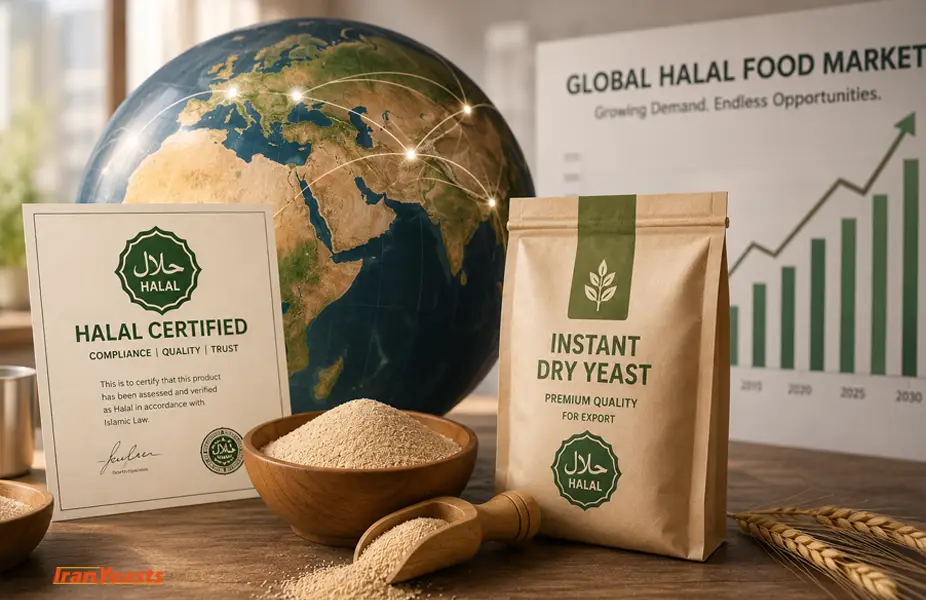
For food importers sourcing halal yeast in volume, the certificate on the packaging is only the beginning of the due diligence process. What issuing body granted it? Does that body carry recognition in your target market? What does it actually cover , and what doesn’t it?
These questions matter because halal compliance in the food industry is not uniform across borders. A certificate accepted without question in Iraq may require additional documentation in Malaysia or Indonesia. For a product like instant dry yeast , used directly in bread and baked goods consumed daily by millions , getting this wrong is not a minor administrative oversight.
This article of Irany Yeast breaks down exactly what halal certification means for instant dry yeast, how Iran’s certification system works, which markets it covers, and the specific questions every importer should ask any halal certified instant yeast supplier before placing an order.
Looking to Import Iranian Instant Dry Yeast at Wholesale Scale?
Get expert guidance on product selection, packaging, export documentation, pricing, and international shipping directly from our export team.
Why the Global Halal Food Market Makes Yeast Certification Non-Negotiable
The scale of the halal food market makes the certification question increasingly commercial , not just regulatory.
The global halal food market was valued at approximately $2.74 trillion in 2024 and is projected to reach $6.49 trillion by 2034, growing at a CAGR of around 9% annually. Asia Pacific accounts for over 48% of current market share, with the Middle East and Africa identified as the fastest-growing region for the forecast period. The global Muslim population is projected to grow by nearly 50% by 2050, reaching 2.76 billion individuals , a demographic trend with direct downstream implications for every certified food ingredient in the supply chain.
For bulk yeast importers, this isn’t abstract market data. It means the distributors, bakeries, and food manufacturers you supply are operating in markets where halal certification is a baseline purchasing requirement , not a premium feature. Supplying an uncertified or improperly certified product into these channels creates liability at every level of the distribution chain.
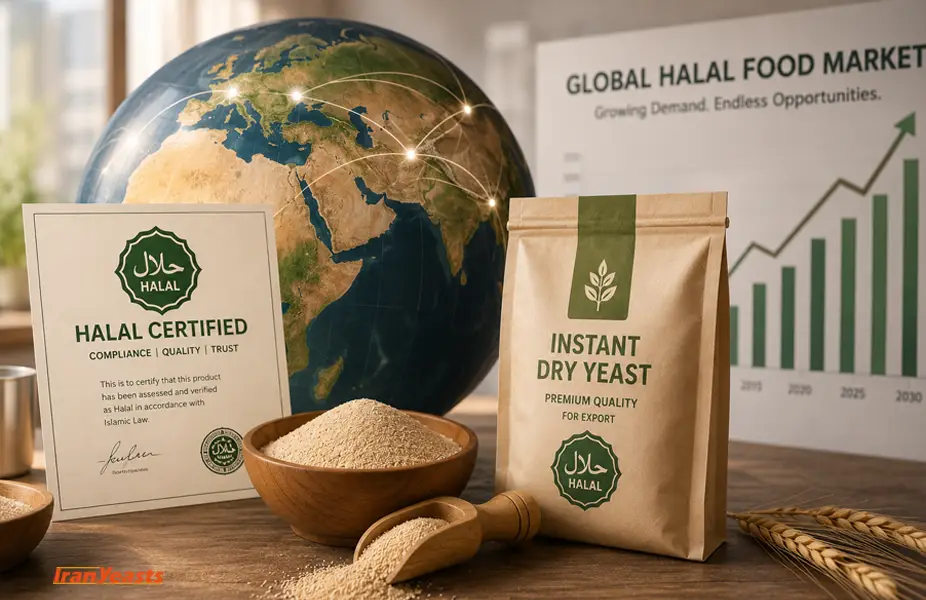
What Halal Certification Actually Covers in Yeast Production , and Where the Complexity Lies
Yeast itself , Saccharomyces cerevisiae , is inherently permissible under Islamic dietary law. The halal compliance question for instant dry yeast isn’t about the organism; it’s about the production environment, the input materials, and the processing aids used during manufacturing.
Key areas that halal auditors examine in a yeast production facility:
Growth media and nutrients: Yeast is cultivated on molasses-based sugar substrates. The origin and processing of these substrates must be free from any haram (impermissible) contamination.
Emulsifiers and processing aids: Some instant dry yeast formulations include sorbitan monostearate (E491), an emulsifier that protects yeast cells during the drying process. This compound must be derived from plant sources , not animal fat , to qualify as halal.
Shared production lines: If the same facility produces other food products or uses shared equipment, cross-contamination protocols must be documented and verified.
Packaging materials: Inks, adhesives, and packaging films used in contact with the product must also meet halal input requirements.
This is why the question is not simply “is yeast halal?” , it is “is this production process halal-compliant, as verified by a recognized third-party body?” The certificate answers that question. The issuing body determines who accepts that answer.
How Iran's Halal Certification System Works: ISIRI, Its Authority, and What It Covers
Iran’s halal standards are set and enforced by the Institute of Standards and Industrial Research of Iran (ISIRI), also referred to as the Iran National Standards Organization (INSO). ISIRI was founded in 1960 and has been a member of the International Organization for Standardization (ISO) since the same year , giving it formal standing within international standards frameworks.
ISIRI is recognized by the Codex Alimentarius Commission (the joint FAO/WHO food standards body) as Iran’s competent authority for food inspection and certification for both import and export. This is the institutional anchor that gives an ISIRI Halal certificate weight beyond Iran’s domestic market.
For export-grade instant dry yeast, ISIRI Halal certification covers:
- Verification that all production inputs are free from haram substances
- Inspection of the manufacturing facility and processes
- Microbial and quality testing in line with national food standards
- Documentation valid for international customs and import clearance
The Halal certificate issued by ISIRI is accepted across the majority of our active export markets, including the UAE, Iraq, Qatar, Oman, Lebanon, Afghanistan, Pakistan, Turkmenistan, Tajikistan, Uzbekistan, India, and Maldives. For European markets such as Germany and the UK, and for the Australian market, the ISIRI Halal certificate is typically accompanied by HACCP documentation and a full Certificate of Analysis, which together satisfy import compliance requirements.
Halal Certification by Destination Market: What's Required Where
Not every market treats halal certification the same way. Before placing an order with any halal yeast export supplier, importers should verify what their specific destination market requires.
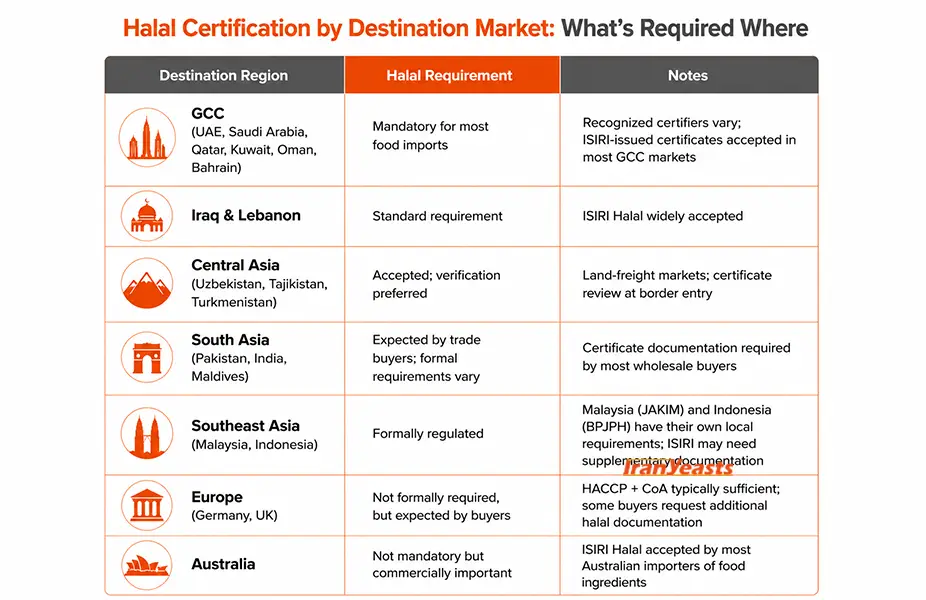
For importers entering Southeast Asian markets , particularly Indonesia and Malaysia , we recommend discussing your specific destination requirements before finalizing the order, as these markets have their own national halal regulatory bodies (BPJPH and JAKIM respectively) with specific accreditation requirements.
The 5 Questions Every Importer Should Ask a Halal Certified Instant Yeast Supplier
The certificate exists. The question is whether it covers what you need, in the format your market requires. These are the five questions that separate a well-documented supplier from one who produces a certificate on request and hopes you don’t look closely.
- Which body issued your Halal certificate , and can you show me the original document? The issuing body matters as much as the certificate itself. Ask for the original certificate with the issuer’s name, logo, and contact information. Cross-reference the issuing body’s recognition in your destination market before accepting it.
- What does the certificate specifically cover , the product, the production line, or the facility? A facility-level certificate is broader and more rigorous than a product-level one. Know what scope of certification you’re receiving.
- When was the certificate last renewed, and what is its current expiry date? Halal certificates have validity periods , typically one to two years. An expired certificate is worthless for customs clearance. Always verify the current issue and expiry dates on the document itself.
- Does your halal certification cover private label production under my brand name? If you’re sourcing under a private label, the product leaving the facility under your brand name must still be covered by the supplier’s halal certification. Not all suppliers maintain this coverage for OEM/private label runs. Confirm this explicitly.
- What quality and microbial testing is conducted per batch, and is that documentation available? Halal certification covers the process. Batch-level quality documentation , Certificate of Analysis, fermentation viability tests, microbial results , covers the product. Both should be available for every export shipment.
How IranYeasts Maintains Halal Compliance Across All Products and Private Label Orders
This is where our answer becomes specific rather than general.
Every batch of instant dry yeast exported by IranYeasts carries ISIRI Halal certification, alongside HACCP and Iran National Standard documentation. These certificates are provided as part of the standard export documentation package , not on request, and not at additional cost.
For private label clients , and we currently produce for 6 clients across 7 packaging formats , halal certification applies to every production run regardless of the brand name on the finished packaging. The certificate covers the production process and facility, meaning your brand benefits from the same certified production environment as our own-brand products.
When preparing export shipments, we provide:
- Original Halal Certificate (ISIRI-issued, current validity)
- HACCP Compliance Documentation
- Certificate of Analysis (CoA) for each batch, including fermentation power verification (minimum 1,350+) and microbial results
- Iran National Standard (ISIRI) Compliance Certificate
- Full customs paperwork and origin documentation
For buyers in markets with specific requirements beyond ISIRI’s scope , Southeast Asian markets in particular , we discuss documentation needs at the inquiry stage and advise on the most appropriate approach before confirming the order. We have completed export shipments to 16 countries across the Middle East, Central Asia, South Asia, Europe, and Oceania, so in practice we have encountered and navigated most of the documentation scenarios importers face.
What a Compliant Halal Yeast Export Shipment Documentation Package Looks Like
For importers unfamiliar with Iranian export documentation, here is the standard set of documents that should accompany every halal-certified instant dry yeast shipment:
- Halal Certificate , Issued by ISIRI, showing product name, facility, issuing date, and expiry. Should carry the official ISIRI seal.
- HACCP Certificate , Confirming food safety management system compliance at the production facility.
- Certificate of Analysis (CoA) , Batch-specific document confirming fermentation power, moisture content, microbial counts (total plate count, coliform, salmonella), and appearance specifications.
- Certificate of Origin , Issued by the relevant Iranian trade authority, required by customs in most destination markets.
- Commercial Invoice and Packing List , Standard trade documents detailing product specifications, quantities, packaging, and shipment details.
- Bill of Lading / CMR (land freight) , The transport document confirming shipment terms and carrier details.
Any supplier unable or unwilling to provide all of these documents , in original or certified copy form , for a given shipment should be treated as a compliance risk, regardless of what their marketing materials claim.
Final Thoughts
Halal certification for bulk yeast is a straightforward requirement that becomes complicated when importers don’t ask the right questions upfront. The certificate itself is rarely the problem , the issuing body, the scope of coverage, the expiry date, and whether it extends to private label production are where gaps typically appear.
Iran’s ISIRI-issued Halal certification is a recognized, institutionally grounded standard with formal standing in Codex Alimentarius frameworks. For the markets where IranYeasts operates , the Middle East, Central Asia, South Asia, and beyond , it covers what buyers need. If your market has requirements beyond that scope, the right answer from a supplier is a clear explanation of what’s available and how to handle the gap , not silence, and not a certificate that doesn’t say what you think it says.
References
- Straits Research. (2024, December). Halal food market size, share, trends and forecast 2025–2033. Straits Research.
- Institute of Standards and Industrial Research of Iran (ISIRI) / Codex Alimentarius Commission. (2023). Iran country profile: Food safety competent authorities and standards framework. FAO/WHO Codex.
- Zanin, L. M., et al. (2023). Global trends in halal food standards: A review. International Journal of Environmental Research and Public Health, 20(23).
- American Halal Foundation. (2025, December). Halal certification requirements by country: A manufacturer's guide. AHF Export Compliance Division.
- HalalLens. (2026, February). Dry yeast: Halal status analysis and guide. HalalLens Knowledge Base.
Frequently Asked Questions
Find answers to common questions about Iranian instant dry yeast, including certifications, bulk orders, private labeling, export logistics, and delivery worldwide
Is instant dry yeast automatically halal?
Not necessarily. While Saccharomyces cerevisiae itself is permissible under Islamic dietary law, the production process , including growth media, emulsifiers, and shared equipment , must also meet halal requirements. A Halal certificate from a recognized body confirms that the full production process has been audited and approved, not just the ingredient itself.
Who issues the Halal certificate for IranYeasts products?
Our Halal certificates are issued by the Institute of Standards and Industrial Research of Iran (ISIRI), also known as the Iran National Standards Organization (INSO). ISIRI is Iran’s competent authority for food standards and is recognized by the Codex Alimentarius Commission.
Is ISIRI Halal certification accepted in Gulf countries?
Yes. ISIRI Halal certification is accepted across the GCC markets we export to, including the UAE, Qatar, Oman, and Iraq. For Saudi Arabia specifically, we recommend confirming acceptance with your local import agent, as Saudi Arabia’s SFDA has its own recognized certifier list that can vary by product category.
Does your Halal certification cover private label products?
Higher moisture content increases the risk of premature activation, clumping, and reduced shelf life during transit, especially under the temperature and humidity conditions common in sea freight to tropical destinations. IDY’s lower moisture content (3-5% vs. 6-8% for ADY) makes it significantly more stable, which is why most yeast for bakery importers serving warm-climate markets prefer IDY for bulk orders.
What documents will I receive with a halal-certified yeast shipment?
A standard shipment includes: ISIRI Halal Certificate, HACCP Certificate, Certificate of Analysis (batch-specific), Certificate of Origin, Commercial Invoice, Packing List, and Bill of Lading or CMR (land freight). All documents are provided as standard , not on special request.
Is your Halal certification accepted in Malaysia and Indonesia?
Malaysia (JAKIM) and Indonesia (BPJPH) each have their own national halal regulatory systems with specific accreditation requirements. ISIRI certification may be accepted on a case-by-case basis. We advise buyers targeting these markets to confirm requirements with their local import authority before placing an order, and we’re happy to advise based on our experience with similar destination markets.
How often is your Halal certification renewed?
Halal certifications are periodically renewed. We provide current certificates with every shipment, and the document includes the issue date and expiry date on its face. Buyers are welcome to request a copy of the current certificate before confirming an order.
Can I verify the Halal certificate independently?
Yes. ISIRI’s contact details appear on the certificate, and buyers can contact the organization directly to verify certificate authenticity. We encourage due diligence and are happy to facilitate this process.