Iranian Vanilla Production Overview for Bulk Importers & Distributors (2026)

Iranian Vanilla Production Overview

جدول محتوایی

The word “vanilla” on a food label rarely means what most consumers imagine. In commercial bakeries, ice cream factories, confectionery lines, and beverage production across the Middle East, Central Asia, and beyond, the vanilla flavor in the product almost certainly comes from food-grade vanillin powder , not from vanilla beans grown in Madagascar or Indonesia.

For distributors and food manufacturers sourcing bulk premium vanilla flavoring for industrial use, this distinction matters. It changes what specifications you should be asking for, which suppliers are relevant, and how to evaluate quality and price on equal terms.

This article explains what Iranian food-grade vanillin powder is, how it compares to alternatives from China and Turkey, what the regional market opportunity looks like, and what bulk importers should know before placing a first order with an Iranian supplier.

Vanillin vs. Natural Vanilla: What the Food Industry Actually Buys in Bulk

Before evaluating any supplier of Iranian vanilla or vanillin products, it helps to understand what the commercial food industry actually purchases , and why.

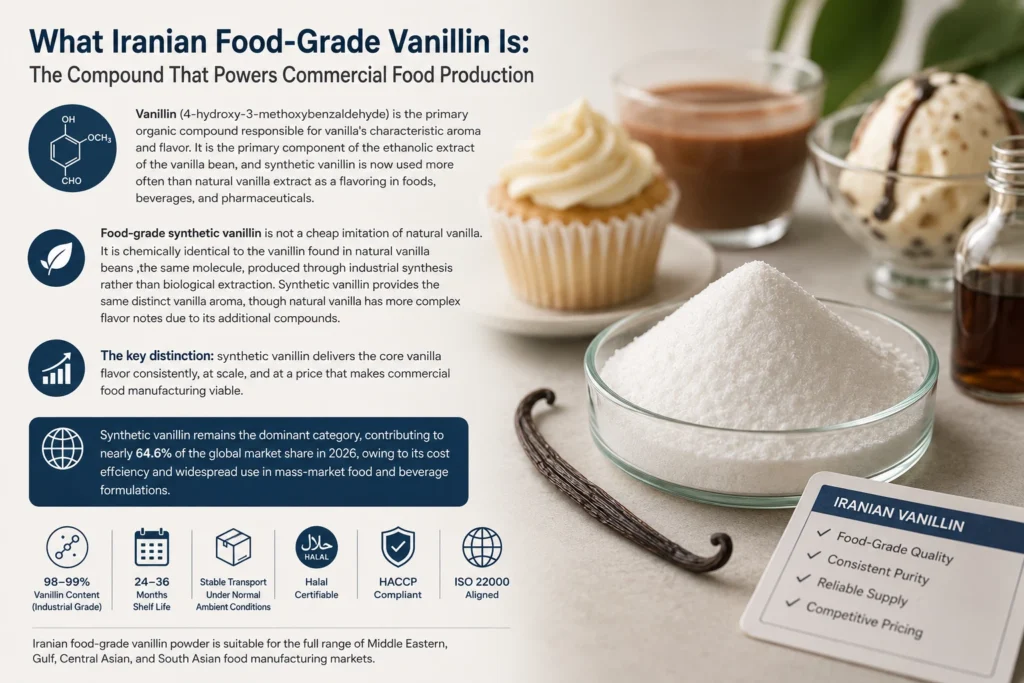
Synthetic vanillin remains the dominant category in the global vanillin market, contributing to nearly 64.6% of global market share in 2026, owing to its cost efficiency and widespread use in mass-market food and beverage formulations. The reason is straightforward: natural vanilla extract from real vanilla beans is one of the most expensive food flavorings in the world. Natural vanillin prices typically range between $1,200 to $1,500 per kilogram, making it commercially impractical for industrial bakeries, ice cream manufacturers, and confectionery producers operating at scale.

Food-grade synthetic vanillin , chemically identical to the primary flavor compound found in natural vanilla beans (4-hydroxy-3-methoxybenzaldehyde) , delivers the same characteristic vanilla aroma and taste at a fraction of the cost. Bulk pricing for food-grade vanillin from major suppliers ranges from approximately $8–$35 per kilogram, depending on purity, order volume, and packaging format.

Powder and crystal vanillin represent the leading subcategory, commanding more than 68.2% of total market volume in 2026, driven by superior stability, long shelf life, and compatibility with a wide range of food manufacturing processes. For bulk importers, this means powder format is the standard , and the format most relevant when evaluating wholesale vanilla suppliers.

The Global Vanillin Market in 2026: Why Regional Sourcing Is Becoming More Strategic

The vanillin market size was valued at USD 1.12 billion in 2026 and is estimated to grow from USD 1.21 billion in 2026 to reach USD 1.79 billion by 2031, at a CAGR of 8.09% during the forecast period. Strong demand from food and beverage manufacturers anchors current volume, while rising consumption of processed and packaged foods in emerging markets continues to drive growth.

The Middle East and Africa are estimated to grow at the highest CAGR over the forecast period among all regions , a direct reflection of expanding food manufacturing capacity, rising consumer purchasing power, and growing demand for certified Halal food ingredients across the region.

For distributors supplying the Middle East, Iraq, the Gulf states, or Central Asian markets, this growth trajectory has a practical implication: the demand from downstream customers , bakeries, confectionery producers, ice cream manufacturers , for consistent, Halal-certified vanillin is increasing. The question is where you source it.

China dominates over 80% of global vanillin production, making Chinese suppliers the default option for most bulk buyers. But long shipping routes, minimum order quantities, documentation complexity, and certification requirements for Halal-specific markets create friction , particularly for distributors in Iraq, the UAE, Afghanistan, and neighboring countries where Iranian-origin food products move through established, shorter trade routes.

What Iranian Food-Grade Vanillin Powder Actually Delivers: Specifications That Matter

Not all vanillin powder is equal , and the specification that matters most for food manufacturers is purity.

Our Iranian vanilla powder products are supplied at 98–99% vanillin content, the standard industrial specification for food-grade applications. At this purity level, the product is suitable for direct use in:

  • Commercial bakeries and artisan bread production
  • Confectionery and chocolate manufacturing
  • Ice cream and dairy flavoring
  • Biscuit, cake, and pastry production
  • Beverage flavoring (hot and cold drink applications)
  • Industrial food additives and compound flavoring systems


Full technical profile:Laboratory documentation available for every batch includes Certificate of Analysis (CoA), Technical Data Sheet (TDS), and Safety Data Sheet (SDS/MSDS). Quality testing conducted covers purity, microbial load, moisture content, stability, flavor and aroma profile, and solubility.

Certifications That Regional Markets Require , and What We Are Building Toward

For bulk premium vanilla suppliers serving Middle Eastern, Gulf, South Asian, and Central Asian markets, certifications are not administrative formalities , they are purchasing prerequisites.

Our current certification development targets:

Halal Certification , Mandatory for buyers in Iraq, UAE, Qatar, Oman, Saudi Arabia, Kuwait, Afghanistan, Pakistan, and across Muslim-majority markets globally. Our Halal certification follows the same ISIRI-issued framework as our food-grade yeast products, which are already accepted in all of our active export markets.

HACCP , Food safety management system compliance, required by most regulated food manufacturers and institutional buyers as a baseline procurement requirement.

ISO 22000 , International food safety management standard, strengthening credibility for buyers in European markets and larger FMCG procurement operations.

GMP (Good Manufacturing Practice) , Manufacturing process compliance, relevant for pharmaceutical-adjacent food ingredient applications and regulated market entry.

Iran National Standard (ISIRI) , Domestic compliance standard covering food-grade production requirements.

For buyers targeting specific regulated markets , the EU, Australia, or markets requiring FDA GRAS documentation , additional destination-specific certifications are being evaluated. If your market has specific requirements beyond this list, we welcome the conversation at the inquiry stage.

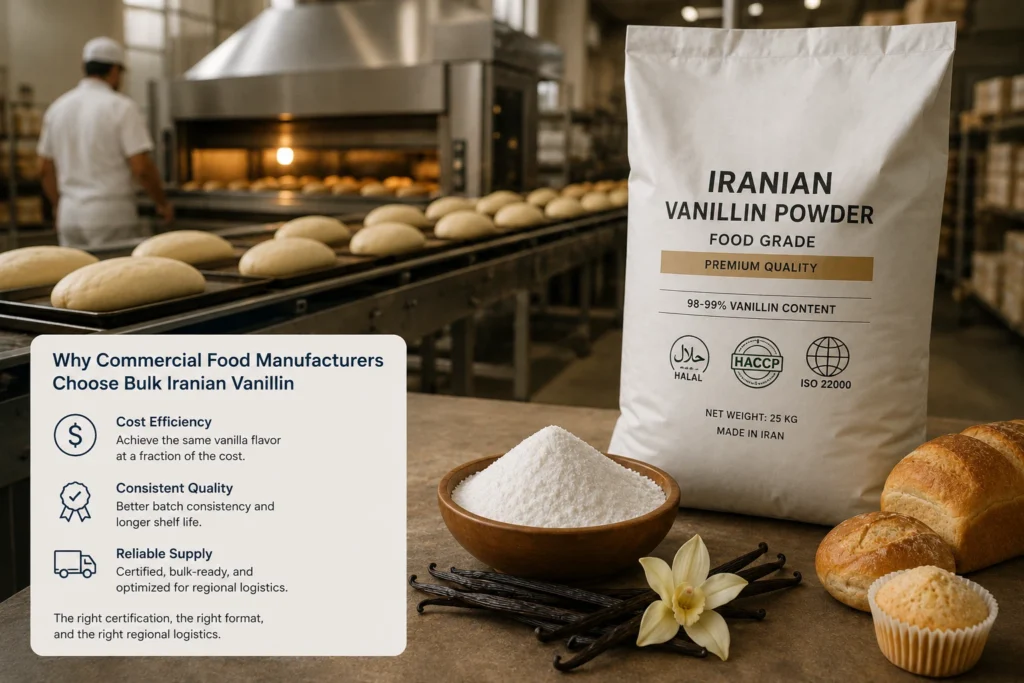
Why Commercial Food Manufacturers Choose Bulk Iranian Vanillin Instead

From 10g Retail Sachets to 25kg Industrial Bags: Packaging for Every Buyer Profile

One of the clearest advantages for regional distributors sourcing wholesale vanilla through Iranian supply is packaging flexibility , the ability to receive product in the format that matches your downstream customers, without re-packing or reformatting.

Available packaging configurations:

Retail formats:

  • 10g sachet , single-use consumer format, dominant in Middle Eastern and South Asian household markets
  • 20g sachet
  • 50g sachet
  • 100g sachet , popular for foodservice and small bakery use

Tin packaging:

  • Small, medium, and wholesale tin formats , suitable for branded retail and gifting segments

Industrial formats:

  • 1kg, 5kg, 10kg, 25kg multi-layer industrial bags , for commercial bakeries, food manufacturers, and bulk distributors

Export packaging:

  • Export cartons and palletized shipments configured for sea and land freight

All retail and industrial formats are available with multilingual packaging , English, Arabic, and Persian , and custom branding under private label arrangements. Customer logo printing and custom artwork are supported.

How Iranian Vanillin Competes Against Chinese and Turkish Alternatives

The honest competitive picture for Iranian vanilla powder looks like this:

Against Chinese suppliers

 China dominates global vanillin production and offers the lowest bulk prices at scale. However, for buyers in Iraq, the UAE, Afghanistan, Pakistan, Qatar, and neighboring markets, Iranian-origin product has structural advantages that Chinese supply cannot easily replicate: shorter transit times, established overland and short-sea routes, shared regional logistics infrastructure, and a supplier relationship that operates in the same time zone with the same business calendar. For buyers who have previously had documentation or customs issues with Chinese-origin food ingredients in their market, the difference in logistics complexity is material.

Against Turkish suppliers

 Turkey is the closest regional competitor. Turkish vanillin products are present across Middle Eastern markets and benefit from strong existing trade relationships. Iranian products compete on price , positioned at or below Turkish pricing levels , while offering comparable certification levels (Halal, HACCP) and the additional advantage of direct private label capability from a minimum order of 500kg, lower than most Turkish suppliers’ branded minimums.

The competitive positioning is not “cheaper at the cost of quality.” It is: comparable specification, regional logistics advantage, Halal-certified supply, and private label flexibility at accessible minimums.

What Iranian Food-Grade Vanillin Is: The Compound That Powers Commercial Food Production

Who This Product Is Right For: Primary Customer Segments

Wholesale vanilla powder from Iran is best suited for:

Regional food distributors in Iraq, UAE, Qatar, Oman, and Gulf markets who supply bakeries, confectioneries, and food manufacturers and need a reliable Halal-certified source with short lead times and documented quality.

Food manufacturers , commercial bakeries, ice cream producers, confectionery factories, and beverage companies , sourcing vanillin as a direct production input and requiring consistent purity, batch documentation, and certified supply.

Private label companies looking to develop their own branded vanilla flavoring product for retail or foodservice distribution in a regional market. We support custom branding from 500kg minimum order with Arabic, English, or multilingual packaging.

FMCG importers building diversified ingredient portfolios for national distribution who need a secondary or primary source for certified vanillin outside of Chinese supply dependency.

Sourcing Iranian Vanilla Powder: MOQ, Pricing, and How to Start

This product line is in its export development phase. We are actively building our first distribution relationships in the Middle East and neighboring markets , which means first movers have the opportunity to establish terms and market positioning before the product reaches scale.

MOQ:

  • Bulk export: 500kg–1 metric ton
  • Private label: dependent on packaging format; discussed at inquiry stage

Pricing: Pricing is under finalization and will be confirmed with a formal quote based on packaging format, volume, destination, and certification requirements. Positioning is competitive against both Chinese and Turkish market alternatives. Contact us for a preliminary quote.

Payment terms and Incoterms: Consistent with our yeast export model , standard terms with flexibility for established buyers. FOB and CIF options available depending on destination.

Samples: Available by arrangement. We recommend buyers test the product in their own production environment before placing a commercial order.

Lead time: Confirmed at inquiry stage based on packaging format and order volume.

To request a quote or sample, contact the export team directly via the website. Share your destination market, required packaging format, and volume estimate, and we will respond within 24–48 hours.

Final Thoughts

Food-grade vanillin powder is one of the most widely used flavoring ingredients in the commercial food industry , and for most bulk buyers in the Middle East, Central Asia, and South Asia, the sourcing conversation has historically defaulted to China or Turkey. Iranian supply changes that equation for regional buyers who value shorter logistics routes, Halal-certified production, private label flexibility, and a supplier relationship built on the same food export infrastructure that already moves Iranian yeast to 16 countries worldwide.

This is a new product line and we are transparent about that. What we bring to it is not a fabricated track record , it is a decade of food export experience, an established logistics and documentation infrastructure, and a clear understanding of what regional distributors actually need from a supplier. If you are evaluating sources for bulk premium vanilla and want to know if Iranian supply fits your market, a sample and a conversation is the right first step.

Frequently Asked Questions

Find answers to common questions about Iranian instant dry yeast, including certifications, bulk orders, private labeling, export logistics, and delivery worldwide

What exactly is Iranian vanilla powder , is it natural or synthetic?

The primary product is food-grade synthetic vanillin powder (98–99% vanillin content). Synthetic vanillin is chemically identical to the principal flavor compound in natural vanilla beans and is the standard ingredient used in commercial food manufacturing worldwide. Natural vanilla extract is a separate product category, significantly more expensive, and used primarily in premium retail applications. Future expansion into natural vanilla flavoring is under evaluation.

Our export-grade vanillin powder is produced at 98–99% vanillin content , the standard specification for industrial food-grade applications covering bakery, confectionery, ice cream, and beverage manufacturing.

Halal certification is a primary target for this product line, following the same ISIRI-issued framework as our food-grade yeast products. For buyers in Gulf markets, Iraq, Pakistan, Afghanistan, and other Halal-required markets, certification documentation will be provided with every shipment. Confirm specific certification requirements for your market at the inquiry stage.

 Retail sachets from 10g to 100g, tin formats for retail and wholesale, and industrial bags from 1kg to 25kg. Private label and custom packaging are available with multilingual options (Arabic, English, Persian).

Chinese suppliers currently dominate global vanillin production and set the price floor for bulk buyers. Iranian pricing is positioned competitively against Chinese alternatives while offering meaningful logistics advantages for regional buyers , shorter transit routes, established land and short-sea freight infrastructure, and a supplier operating within the same regional trade ecosystem as your market.

500kg for bulk export orders. Private label minimums depend on the packaging format and are confirmed at the inquiry stage.

Yes. We recommend all new buyers test products in their own production environment before placing a commercial order. Contact us to arrange sample shipment.

 Yes. The product range covers both retail formats (consumer sachets and tins) and industrial formats (bulk bags for food manufacturers). Packaging format is selected based on the buyer’s downstream customer profile.

Phone

09374304342

Email

iranyeasts@gmail.com

Address

Mashhad, Sepad Square, Negin Sharq Office Complex, Unit 507

Address

No. 14, Qasem Abad, Mashhad, corner of Ostad Yousefi 27.

Iran yeast is one of the leaders in the supply and sale of yeast in Iran, which began its activity in 2017. During this period, it has exported about 1000 tons of yeast to 9 countries around the world, which is a very amazing achievement. This group is also responsible for packaging yeast under the Samineh Yeast brand.

Quick access

Location

Central office

Mashhad, Sepad Square, Negin Sharq Office Complex, Unit 507

Production unit

No. 14, Qasem Abad, Mashhad, corner of Ostad Yousefi 27.

Warehouse

Mashhad, Toos Industrial Town, No. 8, Omid Sanat Street, 2

Scroll to Top
Scroll to Top
Specification Standard
Vanillin Content 98–99% minimum
Appearance White to off-white crystalline powder
Food Grade Status Certified Food Grade (Industrial & FMCG Use)
Shelf Life 24–36 months under controlled storage conditions
Storage Conditions Cool, dry environment; away from sunlight; sealed airtight packaging
Recommended Transit Temperature Ambient temperature (stable under standard export logistics)