

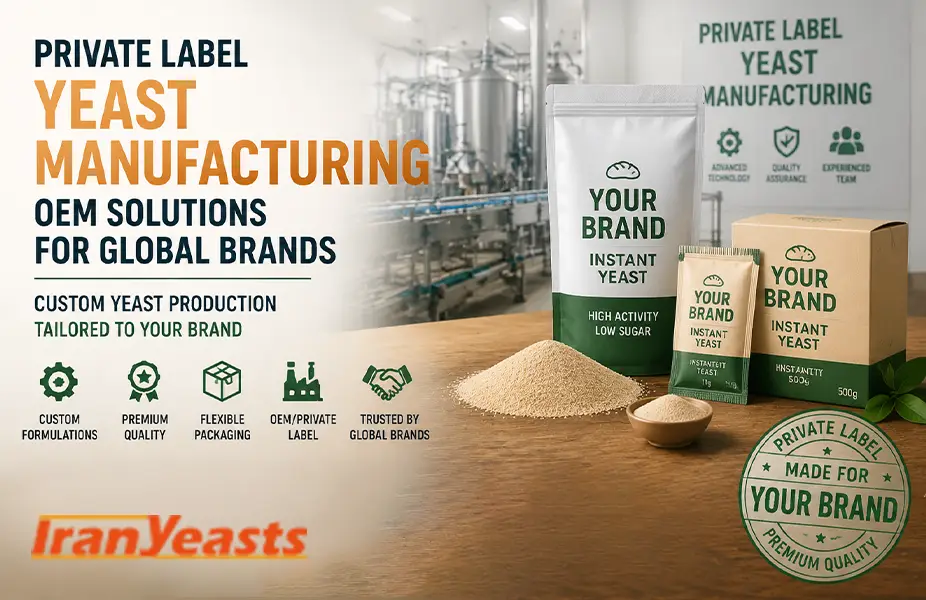
Most yeast distributors start the same way: reselling a recognized brand at a thin margin, competing on price against every other distributor in their market carrying the same product in the same packaging. The business works, up to a point. Then the margin compression starts.
The distributors who break out of that pattern almost always make the same move. They stop reselling someone else’s brand and start selling their own. Private label yeast manufacturing is how that transition happens , and the barriers to entry are lower than most people in the industry assume.
This post explains what private label yeast manufacturing actually involves, what the process looks like from first inquiry to finished product, what questions to ask a potential manufacturing partner, and why Iranian yeast producers have become the preferred private label source for distributors across the Middle East, Central Asia, and beyond.
Looking to Import Iranian Instant Dry Yeast at Wholesale Scale?
Get expert guidance on product selection, packaging, export documentation, pricing, and international shipping directly from our export team.
What Private Label Yeast Manufacturing Actually Means for Distributors and Food Brands
Private label yeast manufacturing refers to the production of instant dry yeast under a buyer’s own brand name, packaging design, and labeling , using an established producer’s manufacturing infrastructure, quality systems, and certified production processes.
The product inside the packaging is identical to the manufacturer’s standard export-grade yeast. What changes is everything on the outside: the brand name, the logo, the packaging format, the label language, and the visual identity. The buyer sells the finished product as their own brand in their market.
This model is standard across the food ingredient industry. The global yeast market was valued at $4.8 billion in 2023 and is growing at approximately 6.2% annually, with distributors and wholesalers accounting for over 37% of total distribution. A significant and growing share of that distribution happens under private label arrangements, particularly in markets where regional brands carry more consumer trust than unfamiliar imported names.
For a distributor in Iraq, the UAE, or Uzbekistan, selling yeast under a locally recognized brand name they own is commercially more valuable than reselling a Chinese or Turkish brand at a thin margin. The brand equity compounds over time. The pricing flexibility improves. The customer relationship shifts from transactional to loyal.
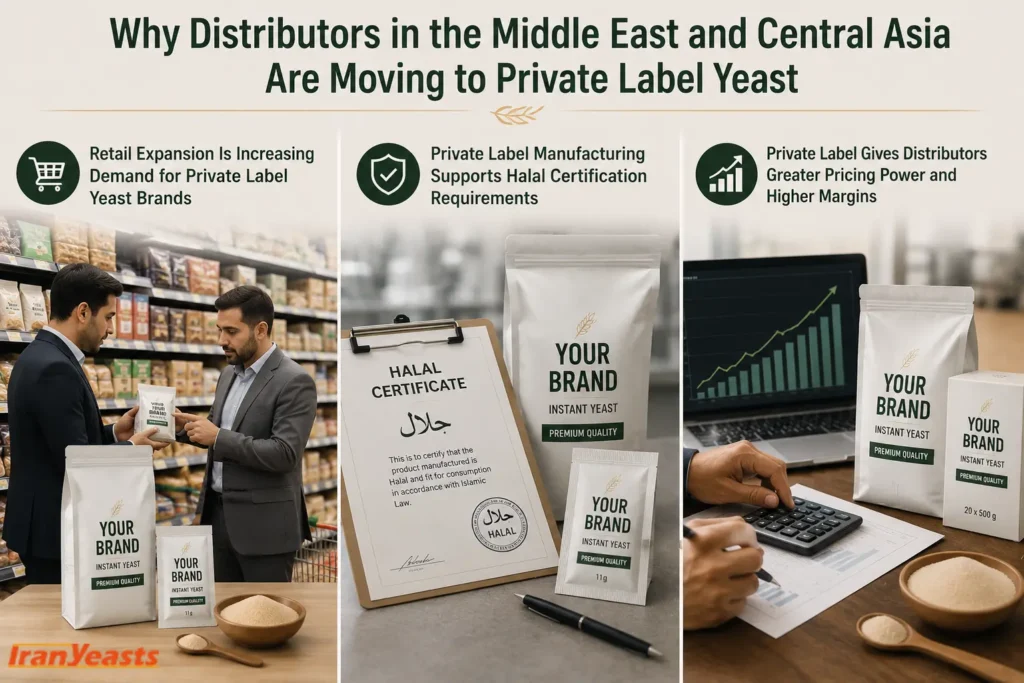
Why Distributors in the Middle East and Central Asia Are Moving to Private Label Yeast
The shift toward private label yeast brands in these regions is being driven by three converging trends.
Retail Expansion Is Increasing Demand for Private Label Yeast Brands
The first is retail maturation. As supermarket chains and organized retail expand across Iraq, the Gulf states, and Central Asian markets, shelf space decisions are increasingly made by category buyers who prefer to stock brands they recognize. A regional distributor with their own branded yeast has a structural advantage over one bringing in a foreign brand with no local market recognition.
Private Label Manufacturing Supports Halal Certification Requirements
The second is Halal compliance. Distributors supplying Halal-regulated markets need full control over their product’s certification documentation. Under a private label arrangement, the Halal certificate is issued for the production batch and applies to the finished product regardless of what brand name appears on the packaging. This means a distributor can sell under their own brand while carrying the same certification depth as if they had manufactured the product themselves.
Private Label Gives Distributors Greater Pricing Power and Higher Margins
The third is margin structure. A distributor reselling a third-party brand is capped at the margin between their buying price and what the market will pay for that brand. A distributor selling their own brand sets both the product identity and the market price. Over time, this compounds into a meaningfully different business.
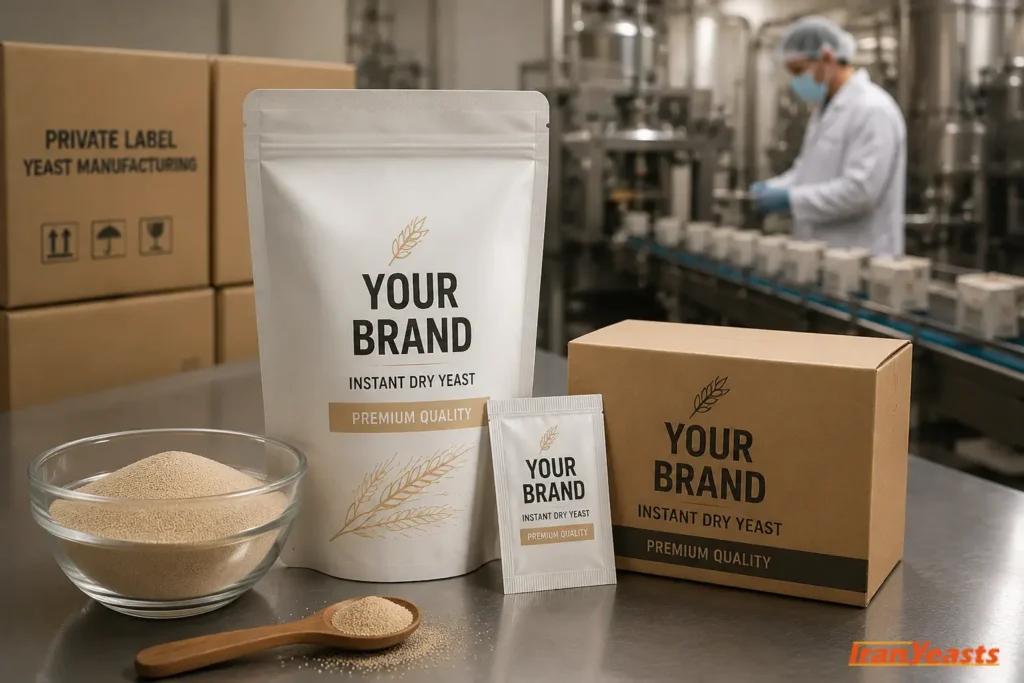
How Private Label Instant Dry Yeast Manufacturing Works: From Inquiry to Finished Product
The process is more straightforward than most first-time private label buyers expect. Here is how it works in practice with IranYeasts.
- Step 1 , Initial inquiry and specification The buyer provides target market, required packaging format, desired volume, and any specific labeling requirements (languages, regulatory text, Halal logo placement). We respond with a preliminary quote and product specification within 24 to 48 hours.
- Step 2 , Packaging design and approval The buyer supplies packaging artwork, or we provide design support. For buyers entering a new market without existing packaging assets, we advise on what the label needs to include for the destination market’s regulatory requirements. Artwork is reviewed and confirmed before production begins.
- Step 3 , Pre-production sample Before the first full production run, a sample of the finished product in the buyer’s packaging is produced for approval. This is the point at which the buyer confirms label placement, color accuracy, and physical finish against their specifications.
- Step 4 , Production and quality testing The full order is produced and goes through our standard quality testing sequence: fermentation power verification (minimum 1,350+), moisture content check, microbial testing, and appearance inspection. A Certificate of Analysis is generated for the specific batch and will accompany the shipment.
- Step 5 , Documentation preparation Export documentation is prepared in parallel with production: Halal certificate, HACCP documentation, Certificate of Origin, Commercial Invoice, and Packing List. All documentation is issued under the product’s specifications. The buyer’s brand name appears on the packaging; all certifications apply to the product batch regardless of the brand name printed on the label.
- Step 6 , Shipment and delivery Cargo is shipped via the buyer’s preferred route and Incoterm. Production lead time from confirmed order to loading is typically 2 to 10 working days depending on packaging format. Sea freight from Bandar Abbas reaches Gulf ports in 3 to 5 days; land freight to Iraq and Afghanistan is typically 5 to 10 days.
The 7 Packaging Formats Available for Private Label Yeast Branding
One of IranYeasts’ most operationally significant differentiators is the breadth of packaging formats available for private label production. We currently produce private label yeast across seven distinct formats, reflecting our active client base across multiple markets with different retail and distribution requirements.
Consumer sachets (10g and 11g) The dominant retail format in Iraq, Afghanistan, Pakistan, and across Central Asian consumer markets. IranYeasts was the first producer in Iran to develop and scale the 10/11g sachet format. This format requires precision filling equipment and higher per-unit packaging investment, which is why many suppliers either do not offer it at all or require very high minimum runs.
Retail multi-packs (5-sachet and 10-sachet boxes) Popular with supermarket buyers who want a higher-value retail unit without increasing per-sachet cost significantly. The multi-pack format allows a distributor to position a premium product at a higher price point while using the same sachet format.
500g vacuum retail pack Suited for foodservice buyers, professional bakers, and mid-tier retail. This format carries 18 to 24 months shelf life in vacuum-sealed packaging, making it well suited for markets with longer distribution chains.
2.5kg vacuum pack Entry-level industrial format used by small commercial bakeries and catering operations. Often the preferred format for food service distributors who want something between retail and full industrial bags.
5kg vacuum bag Standard commercial format for mid-sized commercial bakeries. High shelf life, manageable unit size for storage and handling at the bakery level.
10kg vacuum bag Industrial format for larger commercial bakeries. Often the preferred format for distributors who supply bread factories or large foodservice operations directly.
20kg vacuum bag Maximum bulk format, suited for industrial food manufacturers and large-scale ingredient distributors who break bulk for downstream distribution.
The ability to run private label across this full range from a single supplier simplifies procurement for distributors who want to build a complete product portfolio under one brand.
What Iranian Private Label Yeast Suppliers Offer That Others Often Cannot
The private label yeast market is dominated at the high end by European producers (Lesaffre, Lallemand, AB Mauri) and at the volume end by Chinese manufacturers. Understanding where Iranian supply fits the competitive landscape helps buyers make a more informed decision.
European producers carry the highest brand equity and most rigorous quality systems, but their MOQs for private label are often prohibitively high for regional distributors. Industry data suggests MOQs for branded baker’s yeast from European producers start at 50,000kg or more for custom private label runs. For a mid-sized Middle Eastern distributor, this is commercially inaccessible.
Chinese producers, particularly those in the Shandong and Zhejiang manufacturing clusters, offer competitive pricing and OEM capability at lower MOQs (typically 1,000kg to 3,000kg for standard formats, 3,000kg to 5,000kg for fully custom private label). However, transit time from Chinese ports to Gulf and Central Asian markets runs 15 to 25 days by sea, and Halal certification depth varies significantly across Chinese producers.
Iranian private label yeast fills the gap that neither of those options covers well. IranYeasts offers:
MOQ from 5 metric tons for private label production across all formats, including the 10/11g sachet which most Chinese suppliers do not produce at this specification level.
Halal certification (ISIRI) included on all private label runs, accepted across GCC markets, Iraq, Pakistan, Afghanistan, and Central Asian markets without additional documentation requirements.
Transit advantage that no Chinese or European competitor can match for Gulf and Central Asian buyers: 3 to 7 days to Gulf ports by sea, 5 to 10 days overland to Iraq, Afghanistan, and Pakistan.
Fermentation Power 1,350+ verified by batch testing and documented in the COA. This is a specific, testable specification that buyers can verify independently rather than accepting a general quality claim.
We currently produce for 6 active private label clients across 7 packaging formats in multiple countries. This is not an aspirational capability; it is an operational reality backed by existing client relationships.
MOQ Reality Check: What Private Label Yeast Actually Costs to Get Started
The practical question most buyers have before committing to a private label arrangement is: how much product do I need to order to make it viable?
For IranYeasts private label production, the minimum order quantity is 5 metric tons. At the 10g sachet format, that translates to 500,000 individual consumer sachets. At the 500g retail pack format, it is 10,000 units. At the 10kg industrial bag format, it is 500 bags.
Whether 5 tons is the right starting volume depends entirely on the buyer’s market. For a distributor entering a new market with an untested brand, 5 tons is a sensible initial run that limits financial exposure while generating enough product to test market reception across multiple retail accounts.
For context on pricing: bulk instant dry yeast from IranYeasts is priced at $1,500 to $2,600 per metric ton FOB Bandar Abbas, depending on packaging format and volume. Private label production carries a small premium over standard branded product, reflecting artwork setup and shorter production run costs. This premium is confirmed in the formal pro-forma invoice rather than left as an estimate. A buyer evaluating private label economics against reselling a third-party brand should model the margin difference at scale, not just the per-ton price.
How to Brief a Private Label Yeast Supplier: What Information You Need Ready
The quality of your initial inquiry determines the speed and accuracy of the quote you receive back. When approaching IranYeasts for a private label arrangement, having the following information confirmed in advance eliminates multiple rounds of back-and-forth.
Destination market and distribution channel: The market you are selling into affects label language requirements, Halal certification expectations, and which packaging format best suits your retail or foodservice buyers.
Packaging format: Which of the seven formats described above fits your buyer profile. If you are uncertain, describe your end customers (bakeries, supermarkets, household consumers, food manufacturers) and we will advise on the most commercially appropriate format.
Brand assets: A final or near-final version of your logo and any required brand visual elements. For buyers who do not yet have packaging artwork, we can advise on what the label must include for your target market.
Volume per order and estimated annual volume: A rough annual volume estimate helps us confirm production scheduling and whether volume discounts apply from the first order.
Certification requirements: Most buyers need Halal and HACCP documentation as standard. If your market requires additional documentation, note it at the inquiry stage rather than after production is underway.
Sample requirement: Whether you want a pre-production packaging sample before the full run proceeds. We strongly recommend this for first-time orders.
Final Thoughts
Private label yeast manufacturing is one of the most commercially rational steps a regional food ingredient distributor can take once their market volume justifies it. The entry point is lower than most buyers expect, the process is straightforward with the right manufacturing partner, and the long-term brand equity built through a private label yeast business compounds in ways that reselling never does.
We have been building and managing these relationships for over a decade, across markets in the Middle East, Central Asia, South Asia, Europe, and Oceania. If you are evaluating private label yeast as a next step for your business, the right starting point is a conversation and a sample. We can move from inquiry to finished product faster than most buyers expect.
References
- Grand View Research. (2024). Yeast market size, share and trends analysis report by product, by application, by region, and segment forecasts, 2024–2030. Grand View Research Inc.
- Maximize Market Research. (2025, June). Instant dry yeast market size, share, growth trends and forecast 2025–2032. Maximize Market Research Pvt. Ltd.
- Torg B2B Marketplace. (2025). Baker's yeast private label and wholesale sourcing guide. Torg Global Food Marketplace.
- Coherent Market Insights. (2026, March). Instant dry yeast market size, share, trends and forecast. Coherent Market Insights Research.
- Market.us. (2025, May). Dried yeast market size, share, growth and forecast 2025–2034. Market.us Research.
Frequently Asked Questions
Find answers to common questions about Iranian instant dry yeast, including certifications, bulk orders, private labeling, export logistics, and delivery worldwide
What is private label yeast manufacturing?
Private label yeast manufacturing is the production of instant dry yeast under a buyer’s own brand name and packaging, using an established manufacturer’s certified production infrastructure. The buyer owns the brand identity; the manufacturer produces the product to specification and applies the buyer’s packaging artwork before shipment.
What is the minimum order quantity for private label yeast?
At IranYeasts, the minimum order quantity for private label production is 5 metric tons. This applies across all packaging formats, from 10g consumer sachets to 20kg industrial vacuum bags. For context, 5 tons at the 10g sachet format equals 500,000 individual consumer units.
Does Halal certification apply to private label products?
Yes. Our ISIRI-issued Halal certification covers the production facility and process, which applies to all products manufactured in that facility regardless of the brand name printed on the packaging. Every private label batch carries the same Halal certification as our own-branded products. For more on how Halal certification applies to yeast exports, see our post on halal-certified yeast export from Iran.
How long does private label production take?
Production lead time from confirmed order and approved artwork to loading is 2 to 10 working days depending on packaging format and order volume. Artwork approval and pre-production sampling, if required, add time before this window begins. Plan for a total timeline of 3 to 4 weeks from first inquiry to goods-on-board for a first private label order.
What packaging formats are available for private label yeast?
IranYeasts offers private label production across seven formats: 10g and 11g consumer sachets, retail multi-packs (5 and 10-sachet boxes), 500g vacuum retail packs, 2.5kg vacuum packs, 5kg vacuum bags, 10kg vacuum bags, and 20kg vacuum bags.
How does Iranian private label yeast compare to Chinese suppliers on MOQ?
Chinese manufacturers typically require 1,000kg to 3,000kg for standard OEM runs, rising to 3,000kg to 5,000kg for fully custom private label production at the 10g sachet format specifically. IranYeasts starts from 5 metric tons across all formats, with the added advantage of 3 to 7 day transit to Gulf markets versus 15 to 25 days from Chinese ports, and ISIRI Halal certification accepted without supplementary documentation in Middle Eastern and Central Asian markets.
What documentation is provided with a private label yeast shipment?
Every private label shipment includes: Certificate of Analysis (batch-specific, with Fermentation Power result), Halal Certificate (ISIRI), HACCP Compliance Certificate, Certificate of Origin, Commercial Invoice, Packing List, and Bill of Lading or CMR (land freight). All documents are provided as standard, not on request.
Can I see a sample of the finished product in my packaging before the full run?
Yes. We recommend a pre-production packaging sample for all first-time private label buyers. The sample allows you to confirm label placement, print quality, and physical finish against your specification before the full production run proceeds.