

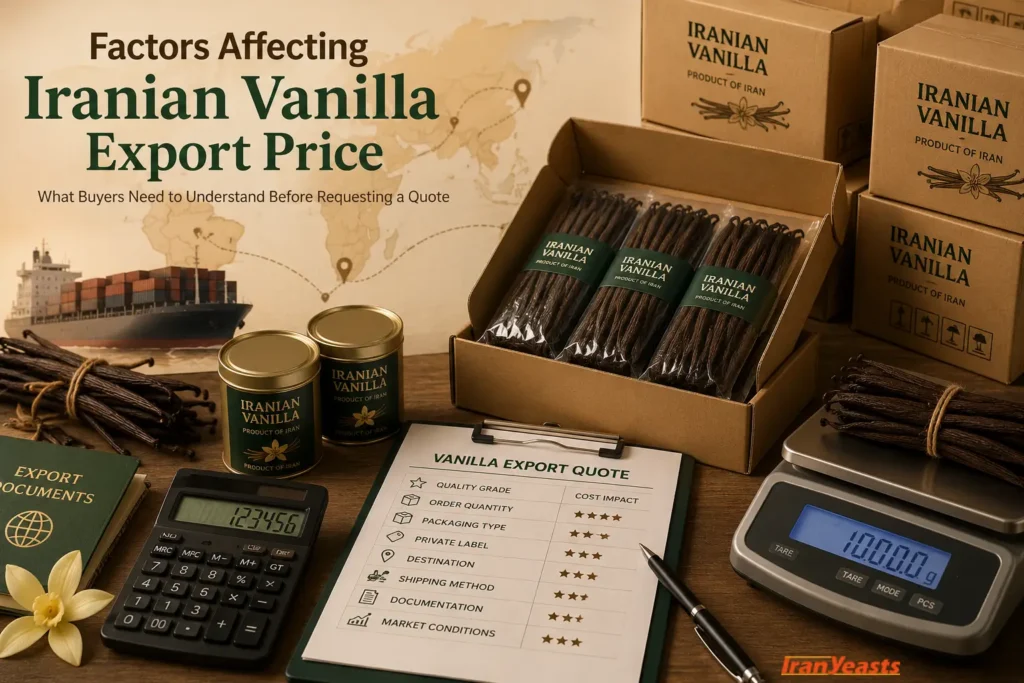
When a buyer requests a price for Iranian vanilla and receives a range rather than a single figure, the reaction is sometimes frustration. The frustration is understandable : but the range is accurate, and understanding why is what allows a buyer to plan procurement costs correctly.
Iranian food-grade vanillin powder is not a single SKU with a fixed price. It is a product whose export price moves based on at least seven distinct variables, some within the buyer’s control and some driven by global market conditions. A buyer who understands all seven can build a more accurate budget, negotiate more effectively, and avoid the surprise of a landed cost that differs significantly from an initial quote.
This post explains each factor clearly, with real pricing context from the 2025 to 2026 market, and covers how Iranian vanillin pricing compares against the Chinese and Turkish alternatives most regional buyers are also evaluating.
Looking to Import Iranian Instant Dry Yeast at Wholesale Scale?
Get expert guidance on product selection, packaging, export documentation, pricing, and international shipping directly from our export team.
Why Iranian Vanilla Export Pricing Is Not a Single Number: The Market Context
The vanillin market size was valued at USD 1.12 billion in 2025, with synthetic variants accounting for 56.35 percent of total volume. Food-grade synthetic vanillin prices typically range from $15 to $35 per kilogram, depending on purity, packaging, and order volume.
That range spans more than 100 percent from floor to ceiling. The reason is not market opacity : it is that several legitimate, quantifiable variables determine where a specific order lands within that range. Iranian vanillin is priced within the same global market dynamics, with the additional influence of Iran-specific logistics and production cost structures.
Synthetic vanillin producers face challenges from petrochemical feedstock price swings, which compress margins throughout the value chain, particularly for mid-sized players lacking hedging capabilities. Understanding where those pressures come from : and how they flow through to the buyer’s invoice : is the foundation of accurate cost planning.
Factor 1 : Purity Grade and Technical Specification
Purity is the primary technical specification that determines price, and the difference between grades is commercially significant.
Food-grade vanillin is available at multiple purity levels:
98% vanillin content is the standard specification for most commercial food manufacturing applications : bakeries, confectionery producers, ice cream manufacturers, and beverage producers who require consistent, high-performance flavoring without needing the highest possible purity level. This is the grade used in the majority of global volume transactions.
99% vanillin content commands a price premium reflecting the additional processing required to achieve higher purity. This grade is specified by premium food manufacturers, certain pharmaceutical applications, and buyers in regulated markets where purity documentation needs to clear a higher threshold.
Ethyl vanillin (ethyl vanillin CAS 121-39-1) is a separate compound with approximately three times the flavoring intensity of standard vanillin per gram. It is priced differently and not interchangeable with vanillin without formulation adjustment. Buyers specifying ethyl vanillin rather than standard vanillin will receive a different price entirely.
Iranian vanillin from IranYeasts is exported at 98 to 99 percent vanillin content, with the specific grade and corresponding price confirmed on the pro-forma invoice rather than assumed at the inquiry stage. Buyers should specify their required purity upfront to receive an accurate quote without a subsequent revision.
Factor 2 : Packaging Format and the Shelf Life It Delivers
Orders above 1,000 kilograms typically reduce costs by 30 to 50 percent versus small-batch purchases, and packaging type significantly influences pricing alongside purity and order volume.
Packaging format affects price in two ways: it determines per-unit packaging material cost, and it determines the shelf life the buyer receives : which has real commercial value for importers managing long distribution chains.
Industrial bulk bags (10kg to 25kg, multi-layer)
The lowest per-kilogram price point. Minimal packaging cost per kilogram of product. Shelf life typically 18 to 24 months under standard sealed storage. Suited for food manufacturers using vanillin directly in production.
Vacuum-sealed mid-range packs (1kg to 5kg)
Mid-tier pricing. Vacuum sealing extends protection during transit and storage. Appropriate for distributors who repack into smaller units for wholesale clients.
Retail consumer formats (10g to 100g sachets, tins)
The highest per-kilogram price point in the range, reflecting significantly higher packaging material cost per unit of product, precision filling equipment requirements, and longer production time per ton. These formats are suited for distributors building retail or private label product lines. For buyers considering which retail format best suits their market, our post on Iranian vanilla production overview covers what format decisions buyers typically make for different distribution channels.
Buyers who request a price for “vanilla powder” without specifying packaging format will receive either a clarifying question or a quote for the most common format, which may not be the format they actually need.
Factor 3 : Order Volume: How MOQ and Batch Size Move the Per-Kilogram Price
Volume is the most straightforward pricing lever : and the one most underutilized by buyers placing initial orders.
The minimum order quantity for IranYeasts vanillin export is 500 kilograms. At that minimum volume, pricing sits toward the upper end of the range for a given packaging format. As order volume increases, the per-kilogram price moves down at defined volume thresholds, reflecting reduced setup and handling cost per unit of production and more efficient use of packaging materials and logistics capacity.
A buyer ordering 500kg of 98% vanillin powder in 25kg industrial bags will receive a higher per-kilogram price than a buyer ordering 5,000kg of the same specification. The difference is not arbitrary : it reflects the real cost structure of batch production, quality testing, and export logistics per unit of volume.
For buyers who want to access better pricing but are not yet confident in their initial volume, there are two options worth discussing with any supplier: consolidating multiple SKUs into a single shipment to reach a higher aggregate volume, or placing a smaller first order at a higher per-unit price with a documented agreement on pricing tiers for subsequent orders once market performance is confirmed.
Factor 4 : Raw Material and Petrochemical Feedstock Costs
This is the external market factor buyers cannot control but need to understand because it explains why quoted prices move between one quarter and the next.
The production process for guaiacol-based synthetic vanillin relies on upstream petrochemicals : specifically catechol and glyoxylic acid : whose prices fluctuate with crude oil derivatives and chemical feedstock markets. Leading manufacturers use backward integration strategies to produce these intermediates in-house, successfully lowering their cost of goods sold by up to 15 percent compared to competitors who rely on spot market purchasing.
For Iranian producers who do not have backward integration into feedstock production, these input cost movements pass through to export pricing. When guaiacol and glyoxylic acid prices rise on international chemical markets, vanillin production costs increase accordingly. The correlation is not immediate : production planning cycles mean a cost increase in raw material takes weeks to months to appear in export quotes : but it is consistent.
The US Department of Commerce has imposed anti-dumping duties of 190.2 percent and 42.1 percent respectively on artificial vanillin and ethyl vanillin from China. This trade action has increased pricing pressure across non-Chinese supply sources as buyers who previously sourced exclusively from Chinese manufacturers sought alternatives, compressing the price advantage previously enjoyed by non-US buyers. For Iranian vanillin buyers in the Gulf and Central Asian markets, this has had a modest upward effect on market-clearing prices as global demand for non-Chinese supply increased.
Factor 5 : Incoterm Selection and Where Freight Cost Falls
This factor is not technically a production price variable, but it is one of the most common sources of confusion when buyers compare quotes from different suppliers who quote under different Incoterms.
FOB Bandar Abbas means the quoted price covers production, packaging, certification preparation, export customs clearance, and delivery to the point of loading at Bandar Abbas port. From that point, the buyer takes responsibility for sea freight, cargo insurance, destination port handling, import customs clearance, and inland delivery.
CIF destination port means the quoted price also includes sea freight to the named destination port and a minimum level of cargo insurance. The buyer takes responsibility from the destination port.
These two structures produce different per-ton numbers for the same physical product, which is why direct price comparison between a Turkish supplier quoting CIF Dubai and an Iranian supplier quoting FOB Bandar Abbas is not a valid comparison. To compare accurately, convert both to the same Incoterm basis : typically landed cost at destination, including all freight and handling.
For buyers in Gulf markets, the freight differential between FOB Bandar Abbas and CIF Dubai is typically $150 to $300 per metric ton depending on routing, vessel size, and current freight rates. Including cargo insurance adds approximately 0.3 to 0.5 percent of cargo value. These figures should be added to FOB quotes to produce a comparable landed cost figure. For a worked example of this calculation applied to vanillin from Iran, our discussion of Iranian vanilla versus Madagascar vanilla covers how different sourcing origins compare on a true landed cost basis.
Factor 6 : Destination Market and Import Duty Structure
The import duty applicable in a buyer’s destination country is levied on the CIF value of the goods, meaning it directly multiplies any landed cost difference between supply origins.
Synthetic vanillin (CAS 121-33-5) is classified under HS Code 2912.41 internationally. Import duty rates under this code vary significantly by market:
Destination | Typical Import Duty Rate | Notes |
UAE | 5% on CIF value | Standard GCC tariff schedule |
Saudi Arabia | 5% on CIF value | Standard GCC tariff schedule |
Iraq | 0–5% | Verify with customs agent |
India | 100%+ | Indian chemicals tariff, varies by sub-classification |
EU countries | 0–6.5% | EU common external tariff for this HS code |
Australia | 0% | No duty applicable |
Russia | 5–12% | Subject to EAEU tariff schedule |
These rates are indicative and subject to change. Buyers should verify the current applicable rate with a licensed customs broker in their market before finalizing landed cost calculations. The difference between a 5 percent duty rate and a 100 percent duty rate on a $15/kg product is the difference between a viable procurement and an uneconomic one.
Factor 7 : Private Label, Custom Packaging, and Certification Requirements
Buyers purchasing vanillin under their own brand name rather than under a standard IranYeasts brand carry a small price premium reflecting the additional production steps involved: artwork setup, custom packaging material procurement (tins, custom-printed sachets, branded pouches), smaller production run efficiency, and any market-specific labeling compliance requirements.
For buyers in GCC, Iraqi, or South Asian markets, Halal certification documentation is a standard requirement included in base pricing. For buyers in European markets requiring EU-compliant flavoring regulations documentation, or US buyers requiring GRAS status verification, additional documentation may carry separate fees. Discuss certification requirements at the inquiry stage.
Custom tin formats for retail private label buyers carry the most significant premium in the range : reflecting tin sourcing cost, embossing or printing setup, and lower production efficiency per kilogram of filled product compared to bulk bag formats. For a detailed breakdown of what the private label manufacturing process looks like across all available formats, the structure is covered in our broader vanilla export documentation.
How Iranian Vanillin Pricing Compares to Chinese and Turkish Alternatives
China dominates over 80 percent of global vanillin production, making Chinese suppliers the default option for most bulk buyers. Chinese guaiacol-based vanillin at 99 percent purity trades at approximately $15 to $35 per kilogram FOB Chinese port, with the wide range reflecting purity grade, packaging, and volume. The US anti-dumping duties imposed on Chinese vanillin have not affected buyers outside the US market directly, but have created secondary pricing pressure as displaced US buyers sought non-Chinese alternatives.
Turkish vanillin suppliers operate predominantly as trading intermediaries rather than primary producers : most vanillin sold through Turkish channels is sourced from Chinese or European manufacturers and re-exported. This adds a margin layer to the base production cost.
Iranian food-grade vanillin is positioned competitively against both these origins for buyers in the Gulf, Middle East, Central Asia, and South Asia, with three structural pricing advantages that appear in the landed cost calculation even when FOB prices appear similar:
- Shorter freight distance to Gulf and regional markets reduces sea freight cost by $100 to $200 per metric ton compared to Chinese FOB pricing, depending on routing.
- Lower freight risk exposure from shorter transit reduces cargo insurance cost and minimizes the chance of quality degradation from extended storage in transit conditions.
- Halal certification depth from ISIRI avoids supplementary certification costs that buyers sourcing from Chinese producers sometimes incur when their supplier’s Halal documentation requires additional validation for Gulf market entry.
Final Thoughts
Iranian vanilla export pricing is a function of seven independent variables, each of which moves the final number by a meaningful amount. Purity grade alone can shift pricing by 15 to 20 percent. Packaging format shifts it further. Volume moves it in the buyer’s favor as order size increases. Incoterm choice changes what the quoted number actually covers.
The most accurate price a buyer can receive is a formal pro-forma invoice based on a complete specification: exact purity grade, packaging format, volume, destination port, Incoterm, and certification requirements. Generic inquiry pricing is always approximate. Specification-specific pro-forma pricing is what a buyer can actually plan around.
References
- Mordor Intelligence. (2026, January 15). Vanillin market size and forecast 2025–2031. Mordor Intelligence Research.
- Future Market Insights. (2026, May 8). Vanillin market trends, growth and forecast 2026–2036. Future Market Insights Inc.
- Alibaba.com. (2025, December 1). Vanillin food grade supplier guide: Sourcing from top manufacturers. Alibaba Food and Beverage Intelligence.
- Synergy Flavors. (2025, October 6). Synthetic vanillin price surge: What brands can do. Synergy Flavors Industry Intelligence.
- Intel Market Research. (2025, September 10). Natural and synthetic vanillin market outlook 2025–2032. Intel Market Research.
Frequently Asked Questions
Find answers to common questions about Iranian instant dry yeast, including certifications, bulk orders, private labeling, export logistics, and delivery worldwide
What is the typical export price of Iranian vanilla powder?
Food-grade synthetic vanillin from Iran is priced in line with the global market range of $15 to $35 per kilogram, depending on purity (98 percent or 99 percent), packaging format (bulk bags to consumer sachets), order volume, and Incoterm basis (FOB Bandar Abbas or CIF destination port). Contact IranYeasts directly with your specification for a formal quote.
Why is the price quoted as a range rather than a fixed number?
Because purity grade, packaging format, and order volume each independently affect the per-kilogram price, and none of these can be assumed without a buyer’s specification. A 99 percent purity consumer sachet in a 500kg minimum order costs more per kilogram than 98 percent purity in a 25kg bulk bag at 5,000kg volume. The range reflects real specification variability, not price uncertainty.
Does the Incoterm affect the price I pay?
Yes, significantly. A FOB quote and a CIF quote for the same product at the same volume are not directly comparable. The FOB price excludes freight and insurance; CIF includes both to the named destination port. Always convert quotes to the same basis : typically landed cost at destination : before comparing suppliers.
How does Iranian vanillin pricing compare to Chinese vanillin?
Chinese guaiacol-based vanillin dominates global production and sets the price floor for the market. Iranian pricing is competitive with or modestly above Chinese FOB pricing but frequently lands at a lower total landed cost for buyers in the Gulf, Iraq, and Central Asian markets because shorter sea and land freight routes reduce freight cost by $100 to $200 per metric ton and reduce transit risk.
What import duty applies to vanillin in GCC countries?
Synthetic vanillin (HS Code 2912.41) is subject to a 5 percent import duty on CIF value in UAE, Saudi Arabia, Qatar, Oman, Kuwait, and Bahrain under the GCC common external tariff schedule. This figure should be added to the landed CIF price to calculate total cost at the point of customs clearance.
Does private label packaging affect the price?
Yes. Private label orders carry a small premium over standard branded product, reflecting custom packaging setup, artwork management, and shorter production run efficiency. The premium varies by packaging format : custom tin formats carry the highest premium; standard sachet with custom printing carries a more modest addition to base pricing.
How can raw material price changes affect my vanillin quote over time?
Synthetic vanillin production relies on guaiacol and glyoxylic acid as primary feedstocks, which are petrochemical derivatives. When crude oil derivatives move significantly, production input costs change accordingly, and this eventually flows through to export pricing. Buyers who lock in pricing through a formal pro-forma invoice for a defined order validity period have protection against short-term cost movements during that window.
Is a free sample available before placing a commercial order?
Yes. Samples are available by agreement for new buyers. Confirming product specification : purity, appearance, aroma, and solubility : through your own facility testing before placing a commercial order is standard practice and strongly recommended.