

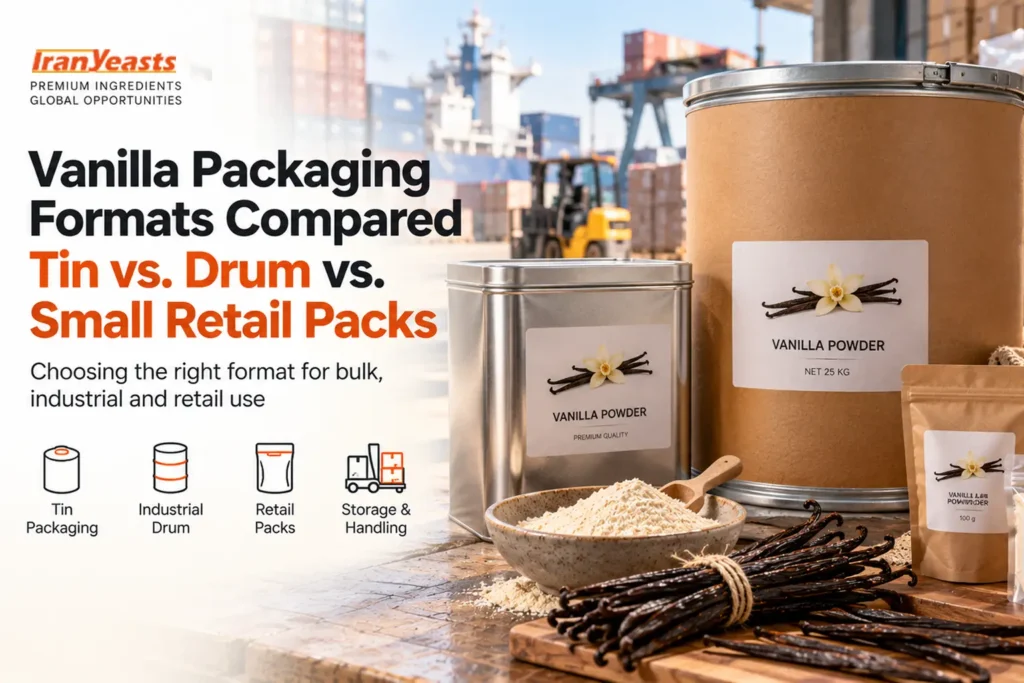
Choosing a vanilla packaging format is not just about what fits the shipping container. Tin, drum, and small retail packs protect the product differently, cost differently, and suit very different buyers, and picking the wrong one either wastes money on protection you did not need or leaves a shipment more exposed than it should be.
Bulk vanilla packaging options are not interchangeable the way a generic size chart might suggest. A format that makes sense for an industrial bakery running through a drum a week can be the wrong choice entirely for a distributor testing a new retail market with a few hundred small units.
This guide compares the three main formats on protection, cost, and typical use case, and walks through how to match one to your own order.
Looking to Import Iranian Premium Vanilla at Wholesale Scale?
Get expert guidance on product selection, packaging, export documentation, pricing, and international shipping directly from our export team.
Bulk Vanilla Packaging Options for Iranian Vanilla, at a Glance
Iranian vanilla is available across all three formats covered in this guide, and the right one depends far more on your order volume and distribution plan than on the product itself. Before comparing the details, the table below gives a quick side-by-side view of how tin, drum, and small retail packs stack up. A full look at the product line is available on the Iranian vanilla hub page.
| Format | Typical Capacity | Barrier Protection | Best Suited For |
|---|---|---|---|
| Tin | 1kg to 5kg | Near-total, blocks oxygen, moisture, and light | Premium retail, long-term storage, gifting |
| Drum | 10kg to 25kg+ | Strong, though seams and liners vary by drum type | Industrial bakeries, high-volume manufacturers |
| Small retail pack | 50g to 1kg | Varies widely by sub-format (sachet, jar, pouch) | Market testing, retail shelves, private label launches |
Tin Packaging: Maximum Protection, Premium Presentation
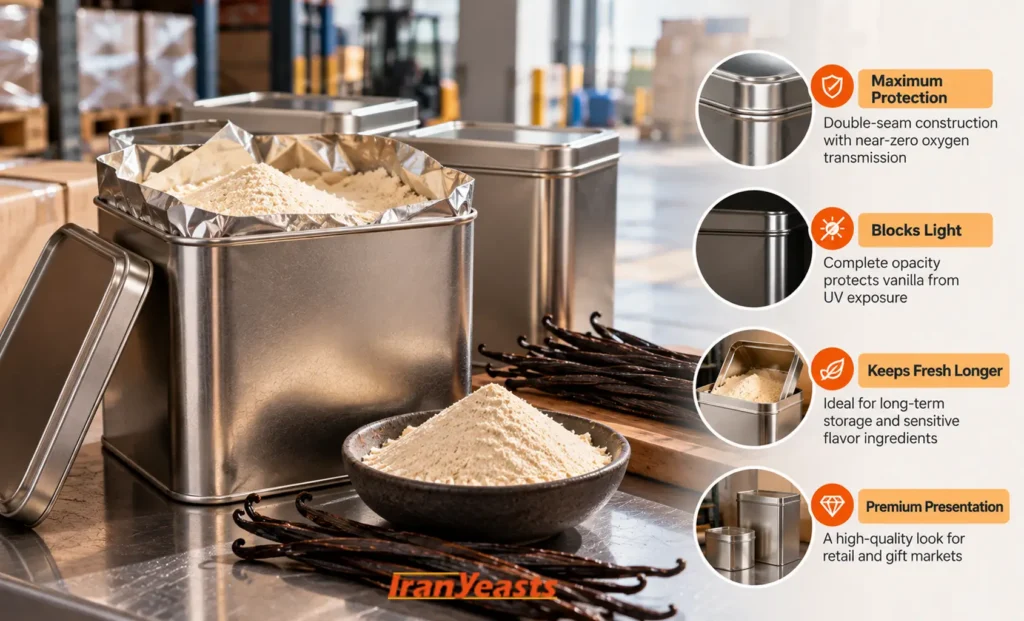
Tin containers are the gold standard for protecting a sensitive flavor ingredient like vanilla over long periods, and that protection is measurable rather than just a marketing claim.
How Tin Packaging Performs
A properly sealed metal tin with a double-seam construction has an oxygen transmission rate close to zero, meaningfully better than even a high-barrier flexible pouch. Independent packaging industry data shows premium laminated pouches still allow measurable oxygen ingress over time, while metal cans are considered an effectively total barrier, and the same opacity that gives tin its classic look also blocks essentially all light, which matters for a flavor compound that degrades under UV exposure.
When Tin Makes Sense
- Premium retail positioning: Products marketed on a premium or gift-quality positioning, where the packaging itself signals value to the end buyer.
- Long-term storage: Vanilla intended for storage well beyond a year, where even a small amount of oxygen or moisture ingress compounds over time.
- Rugged handling requirements: Distributors who want a packaging format that survives rough handling in transit and storage without denting or puncturing.
Tradeoffs to Consider
- Higher cost: Tin costs more per unit than flexible packaging formats, which affects margin on lower-priced product lines.
- Weight: Metal tins add more shipping weight than an equivalent volume of pouches, which increases freight cost on a per-kilogram basis.
- Less flexible for small runs: Custom tin sizes and printing generally require higher minimum order quantities than flexible small-pack formats.
For buyers ready to move forward with this format, wholesale tin vanilla packaging covers the specific sizes and terms available.
Drum Packaging: Built for Industrial Volume
Drums are the default choice once order volume moves past what tins or small packs can practically handle, and the economics shift accordingly.
How Drum Packaging Performs
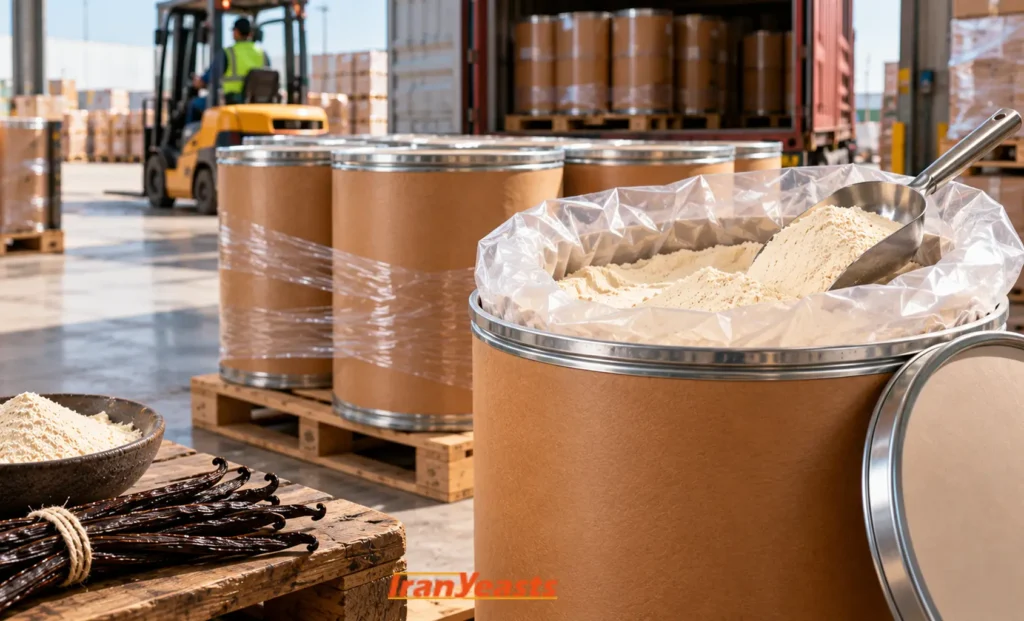
Bulk drums, whether fiber, plastic, or metal, are designed around volume efficiency rather than maximum barrier performance on a per-unit basis. Protection still matters, and a well-made drum with an appropriate inner liner performs well against moisture and light, but the format is optimized for moving large quantities cost-effectively rather than for the kind of long-term, undisturbed storage a tin is built for.
When Drum Packaging Makes Sense
- High, steady consumption: Bakeries and manufacturers running consistent, predictable volume who will use a full drum within a reasonable timeframe rather than storing it indefinitely.
- Cost efficiency at scale: Buyers who value the lowest possible cost per kilogram over premium unit presentation.
- Internal repackaging already planned: Manufacturers who portion the product into their own internal containers after receipt, making the outer packaging’s presentation irrelevant.
Tradeoffs to Consider
- Repeated exposure after opening: Once a drum is opened, the remaining product is exposed to more air and handling with each use than a smaller, single-use format would allow.
- Less quality control granularity: A drum represents a large, single point of failure if quality control on that specific batch turns out to be inconsistent.
- Not suited to small or first-time orders: Buyers testing a new market or product line rarely want to commit to drum-sized volume before demand is proven.
This is generally the right format for buyers already working at scale; bulk premium vanilla is built specifically around this kind of high-volume order.
Small Retail Packs: Flexibility for Testing and Distribution
Small retail packaging covers more ground than the other two formats combined, since it includes everything from single-use sachets to small jars and pouches aimed at consumers or light commercial use.
How Small Retail Packaging Performs
Barrier performance in this category varies more than in tin or drum packaging, since it depends heavily on the specific film or container used. Flexible pouch laminates with a foil or high-barrier film layer can approach the protection of rigid packaging, while a basic single-layer bag offers meaningfully less protection over the same period, so the specific construction matters more than the general category when evaluating a small-pack supplier.
When Small Packs Make Sense
- Testing a new market: Distributors entering a new market who want to gauge demand before committing to a larger order.
- Retail distribution: Products destined for a retail shelf, where package size needs to match consumer purchasing habits rather than industrial volume.
- Private label launches: A distributor’s first private label order, where a smaller commitment reduces risk while the branding and product are still being proven in market.
Tradeoffs to Consider
- Higher per-unit cost: Small packs generally carry a higher cost per kilogram of actual product than bulk formats, since packaging and labor cost is spread across less product per unit.
- Variable barrier quality: Depending on the specific film or container, protection can be noticeably lower than tin or a well-made drum, particularly for extended storage.
- More packaging complexity per order: A retail-format run typically needs its own dedicated packaging line time, separate from a bulk production run.
Buyers who want smaller units, whether as an ongoing supply or a single larger order made up of many individual packs, can start with wholesale small packing vanilla to see the available sizes and terms.
How to Choose the Right Format for Your Business
Working through a short set of questions in order generally points toward the right format without much guesswork.
- Estimate realistic volume first: Start with your actual order volume, not an aspirational future volume. A drum only makes sense if you will use it within a reasonable timeframe.
- Weigh the label claim: If the finished product carries a natural-origin or premium claim, factor tin’s presentation value into the decision alongside its barrier performance.
- Consider your storage and shipping conditions: Vanilla destined for a hot, humid, or long transit route benefits more from tin or a high-barrier drum liner than from a basic pouch.
- Match the format to your relationship stage with the supplier: A first order with a new supplier is a reasonable place to choose a small pack format, regardless of what the long-term volume plan looks like.
- Run the numbers on cost per kilogram, not per unit: Compare total landed cost per kilogram across formats rather than the sticker price of a single unit, since packaging cost, freight weight, and waste from spoilage all factor differently into each format’s real cost.
Where to Source Each Format
Once a format is chosen, sourcing the right Iranian vanilla product to fill it is the next step. Wholesale vanilla is a reasonable starting point for browsing every packaging format covered in this guide in one place before narrowing down to a specific order.
Conclusion
Tin, drum, and small retail packs each solve a different problem rather than competing on the same terms. Tin protects best and presents best, drum delivers the lowest cost at real scale, and small packs give distributors room to test a market or launch a private label line without overcommitting.
Matching the format to actual volume, storage conditions, and where a business is in its relationship with a supplier does more for total cost and product quality than any single packaging choice made in isolation.
References
- Tin Makers. (2026, June 4). Oxygen transmission rate: Why metal cans are a superior barrier for sensitive products. https://www.tinmakers.com/blog/oxygen-transmission-rate/
- YLT Packing. (2026, March 20). Comparing different types of food packaging materials: Barrier properties and use cases. https://www.yltpacking.com/news/comparing-different-types-of-food-packaging-materials.html
- Utah State University Extension. (n.d.). Bulk food storage containers: A comparison guide. https://extension.usu.edu/foodstorage/research/bulk-food-storage-containers
- Multisorb Technologies. (2025, July 30). How desiccants for food shipping protect your food's quality. https://www.multisorb.com/blog/desiccants-in-food-shipping/
- Food and Agriculture Organization of the United Nations. (n.d.). Vanilla: Post-harvest operations [PDF]. FAO Post-Harvest Compendium. https://www.fao.org/fileadmin/user_upload/inpho/docs/Post_Harvest_Compendium_-_Vanilla.pdf
Frequently Asked Questions
Find answers to common questions about vanilla packaging formats, including tin, drum, and small retail packs, barrier protection, cost, and switching formats between orders.
Which vanilla packaging format offers the best protection?
Tin offers the strongest barrier protection, with an oxygen transmission rate close to zero and total light blocking, making it the best choice for long-term storage.
Is drum packaging cheaper than tin for the same volume of vanilla?
Generally yes, on a per-kilogram basis, since drums are optimized for volume efficiency rather than premium presentation, though the tradeoff is lower per-unit protection once opened.
What packaging format is best for testing a new market?
Small retail packs, since they allow a distributor to gauge demand with a lower initial commitment before scaling up to drum or tin volumes.
Does small retail packaging always mean lower quality protection?
Not necessarily. Protection depends on the specific film or container construction, and a high-barrier laminate pouch can approach the performance of rigid packaging, while a basic single-layer bag offers meaningfully less.
Can I switch packaging formats between orders with the same supplier?
Typically yes, since format is usually a packaging line decision rather than a change to the underlying product, though minimum order quantities vary by format.
Is tin packaging worth the extra cost for every vanilla order?
Not for every order. It makes the most sense for premium positioning, long-term storage, or rough handling conditions, while buyers focused purely on cost per kilogram are often better served by drum or small-pack formats.
What should I check when comparing small-pack suppliers?
Confirm the exact film or container construction being used, since barrier performance varies significantly within the small-pack category even though products may look similar from the outside.