

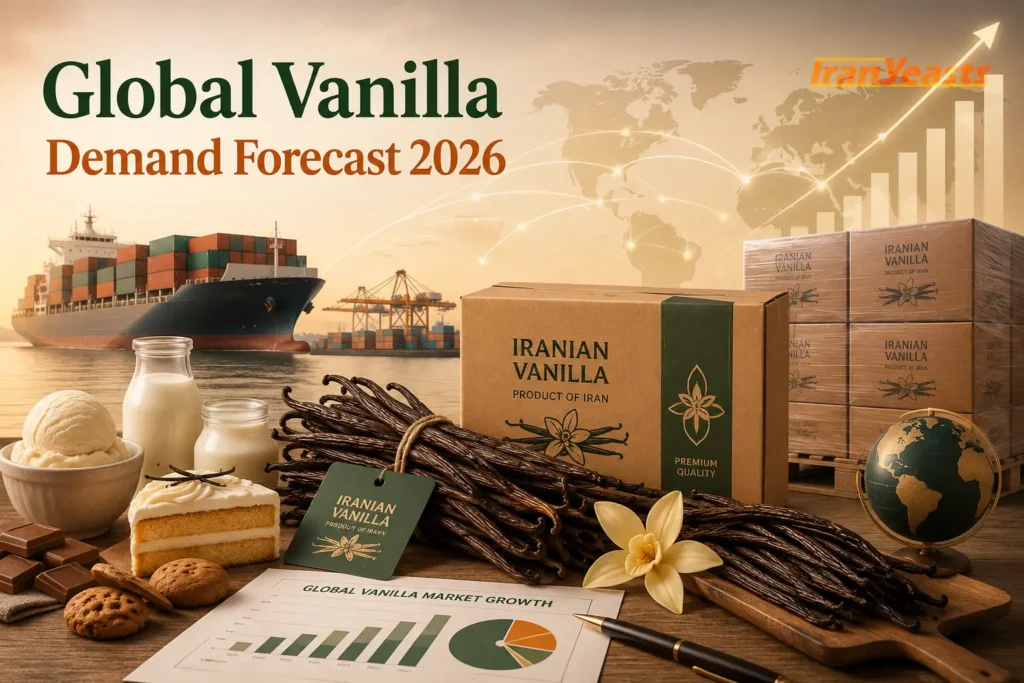
The global vanilla and vanillin market is not moving in a single direction. Natural vanilla is growing on the back of clean-label consumer demand. Synthetic vanillin is growing on the back of commercial food manufacturing expansion. Bio-based vanillin is growing as fermentation technology matures and the price gap with synthetic narrows. All three segments are expanding simultaneously, and the proportions between them are shifting in ways that matter for how buyers source and plan procurement.
For a distributor evaluating where to source vanilla flavoring, or a food manufacturer reviewing their ingredient cost structure for 2026, understanding the market-level demand picture is not academic. It tells you which product formats are growing, which geographic markets are adding the most new volume, and which sourcing regions are gaining or losing position as the trade environment changes around them.
This post draws on multiple verified 2026 market reports to give buyers a clear, data-grounded view of global vanilla demand as it stands today and where the credible forecasts point over the next five years.
Looking to Import Iranian Instant Dry Yeast at Wholesale Scale?
Get expert guidance on product selection, packaging, export documentation, pricing, and international shipping directly from our export team.
Global Vanilla Demand in 2026: The Combined Market Numbers
The vanilla market is most accurately understood as two distinct but related markets operating simultaneously: the natural vanilla market (beans, extracts, and concentrates derived from Vanilla planifolia) and the synthetic vanillin market (food-grade vanillin produced from guaiacol, lignin, or bio-fermentation).
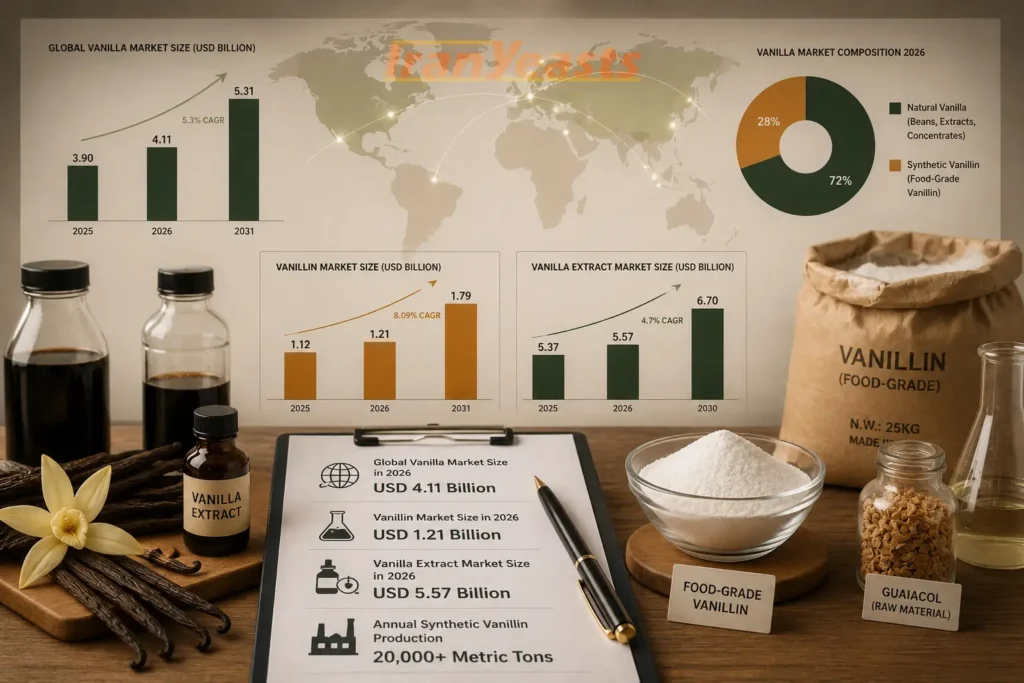
The global vanilla market size is estimated at USD 4.11 billion in 2026, growing from USD 3.90 billion in 2025, with projections showing USD 5.31 billion by 2031 at a 5.3 percent CAGR.
The vanillin market specifically was valued at USD 1.12 billion in 2025 and is estimated to grow from USD 1.21 billion in 2026 to reach USD 1.79 billion by 2031, at a CAGR of 8.09 percent during the forecast period.
The vanilla extract segment, which includes both natural and artificial extract formulations, sits within a larger market. The vanilla extract market will grow from USD 5.37 billion in 2025 to USD 5.57 billion in 2026 at a CAGR of 3.8 percent, with growth expected to accelerate to USD 6.7 billion by 2030 at a CAGR of 4.7 percent.
For buyers evaluating commercial procurement decisions, the vanillin market number is the most relevant figure. It represents the ingredient most food manufacturers actually purchase in volume for production use, rather than the broader vanilla category which includes natural beans sold at premium prices for artisan and gourmet applications.
Annually, over 20,000 metric tons of synthetic vanillin are produced globally to meet consumption needs, with more than 85 percent derived from guaiacol-based synthesis.
Why Synthetic Vanillin Continues to Dominate Volume Despite the Natural Vanilla Trend
Media coverage of the vanilla market tends to focus on Madagascar cyclones, natural vanilla price spikes, and clean-label consumer trends. These are real market forces, but they do not change the fundamental procurement economics that make synthetic vanillin the overwhelmingly dominant form in commercial food manufacturing.
Synthetic vanillin is expected to capture approximately 64.5 percent of the global market share in 2026 due to cost efficiency, serving as the workhorse of the global flavor industry and providing the base note for thousands of products where natural vanilla is economically unfeasible.
China produces over 9,000 metric tons of synthetic vanillin each year, while European countries consume over 3,000 metric tons for food processing applications alone. Food-grade vanillin holds a dominant market share due to its extensive use in baked goods, confectioneries, and beverages.
The economic arithmetic is unambiguous. Natural vanillin requires approximately 500 kilograms of vanilla beans to produce 1 kilogram of extract-grade vanillin. The vanilla bean itself sells at $250 or more per kilogram at Madagascar government export floor pricing. Synthetic vanillin of equivalent flavor-active purity is available in the $15 to $35 per kilogram range. For a commercial bakery producing 50,000 units per day, the ingredient cost difference between natural and synthetic vanillin is not a sourcing preference, it is a business model question.
The bakery and confectionery sectors are increasing their strategic reserves of synthetic vanillin by 15 percent annually to insulate against supply shocks from natural vanilla price volatility. This trend reflects purchasing managers building inventory buffers for a product whose consistent availability and pricing cannot be replicated by natural supply chains concentrated in one cyclone-prone country.
The Four Sectors Driving Global Vanillin Demand Growth in 2026
Demand growth is not uniform across application sectors. Four segments are pulling ahead of the market average, and understanding which ones matters for distributors who need to align their product offering with actual buyer requirements.
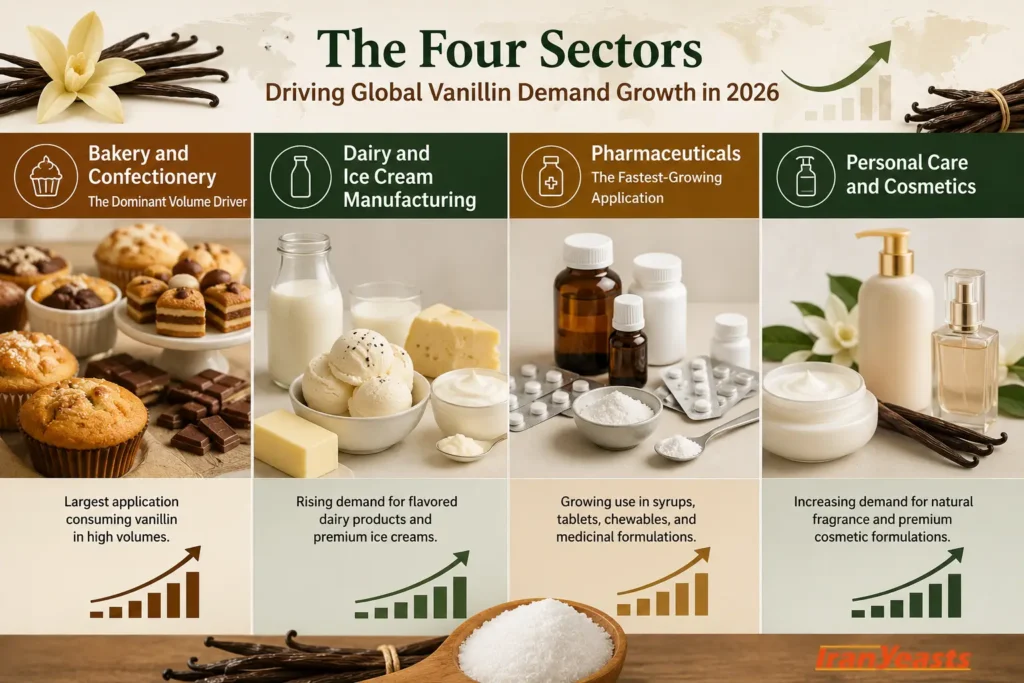
Bakery and Confectionery : The Dominant Volume Driver
Food applications are projected to hold a substantial 45 percent share of the total vanillin market in 2026, with vanilla remaining the most popular flavor globally and acting as a background enhancer even in chocolate and fruit-flavored items. Its ability to withstand baking temperatures without degrading makes it indispensable for industrial bakeries producing cookies and cakes at scale.
Food and beverage applications contributed 66.10 percent of vanillin revenue in 2025, covering bakery, confectionery, dairy, and beverage sectors, which collectively drive global vanillin demand.
This sector is not a growth story in the way that emerging applications are, but it is the stable, predictable volume base that underlies the entire market. Commercial bread production, biscuit and cookie manufacturing, chocolate and confectionery lines : these industrial buyers are purchasing vanillin as a core input to recurring daily production cycles.
Dairy and Ice Cream Manufacturing
Vanillin is applied in milk, yogurt, ice cream, and plant-based dairy alternatives to improve flavor richness, mask off-notes, and enhance creaminess perception. The dairy sector is expanding in emerging markets across Southeast Asia, the Middle East, and Africa as income growth drives packaged food consumption higher. Ice cream production in GCC markets has grown consistently over the past five years. Both trends increase vanillin demand in the geographies where Iranian supply has the strongest logistics position.
Pharmaceuticals : The Fastest-Growing Application
Pharmaceutical applications will post a 10.18 percent CAGR to 2031, significantly outpacing the overall market growth rate. Vanillin serves as a flavor-masking agent in pediatric syrups, chewable tablets, and oral pharmaceutical formulations, improving palatability for patient compliance. Nearly 900 metric tons of vanillin were used in medicinal syrups and lozenges across Asia-Pacific in 2023, and the market is seeing a surge in encapsulated vanillin for controlled release in therapeutic applications.
Personal Care and Cosmetics
In 2023, the cosmetics industry accounted for approximately 2,000 metric tons of vanillin usage, especially in perfumery and lotions. This trend is further accelerated by vanillin’s antimicrobial and antioxidant properties, making it suitable for a broader range of formulations. While cosmetics represent a smaller share of total vanillin volume than food applications, the growth rate in this sector is meaningfully above average and provides additional demand support for producers.
Regional Demand: Where Vanilla Consumption Is Growing Fastest in 2026
Regional growth trajectories for vanilla and vanillin demand diverge significantly, and the fastest-growing markets are not where the largest volume currently sits.
Asia Pacific : Highest Growth Rate
Asia-Pacific is set to deliver the highest 6.52 percent CAGR through 2031, fueled by rising incomes and the adoption of Western-style desserts. The Asia Pacific vanillin segment is set to post a 9.30 percent CAGR to 2031. China’s food processing sector alone drives significant domestic vanillin demand alongside its production dominance. India, Indonesia, Malaysia, and Vietnam are all expanding commercial food manufacturing capacity.
Europe : Largest Revenue Share
Europe captured 31.10 percent of regional vanillin revenue in 2025. European demand is characterized by stricter regulatory standards around natural versus synthetic flavoring classification, higher consumer sensitivity to clean-label claims, and a premium bakery sector that justifies natural vanilla pricing in specific applications. For synthetic vanillin exporters targeting European buyers, HACCP and ISO 22000 documentation are baseline procurement requirements.
Middle East and Africa : Growing Import Dependency
Middle East and Africa represent a combined yeast and vanillin growth opportunity that several market reports identify as the fastest-growing regional import market for food-grade vanillin. Urbanization, expanding commercial bakery sectors in Gulf states, and growing packaged food consumption across North Africa and East Africa are all contributing to rising import demand. Middle East and Africa accounts for approximately 10 percent of global vanilla consumption, driven by food demand and natural flavor trends in the region.
For Iranian vanillin exporters, the Middle East and Gulf markets represent the clearest geographic opportunity: rising demand, Halal certification requirements that align with Iranian production standards, and transit distance advantages over Chinese and European competitors that directly affect landed cost.
North America : Price Sensitivity After Trade Actions
US tariffs of up to 379.87 percent on Chinese vanillin are increasing costs for American buyers and driving sourcing diversification within ASEAN and Europe. While this specific trade action does not directly affect Gulf or Asian buyers, it signals a broader trend: buyers who have relied on single-source Chinese supply are actively evaluating alternatives, and the disruption of established pricing assumptions is prompting procurement reviews across markets.
How US Anti-Dumping Duties on Chinese Vanillin Are Reshaping Global Sourcing in 2026
This is the market development with the broadest indirect effect on non-US buyers, and it is worth understanding in detail even for distributors who do not sell into the American market.
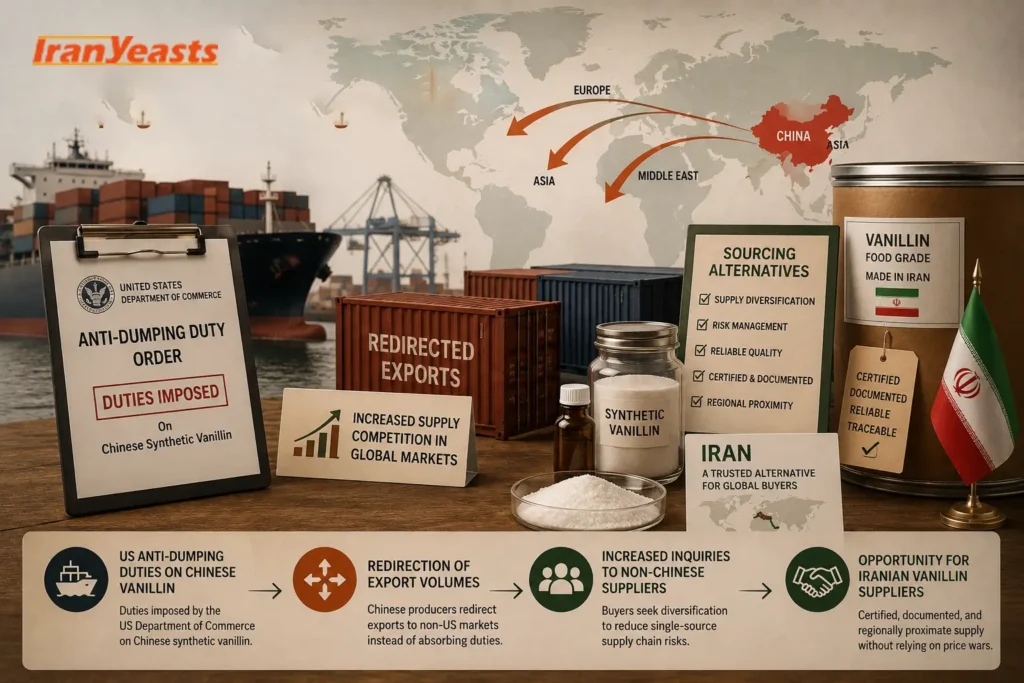
When the US Department of Commerce imposed anti-dumping duties on Chinese synthetic vanillin, Chinese producers did not absorb the duty : they redirected export volume toward non-US markets. This increased supply competition in Asian, Middle Eastern, and European markets as Chinese vanillin that had been priced for US buyers competed for alternative buyers at adjusted prices.
Simultaneously, non-Chinese producers in Europe, India, and Iran experienced increased inbound inquiry from buyers who previously relied on Chinese supply and were evaluating geographic diversification for risk management reasons : not necessarily because Chinese product quality was insufficient, but because single-source dependency on a production country facing trade action is a supply chain risk that procurement managers increasingly need to justify to stakeholders.
For Iranian vanillin specifically, this environment creates an opportunity that is not dependent on price undercutting but on supplying a certified, documented, regionally proximate alternative to buyers for whom Chinese supply carries increasing risk and documentation complexity.
The Clean-Label Trend: How It Is Shifting the Balance Between Natural and Synthetic
The clean-label movement is the most discussed trend in vanilla market commentary, and it warrants a precise reading rather than a general endorsement.
Clean-label products are projected to constitute over 70 percent of product portfolios in 2025 and 2026, rising from 52 percent in 2021. Over 61 percent of consumers globally prefer natural over synthetic flavors in bakery and dairy products.
These numbers sound like a threat to synthetic vanillin demand. In practice, the effect is more nuanced.
The clean-label trend is concentrated in specific market segments: premium retail, organic-certified products, and high-end restaurant supply chains : mostly in North America and Western Europe. In these segments, it is creating genuine demand for natural vanillin and bio-based alternatives.
The natural vanillin market is valued at USD 0.54 billion in 2026 and is projected to reach USD 1.2 billion by 2035, growing at a CAGR of 9.4 percent. That is substantial growth, but it starts from a small base. Less than 1 percent of vanillin consumed globally qualifies as natural, and synthetic vanillin remains dominant due to cost-effectiveness and the fact that natural production requires approximately 500 kilograms of beans to produce 1 kilogram of vanillin.
For commercial food manufacturers selling into mass-market channels in the Middle East, Central Asia, South Asia, or Africa, natural vanilla is not the procurement reality. Food-grade synthetic vanillin at 98 to 99 percent purity is. The clean-label trend matters for premium segment distributors; it does not meaningfully affect the demand forecast for buyers whose customers operate in price-sensitive commercial food production.
Understanding which demand segment your buyers sit in is what determines whether the clean-label trend is relevant to your sourcing decision.
What the 2026 Demand Forecast Means for Distributors Sourcing Iranian Vanilla
Translating market-level data into actionable sourcing decisions requires connecting the forecast numbers to the specific geography and buyer profile a distributor is working with.
For distributors in Gulf states, Iraq, Central Asia, and South Asia, the 2026 forecast picture supports three practical conclusions:
Demand is growing in your markets.
The Middle East and Africa segment is growing faster than the global average, driven by bakery expansion, dairy industry growth, and rising packaged food consumption. Your customers are buying more vanillin-dependent products, which means their ingredient procurement is expanding.
Halal-certified supply from a regional source is increasingly valuable.
As the overall vanillin market grows and more buyers enter, the subset of buyers who need Halal-certified documentation with recognized issuing bodies becomes larger in absolute numbers. ISIRI-certified Iranian vanillin covers this requirement for Gulf, Iraqi, and Central Asian markets without supplementary certification steps.
Supply chain diversification is a real buyer concern.
The trade action on Chinese vanillin has made geographic concentration in a single supply country a documented procurement risk for buyers in many markets. Establishing an Iranian supply relationship now, while building it alongside rather than instead of existing supply sources, is a reasonable risk management step that more procurement teams are actively taking.
For the specific specification and pricing context that applies to your purchasing decision, our post on the factors affecting Iranian vanilla export price covers how the seven key variables in Iranian vanillin pricing interact : including how global feedstock cost movements affect what you pay per kilogram.
For buyers new to Iranian vanilla sourcing, our overview of what Iranian vanilla production actually delivers covers the technical specification, certification framework, and packaging range in detail.
Final Thoughts
The global vanilla demand forecast for 2026 is not a single number or a simple growth story. It is a differentiated market where natural vanilla grows faster by percentage but from a small base, synthetic vanillin grows steadily from a large base, bio-based vanillin emerges as a third category, and regional growth rates vary significantly from Asia Pacific’s near-10 percent CAGR to Europe’s steadier volume expansion.
For buyers making sourcing decisions in 2026, the most useful takeaway from the forecast data is that demand growth in your market is likely real, documentation requirements are tightening, geographic supply diversification is accelerating, and regional proximity to supply is becoming a more important factor in landed cost than it was when Chinese production dominated without significant trade friction.
References
- Mordor Intelligence. (2026, June). Vanilla market size, share and forecast 2026–2031. Mordor Intelligence Research.
- Mordor Intelligence. (2026, January 15). Vanillin market size, share and forecast 2026–2031. Mordor Intelligence Research.
- Future Market Insights. (2026, May 8). Vanillin market trends, growth and forecast 2026–2036. Future Market Insights Inc.
- Business Research Insights. (2026, April 14). Natural vanillin market size, share, analysis and forecast 2026–2035. Business Research Insights.
- Research and Markets. (2026). Vanilla extract market global report 2026. Research and Markets Intelligence
Frequently Asked Questions
Find answers to common questions about Iranian instant dry yeast, including certifications, bulk orders, private labeling, export logistics, and delivery worldwide
What is the size of the global vanilla market in 2026?
The global vanilla and vanillin market is estimated at USD 4.11 billion in 2026 (Mordor Intelligence). The vanillin-specific market is valued at USD 1.21 billion in 2026, projected to grow at 8.09 percent CAGR to reach USD 1.79 billion by 2031. The vanilla extract market separately stands at approximately USD 5.57 billion in 2026.
Is demand for vanilla growing or declining in 2026?
Overall vanilla and vanillin demand is growing. The vanillin market is growing at 6.9 to 8.09 percent CAGR depending on the reporting source. Natural vanillin is growing faster than synthetic in percentage terms (9.4 percent CAGR to 2035) but from a much smaller base. Synthetic vanillin dominates volume at 56 to 65 percent market share and continues to grow steadily.
Which region is seeing the fastest vanilla demand growth?
Asia Pacific is the fastest-growing regional market for vanillin, with a CAGR of 6.52 to 9.30 percent through 2031 depending on the forecast source. Middle East and Africa are identified as the fastest-growing import markets, driven by commercial bakery expansion, rising packaged food consumption, and increasing ice cream and dairy production.
Why is synthetic vanillin dominant despite consumer preference for natural?
The economics are decisive. Natural vanillin derived from vanilla beans requires 500 kilograms of beans per kilogram of vanillin and is priced at $1,200 or more per kilogram at natural purity levels. Food-grade synthetic vanillin is priced at $15 to $35 per kilogram and is chemically identical to the primary flavor compound in vanilla beans. For commercial food manufacturers operating at scale, the price difference determines which product is viable in their cost structure.
How are US anti-dumping duties on Chinese vanillin affecting global markets?
The US imposed anti-dumping duties of up to 379.87 percent on Chinese synthetic vanillin. This has driven Chinese producers to redirect export volume toward non-US markets and has accelerated procurement diversification efforts among buyers globally who previously relied heavily on Chinese supply. The effect for Iranian vanillin is increased inbound inquiry from buyers evaluating non-Chinese alternatives.
What application sectors are growing fastest in vanilla demand?
Pharmaceutical applications are growing fastest (10.18 percent CAGR to 2031), though from a smaller base. Bakery and confectionery remain the dominant volume application at 45 to 66 percent of total market revenue. Personal care and cosmetics are growing above average at approximately 2,000 metric tons of vanillin consumption. Dairy and ice cream production in Middle Eastern and Asian markets is a strong regional growth driver.
What does the 2026 vanilla forecast mean for buyers sourcing Iranian vanillin?
Growing demand in Middle Eastern and Central Asian markets, stricter documentation requirements, and increasing geographic supply diversification among buyers who previously concentrated on Chinese supply all create a favorable sourcing environment for Iranian vanillin in 2026. The combination of ISIRI Halal certification, short transit routes to Gulf and regional markets, and competitive pricing positions Iranian supply favorably against both Chinese and European alternatives for these specific geographies.