

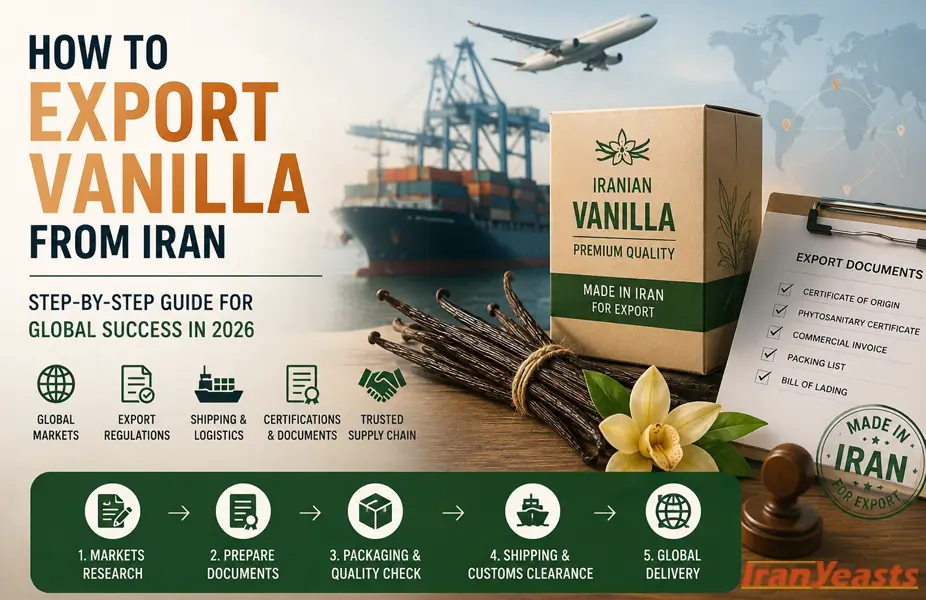
Distributors evaluating Iranian vanilla as a sourcing option usually arrive with two separate questions: how is the product actually made, and what does the export process from order to delivery look like? Most supplier websites answer one or the other , rarely both, and rarely with real specificity.
That gap matters. A buyer who understands how food-grade vanillin powder is produced can evaluate quality claims with more confidence. A buyer who understands the export process , documentation, HS codes, certification, freight , avoids the delays that catch most first-time importers off guard.
This guide covers both halves of the picture: how Iranian vanillin is processed for export, from raw material to finished powder, and the complete step-by-step process of getting it from our facility to your destination port.
How Iranian Vanillin Powder Is Processed for Export
Before discussing logistics, it’s worth understanding what “vanilla processing” actually means for the product most bulk and retail vanilla buyers are sourcing , food-grade synthetic vanillin powder, not whole vanilla beans.
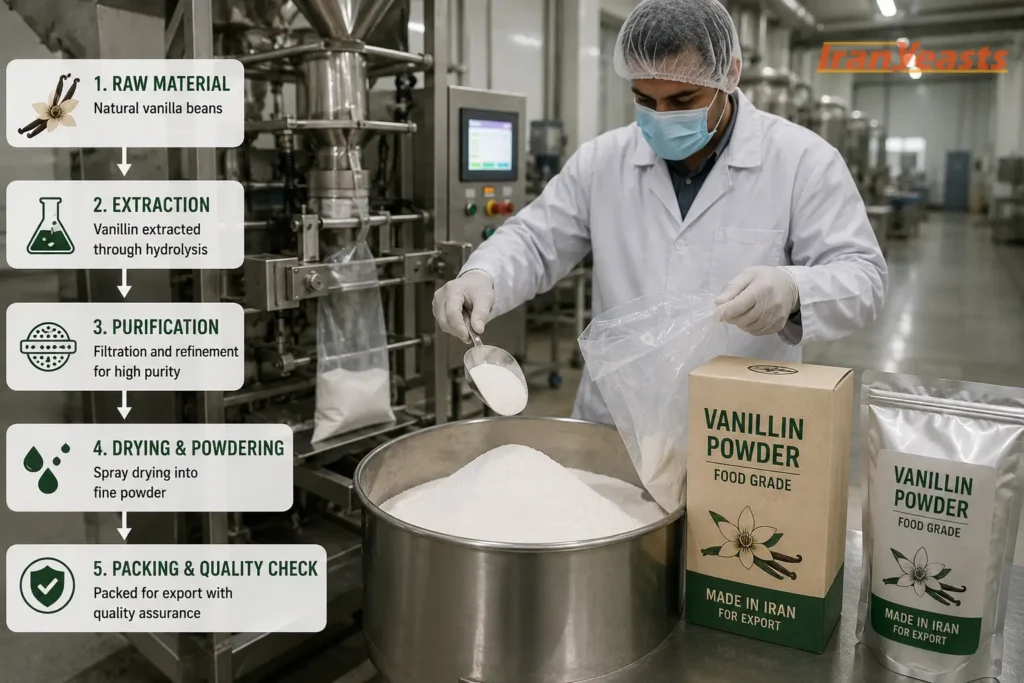
Raw Material: Guaiacol as the Production Base
Industrial vanillin production worldwide is built around guaiacol, an aromatic organic compound. The dominant global manufacturing route , known as the guaiacol-glyoxylic acid process , converts guaiacol into vanillin through a two-step chemical reaction: condensation with glyoxylic acid, followed by oxidative decarboxylation. This process accounts for the majority of global synthetic vanillin production and is the same fundamental chemistry used by major producers in France, China, and the United States.
The resulting compound , 4-hydroxy-3-methoxybenzaldehyde , is molecularly identical to the primary flavor compound found naturally in vanilla beans. This is why food-grade synthetic vanillin delivers a genuine, recognizable vanilla flavor rather than an artificial substitute.
Purification and Crystallization
Following the core reaction, the crude vanillin output goes through purification stages , filtration, crystallization, and recrystallization , to remove reaction byproducts and reach food-grade purity. This is the stage that determines final product purity, which for our export-grade vanillin reaches 98–99% vanillin content.
Drying and Powder Formation
Purified vanillin crystals are dried under controlled conditions to achieve the fine, free-flowing crystalline powder that food manufacturers and packaging lines require. Moisture content is tightly controlled at this stage , excess moisture affects both shelf stability and how the powder performs in dry-mix food applications.
Quality Testing Before Packaging
Before any batch is approved for packaging, it undergoes a structured testing sequence:
- Purity testing , confirming vanillin content meets the 98–99% specification
- Moisture testing , verifying the product meets dry powder stability requirements
- Microbial testing , confirming the batch meets food safety thresholds
- Appearance and solubility testing , confirming consistency with the product’s technical data sheet
Only batches that pass this full testing sequence are approved for export packaging. A Certificate of Analysis (CoA) is generated for each approved batch, documenting these results for the buyer’s records and for customs purposes.
Packaging Under Controlled Conditions
Once approved, vanillin powder is packed in formats ranging from 10g retail sachets to 25kg industrial export sacks, depending on the order. Packaging is conducted in a controlled environment to prevent moisture ingress and contamination, with vacuum-sealing used for formats requiring extended shelf life (18–36 months depending on packaging type).
This is the complete production-to-packaging cycle that happens before any export logistics begin , and it’s the foundation that makes the documentation discussed below meaningful rather than just paperwork.
The Complete Process: How to Export Vanilla from Iran in 7 Steps
With the product itself understood, here is exactly how the export process works from initial inquiry to delivery at your destination port.
Step 1 , Submit Your Inquiry with Clear Specifications
The more specific your initial inquiry, the faster and more accurate your quote will be. A complete inquiry should include:
- Product format , bulk vanillin powder, retail sachets, tins, or private label
- Destination country and port
- Volume required , per shipment and, if known, estimated annual volume
- Packaging preference , sachet size, bulk bag weight, or vacuum format
- Certification requirements specific to your market
We respond to inquiries with a preliminary quote and product specification sheet within 24–48 hours.
Step 2 , Request a Sample and Run Your Own Quality Test
Before committing to a commercial order, we recommend testing the product directly. For food manufacturers, this typically means a small-batch formulation test to confirm flavor performance and solubility in your specific application. For distributors, it usually means reviewing the Certificate of Analysis and confirming packaging quality.
Samples are available by agreement. We encourage every new buyer , whether sourcing bulk premium vanilla or retail-ready small packs , to test before placing a commercial order.
Step 3 , Confirm Specifications, Incoterms, and Payment Terms
Once the sample is approved, we move to commercial terms:
- Packaging format and quantity confirmed in writing
- Incoterm selection , FOB Bandar Abbas is our baseline; CIF to your destination port is available depending on the route
- Payment terms , standard is 30% upfront, balance before loading; negotiable for established buyers
A formal Pro-Forma Invoice is issued at this stage, covering all agreed specifications.
Step 4 , Production, Batch Testing, and Packaging
Once the order is confirmed, production proceeds through the processing stages described above , purification, drying, batch testing, and packaging to your specified format. Lead time from order confirmation to loading is typically 2–10 working days, depending on volume and packaging complexity.
During this period, full export documentation is prepared in parallel, including the Certificate of Analysis for the specific production batch.
Step 5 , Export Documentation and HS Code Classification
Vanillin is classified internationally under HS Code 2912.41, covering the compound 4-hydroxy-3-methoxybenzaldehyde under the Harmonized System’s organic chemicals chapter. This classification determines the applicable import duty in your destination country and the documentation your customs broker will need to reference.
Standard documentation prepared for every shipment includes:
- Commercial Invoice and Packing List
- Certificate of Origin
- Certificate of Analysis (CoA) , batch-specific
- Halal Certificate (where applicable to your market)
- HACCP Compliance Certificate
- Bill of Lading or CMR (for land freight)
Step 6 , Freight, Insurance, and Shipment
Two primary freight routes are used depending on destination:
Sea freight departs from Bandar Abbas or Deyreh, serving Gulf, South Asian, and European markets. Transit times vary: 3–7 days to Gulf ports, 15–25 days to European ports.
Land freight serves Afghanistan, Pakistan, and Iraq via established overland routes , often faster and more cost-effective for these markets.
Cargo is fully insured to destination. Tracking information and final shipping documents are issued once the Bill of Lading or CMR is confirmed.
Step 7 , Customs Clearance at Destination
At your destination port, your customs broker submits the documentation package for clearance. Common requirements vary by market , GCC countries typically require Halal certification alongside standard customs documents; European markets focus more heavily on HACCP and REACH-aligned documentation for the chemical classification.
If any additional documentation is needed for your specific market’s customs process, we provide supplementary paperwork promptly to avoid clearance delays.
Why Understanding the Process Matters for Buyer Confidence
Many importers default to whichever supplier responds fastest or quotes lowest, without understanding what happens between order confirmation and delivery. This creates risk that surfaces later , inconsistent batches, documentation gaps, or customs delays that could have been avoided with a supplier who explains the process clearly upfront.
Understanding both the production process and the export logistics gives you, as a buyer, the ability to ask informed questions and recognize a supplier who genuinely controls quality at every stage , versus one who is simply reselling product from an unknown source. For buyers comparing this product against natural vanilla alternatives, our detailed breakdown of Iranian vanilla vs Madagascar vanilla explains the production and sourcing differences in more depth.
Final Thoughts
Exporting vanilla from Iran is not fundamentally different from exporting any other food-grade chemical product , what matters is documentation accuracy, batch consistency, and a supplier who manages both the production process and the logistics chain competently. The guaiacol-based manufacturing process behind food-grade vanillin is well-established global chemistry, and the export documentation around HS Code 2912.41 is standardized internationally.
What we control, and what buyers should evaluate any supplier on, is consistency at every step: purity testing before packaging, complete documentation before shipping, and reliable logistics from Bandar Abbas to your destination port. If you’re evaluating Iranian vanilla as a sourcing option, a sample shipment and a direct conversation about your specific market’s requirements is the right first step.
References
- Fache, M., Boutevin, B., & Caillol, S. (2016). Vanillin production from lignin and its use as a renewable chemical. ACS Sustainable Chemistry & Engineering, 4(1), 35–46.
- Wikipedia contributors. (2026). Vanillin. Wikipedia, The Free Encyclopedia
- Banerjee, G., & Chattopadhyay, P. (2019). Vanillin biotechnology: the perspectives and future. Journal of the Science of Food and Agriculture, 99(2), 499–506.
- Flexport. (2025). HS Code 291241 , Tariff classification of vanillin (4-hydroxy-3-methoxybenzaldehyde). Flexport Trade Data.
- Fitigu, F., & Wendimu, G. (2022). Vanillin: the case for greener production driven by the sustainability megatrend. Sustainable Chemistry and Pharmacy. PMC.
Frequently Asked Questions
Find answers to common questions about Iranian instant dry yeast, including certifications, bulk orders, private labeling, export logistics, and delivery worldwide
How is Iranian vanillin powder actually made?
Food-grade vanillin is produced through the guaiacol-glyoxylic acid process , the same chemistry used by major global producers , converting guaiacol into vanillin through condensation and oxidative decarboxylation. The result is purified, crystallized, dried, and tested before packaging. For full technical specifications, see our Iranian vanilla production overview.
What is the HS code for exporting vanillin from Iran?
Vanillin (4-hydroxy-3-methoxybenzaldehyde) is classified under HS Code 2912.41 internationally. This code determines import duty rates and documentation requirements in your destination country. Always verify the national sub-classification with your customs broker.
What documentation is provided with an export shipment?
Every shipment includes a Commercial Invoice, Packing List, Certificate of Origin, Certificate of Analysis (batch-specific), Halal Certificate where applicable, and HACCP compliance documentation. Bill of Lading or CMR is issued once cargo is loaded.
What is the minimum order quantity for export?
Bulk export orders start from 500kg. For buyers requiring smaller volumes in retail-ready formats, see our guide to wholesale small packing vanilla for sachet and tin packaging options.
How long does the process take from inquiry to delivery?
Production lead time is 2–10 working days from order confirmation. Sea freight transit ranges from 3–7 days to Gulf ports up to 20–30 days to European destinations. Land freight to Afghanistan, Pakistan, and Iraq typically takes 5–10 days.
Can I request a sample before placing a commercial order?
Yes. We provide samples by agreement for all new buyers. We recommend testing the product’s flavor performance and reviewing the Certificate of Analysis before committing to a commercial volume.
Is the vanillin tested before every shipment?
Yes. Each production batch undergoes purity, moisture, microbial, and solubility testing before packaging approval. Results are documented in the Certificate of Analysis provided with every shipment, regardless of order size.
What packaging formats are available for export?
Formats range from 10g retail sachets to 25kg industrial export sacks, with vacuum-sealed options for extended shelf life. For industrial-scale buyers, see our dedicated page on bulk premium vanilla for full packaging and specification detail.