

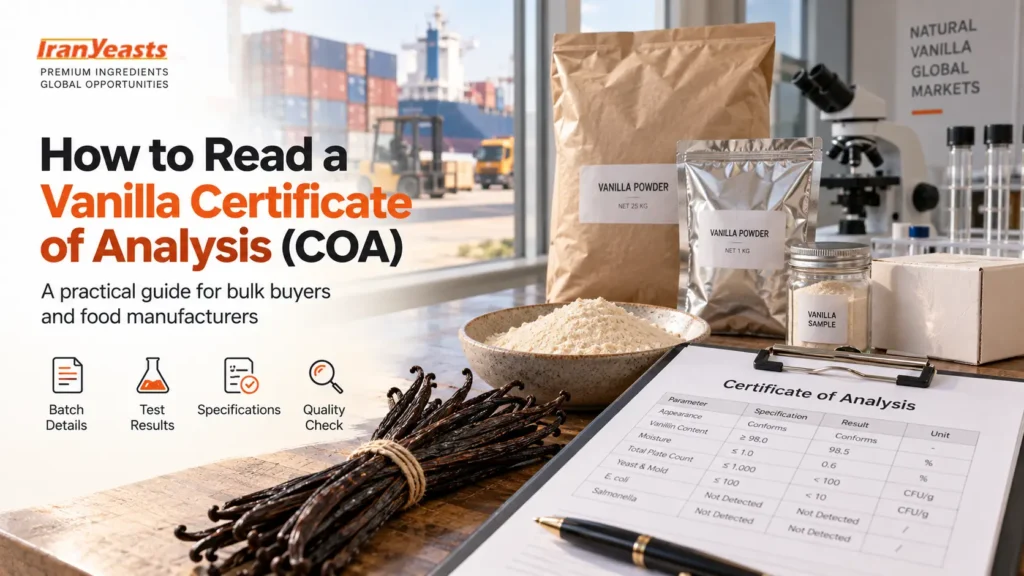
A certificate of analysis is the one document that actually tells you what is in the drum, not just what the label promises. Most buyers glance at it, confirm a signature is present, and move on, which means the document that is supposed to protect them rarely gets read closely enough to do its job.
Vanilla and vanillin add a few wrinkles a generic ingredient COA does not have to deal with: vanillin assay percentage that varies enormously by product type, moisture readings that predict shelf life, and a known history of adulteration in cheaper extracts and powders.
This guide breaks down what a vanilla COA should actually contain, what the numbers mean, and how to spot one that is not telling the full story.
Looking to Import Premium Iranian at Wholesale Scale?
Get expert guidance on product selection, packaging, export documentation, pricing, and international shipping directly from our export team.
Reading a Certificate of Analysis for Iranian Vanilla: What to Look For
A certificate of analysis exists to confirm that a specific batch meets the specification a buyer agreed to, not to serve as generic marketing paperwork. For any Iranian vanilla order, that means the COA should be tied to the exact batch shipped, not a template document reused across multiple orders, and it should list the actual test results rather than simply stating the product passed.
The Core Parameters Every Vanilla COA Should Include
The specific fields vary by product form, but a complete COA for vanilla or vanillin generally covers the following categories.
- Appearance, odor, and flavor: A basic sensory description, confirming the product matches expected color, texture, and aroma before any lab numbers are considered.
- Vanillin assay percentage: The core purity or concentration figure, and the single most important number on the document.
- Moisture content or loss on drying: How much water the product retains, which directly affects shelf life and susceptibility to clumping or mold.
- Melting range: Relevant for vanillin powder specifically, since a shifted melting range can indicate impurities or a different crystalline form than expected.
- Solubility: Confirms the product dissolves as expected in the solvent relevant to its use, whether that is water, alcohol, or oil.
- Heavy metals and contaminant testing: Confirms the product falls within accepted safety limits for elements such as lead and arsenic.
- Microbial testing: Particularly relevant for natural extracts and bean-derived products, confirming the absence of harmful bacterial or mold contamination.
Vanillin Content: The Number That Matters Most
Vanillin assay percentage is the figure that determines flavor strength, and it varies enormously depending on what form of vanilla product is being tested. Pure vanillin powder typically shows an assay in the high nineties, close to chemically pure.
Whole cured vanilla beans carry a far lower vanillin content by weight, commonly cited in the range of 0.75 to 1.5 percent, since the bean is mostly other plant matter and moisture. Vanilla extract’s vanillin content depends on its fold strength and how much of the vanilla constituent was extracted per gallon under the applicable standard of identity.
Because these figures are so form-dependent, a vanillin assay number only means something in context. A COA showing 99 percent on a vanillin powder is unremarkable, while the same number on something sold as whole bean extract would be a clear sign the product is not what it claims to be. Reference test methods used by regulators for this kind of analysis, including chromatographic testing protocols published by the US Alcohol and Tobacco Tax and Trade Bureau, give a sense of how rigorously vanillin content can be verified when a result is disputed.
Moisture and Loss on Drying: Why It Affects Shelf Life
Moisture content is not just a quality data point, it is a direct predictor of how long a product will hold up in storage. This connects directly to the packaging and handling guidance covered in vanilla storage requirements for importers, since a batch that arrives with moisture already at the high end of its acceptable range has less margin left before humidity exposure during transit or storage pushes it toward clumping or mold.
For whole vanilla beans, moisture also correlates with grade and intended use, with higher-moisture beans generally reserved for premium, pliable presentation grades and lower-moisture beans favored for extraction, since a drier bean concentrates vanillin content per gram even though total flavor compound yield may differ.
Red Flags: Adulteration and Missing Data
Vanilla and vanillin have a documented history of adulteration, since the price gap between natural and synthetic sources, and between real vanilla flavor compounds and cheaper substitutes like coumarin, creates a financial incentive to cut corners. A handful of warning signs are worth treating seriously.
- Coumarin or other undisclosed additives: A COA that does not explicitly test for or rule out coumarin and similar compounds leaves room for a substitution that would not otherwise be caught.
- No stated test method: A results table with no indication of which analytical method produced the numbers is harder to trust than one that cites a recognized method.
- Identical COAs across different batches: Real batch-to-batch variation is normal in natural products; a COA that reads identically on every shipment often means it was not actually run for that specific batch.
- Missing batch or production date: A COA without a specific batch number or production date cannot be tied to the physical goods on arrival, which defeats its purpose.
How to Verify a COA Actually Matches Your Shipment
A COA is only useful if it can be cross-checked against the physical product on arrival. On receiving a shipment, confirm the batch number on the COA matches the batch number printed on the packaging itself, not just the paperwork. Where possible, request a COA before the shipment leaves origin rather than after it arrives, so any discrepancy can be resolved before the goods are already in transit. For high-value or first-time orders, an independent third-party lab test on a sample from the received goods is a reasonable extra step, particularly if a supplier relationship is new.
Making COAs Part of Your Buying Process
A strong COA policy fits naturally into a broader vetting process rather than standing alone. The certification and documentation steps covered in how to buy Iranian vanilla in bulk apply directly here, and for distributors building a private label product on top of a supplier’s vanilla, private label vanilla manufacturing covers how batch-specific documentation should factor into an ongoing supplier agreement, not just a first order. Choosing the right form in the first place, as covered in vanilla extract vs. vanilla powder vs. vanillin, also affects which COA parameters actually matter most for a given order.
Conclusion
A vanilla certificate of analysis is only as useful as the attention a buyer actually gives it. The vanillin assay figure, moisture reading, and stated test methods all carry real information, and reading them in context, rather than just checking that a document exists, is what separates a genuine quality check from a formality.
Building COA verification into a standard receiving process, and treating missing data or suspiciously uniform results as a reason to ask questions, protects a buyer far more than any single signature on a page.
References
- Alcohol and Tobacco Tax and Trade Bureau. (2010). Chromatographic analysis of vanilla extracts [PDF].
- PerkinElmer. (2024, January 23). Analysis of vanillin, ethyl vanillin, and coumarin in vanilla extract products [PDF].
- VanillaNice. (2026, April 20). Vanilla bean grades: Grade A, B and C, complete guide
- Cooks Vanilla. (n.d.). How are Madagascar vanilla beans graded?
- International Organization for Standardization. (1999). Vanilla [Vanilla fragrans (Salisbury) Ames] - Part 1: Specification (ISO 5565-1:1999).
Frequently Asked Questions
Find answers to common questions about Iranian instant dry yeast, including certifications, bulk orders, private labeling, export logistics, and delivery worldwide
What is the most important number on a vanilla certificate of analysis?
Vanillin assay percentage, since it determines flavor strength, though the number only makes sense in context of the product form being tested, whether that is pure vanillin, whole beans, or extract.
Why does vanillin content vary so much between different vanilla products?
Pure vanillin powder is close to chemically pure, whole cured beans contain roughly 0.75 to 1.5 percent vanillin by weight, and extract’s vanillin content depends on its fold strength and extraction ratio.
What does moisture content on a COA actually tell a buyer?
It predicts shelf life and storage risk. A batch already near the high end of its acceptable moisture range has less margin before humidity exposure causes clumping or mold.
What is coumarin and why does it matter on a vanilla COA?
Coumarin is a compound sometimes used to cheaply mimic vanilla flavor notes, and its presence can signal adulteration. A thorough COA should explicitly address it rather than omit it.
Is it normal for a COA to look identical across different shipments?
No. Real batch-to-batch variation in natural products is expected, so a COA that reads identically every time often indicates it was not actually tested for that specific batch.
Should I request a COA before or after a shipment arrives?
Before, where possible. Requesting it prior to departure allows any discrepancy to be resolved before the goods are already in transit.
Should I get independent lab testing in addition to a supplier's COA?
For high-value or first-time orders, independent third-party testing on a received sample is a reasonable extra step, particularly with a new supplier relationship.