

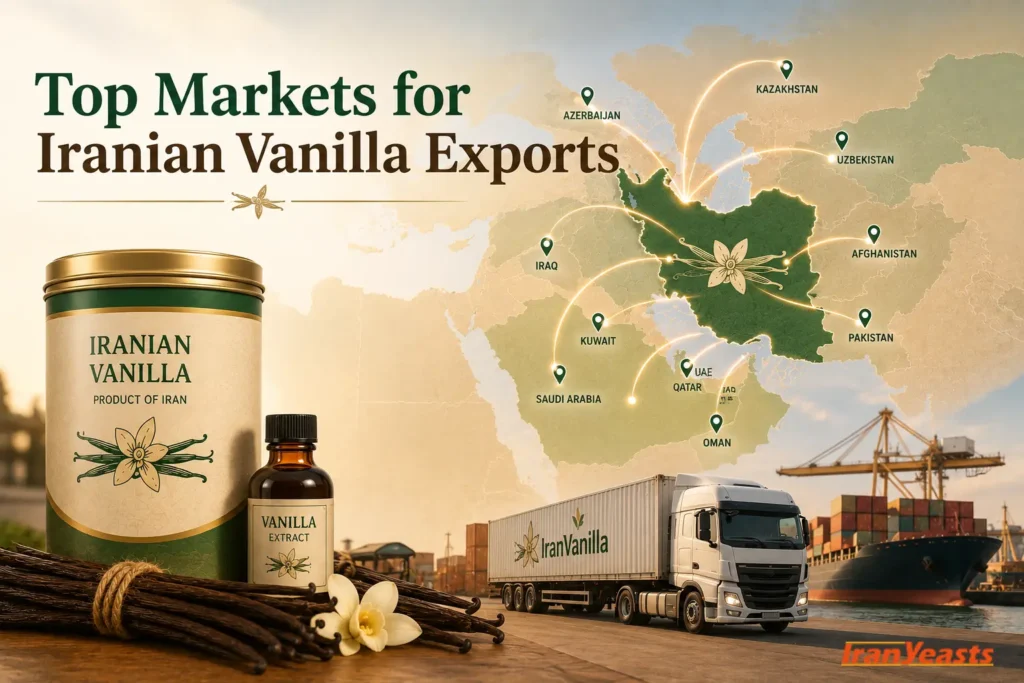
Not every market that imports vanilla is a good fit for Iranian supply. Some markets are dominated by natural vanilla buyers at premium pricing. Others require certification frameworks that differ from what Iranian producers hold. But for a specific and commercially significant set of markets, Iranian food-grade vanillin powder sits in the ideal position: competitive landed cost, the right Halal certification, and a logistics geography that no other major producing country can match.
This post maps the top markets for Iranian vanilla exports, covering what drives demand in each market, what product formats buyers in each region typically require, and what a distributor or food manufacturer entering any of these markets for the first time should understand about sourcing Iranian vanilla into that specific trade corridor.
The product range underpinning this export activity spans the full Iranian vanilla offering: food-grade vanillin powder from 98 to 99 percent purity, available from consumer sachets through to industrial bulk bags, with Halal, HACCP, and ISIRI documentation included on every shipment.
Looking to Import Iranian Instant Dry Yeast at Wholesale Scale?
Get expert guidance on product selection, packaging, export documentation, pricing, and international shipping directly from our export team.
Top Markets for Iranian Vanilla Exports: What Trade Data and Logistics Geography Show
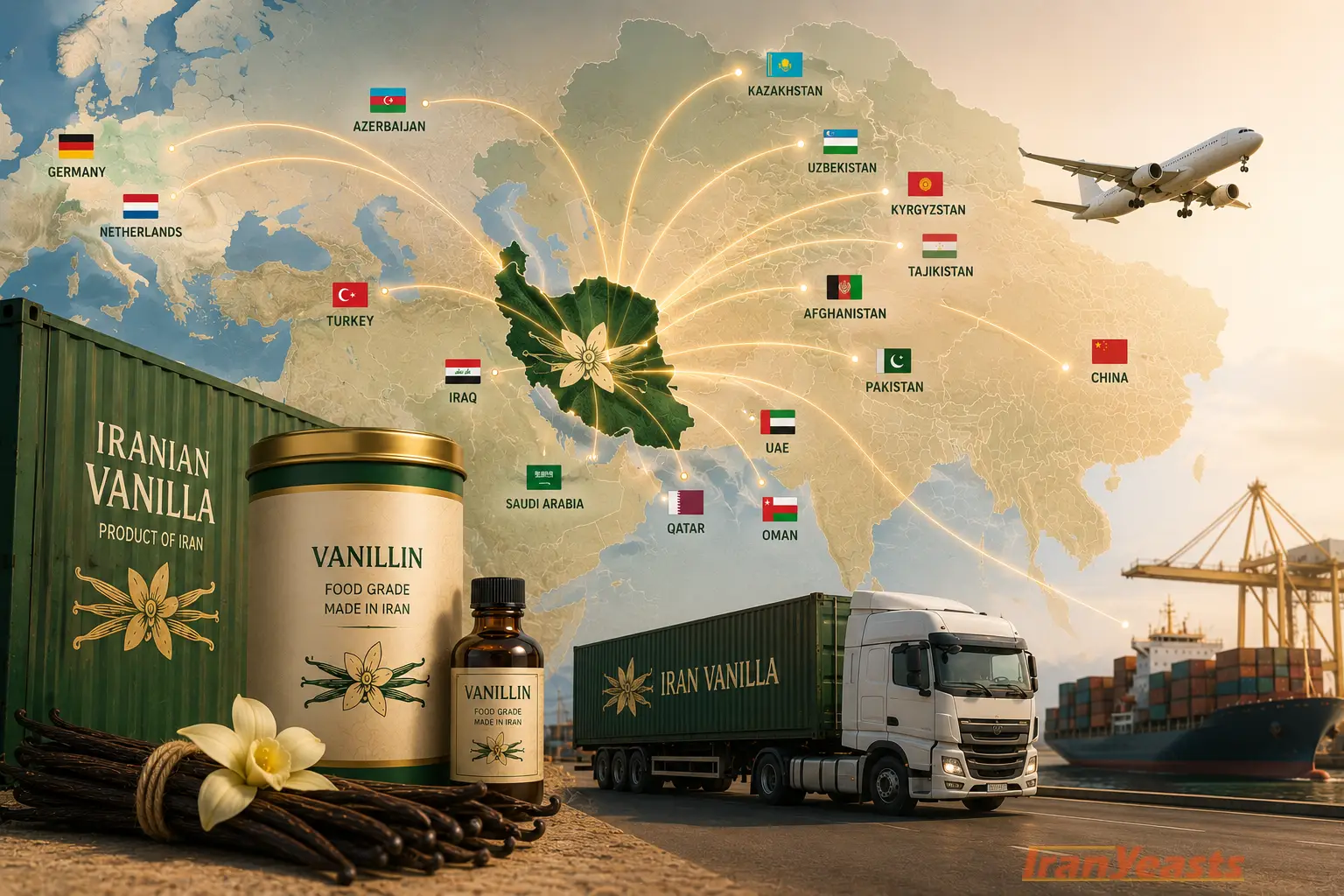
Iranian food-grade vanillin reaches buyers in 16 countries across the Middle East, Central Asia, South Asia, Europe, and Oceania. The markets below are not ranked by prestige or size in the global vanilla trade. They are ranked by the commercial reality of why Iranian supply specifically is well positioned in each one.
The common thread across all of them is geography. Iran sits at the intersection of the Gulf, Central Asia, South Asia, and the Caucasus, giving it land or short-sea access to more major food-ingredient importing markets than any other significant vanillin-producing country. That geographic position is the structural advantage that shapes every market below.
Market 1: UAE The Gulf Hub That Amplifies Iranian Vanilla's Reach Across the Region
The UAE is not just a destination market for Iranian vanilla. It is a trans-shipment hub through which product reaches Qatar, Oman, Bahrain, and beyond, as well as a re-export gateway into African and South Asian markets served by UAE-based distributors.
The Middle East and Africa vanilla extract market is estimated at USD 173.44 million in 2024, rising to USD 216.87 million by 2034, with the GCC countries representing the largest value segment within that total. The UAE specifically is one of the highest per capita vanilla consumers in the world, driven by a large expatriate population with high food spending, a premium hospitality sector, and a food distribution infrastructure that serves the surrounding region.
GCC countries import approximately 85 percent of their food needs, creating deep structural demand for food ingredient imports including vanillin. For Iranian supply, the sea route from Bandar Abbas to Jebel Ali (Dubai’s primary port) runs 3 to 5 days, a transit time that makes inventory management meaningfully more efficient than the 15 to 25 day lead time from Chinese ports.
UAE buyers split across two main product profiles. Commercial bakery and food manufacturing buyers source bulk premium vanilla in industrial bag formats for direct production use. Retail-oriented distributors and FMCG brands source wholesale small packing vanilla in consumer sachet and retail pack formats for supermarket and branded distribution.
Market 2 : Iraq: Iran's Largest Overland Trade Partner for Vanilla
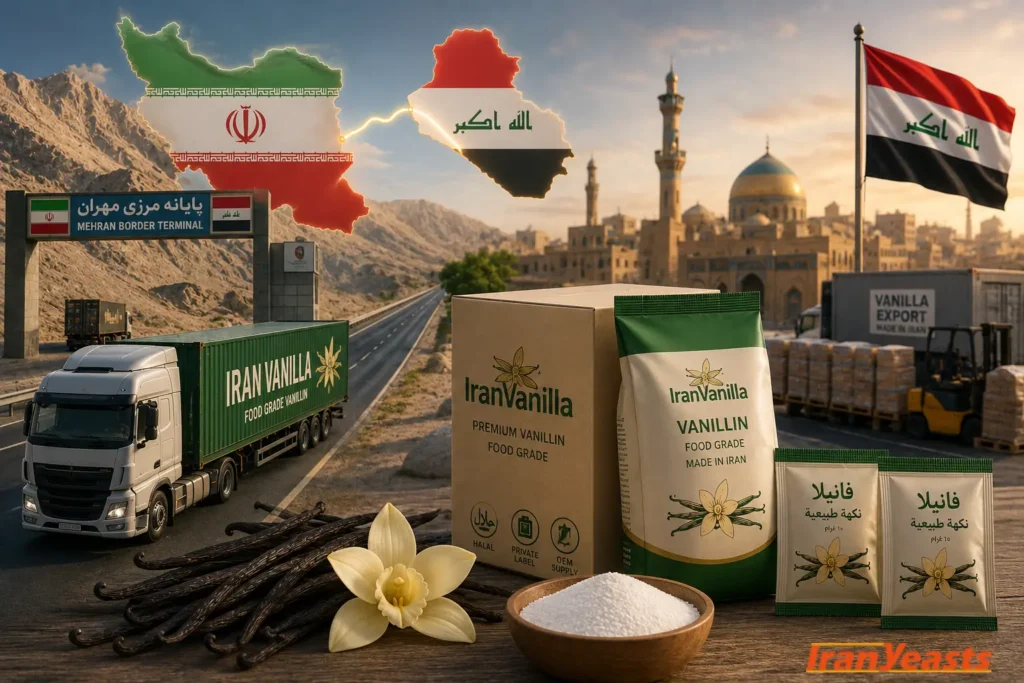
Iraq represents one of the strongest matches between Iranian vanilla supply and market demand. Several factors converge to make this the case.
Iraq shares a long land border with Iran, with established overland freight routes that reduce transit time to 5 to 10 days. Iraq is one of Iran’s largest trade partners overall, accounting for 11.5 percent of Iran’s total exports in recent years, reflecting a mature and well-developed bilateral trade relationship across food ingredients and other categories.
Iraq’s domestic bread culture is built around flatbread as a daily dietary staple. Commercial flatbread production at scale requires consistent, reliable vanillin supply for the flavoring components of enriched bread variants. Household-level demand for packaged vanilla flavoring in the 10g to 11g sachet format is among the highest in the region.
The Halal certification requirement is absolute across the Iraqi food import market. ISIRI-issued Halal certification is accepted without supplementary documentation, which removes a friction point that buyers sourcing from some other origins encounter.
Iraqi distributors building their own retail brand enter the market most effectively through bulk small packing vanilla : the OEM and private label format that allows a distributor to launch an Arabic-labeled vanilla product under their own brand name from a 500 kilogram minimum order.
Market 3 : Saudi Arabia: The Gulf's Largest Commercial Bakery Sector
Saudi Arabia is the Gulf’s most significant commercial food manufacturing market. Vision 2030’s investment in domestic food production has accelerated the growth of commercial bakery, confectionery, and dairy manufacturing, each of which requires food-grade vanillin as a regular production input.
In 2023, the Saudi government implemented enhanced food safety regulations including stricter quality control requirements for imported food ingredients. This regulatory direction increases the documentation bar for all suppliers and gives an advantage to producers who already operate to HACCP and ISO 22000 standards with full batch-level COA documentation.
Saudi Arabia’s per capita vanillin consumption in the broader MENA region data sits among the highest in the GCC, reflecting a large domestic commercial food sector and a food service industry driven by a growing hospitality and restaurant sector.
For commercial bakeries and food manufacturers in Saudi Arabia sourcing at production scale, bulk premium vanilla in vacuum-sealed industrial bags is the appropriate format, delivering the 98 to 99 percent purity specification with 24 to 36 month shelf life. For Saudi retail distributors and FMCG brands developing their own product lines, wholesale small packing vanilla and bulk small packing vanilla cover the retail and private label segments respectively.
Market 4 : Afghanistan and Pakistan: High-Volume Flatbread Markets With Direct Land Access
Afghanistan and Pakistan share two characteristics that make them structurally important for Iranian vanilla export: very high per capita bread consumption, and land border access from Iran that is faster and more cost-effective than sea freight for any competing origin.
Both markets are overwhelmingly Halal-regulated. Both have growing commercial bakery sectors serving urban populations with packaged bread and baked goods. Both have active food ingredient distributor networks that supply commercial bakeries from central import inventory rather than through factory-direct purchasing.
The dominant retail vanilla format in both markets is the 10g to 11g consumer sachet, which is the retail unit most aligned with household purchasing patterns. Commercial bakery buyers purchase in 5kg to 25kg industrial bags, typically vacuum-sealed for transit protection given variable storage conditions in these markets.
The private label segment is developing in both countries. Distributors who entered these markets reselling a Turkish or Chinese brand are increasingly evaluating whether launching their own brand through an Iranian private label arrangement makes commercial sense. The 500 kilogram MOQ available through IranYeasts makes this evaluation accessible without a prohibitive initial commitment.
Market 5 : Central Asia: Uzbekistan, Tajikistan, Turkmenistan, and Kazakhstan
Central Asian markets represent a growing and underserved opportunity for Iranian vanilla export. The region’s food manufacturing sector is expanding alongside urbanization, rising incomes, and the adoption of commercial bread and packaged food categories. Each Central Asian country has significant Muslim-majority populations for whom Halal certification is a firm purchasing requirement.
Iran’s geographic position on the eastern border provides overland access to these markets through established freight corridors that Turkish or European suppliers reach through longer, more complex routes. This transit advantage is particularly significant for perishable-adjacent products like vanillin, where shelf life consumed during transit is a real procurement concern.
The product format mix in Central Asian markets currently skews toward retail sachets for household use and mid-size retail packs for food service, with industrial bag formats emerging as commercial bakery production scales. The broader wholesale vanilla category covers the distributor-level entry point for buyers building a regional distribution position across multiple Central Asian countries from a single procurement relationship.
Multilingual packaging is increasingly expected in these markets. IranYeasts’ private label capability includes packaging in Russian (widely used across CIS markets alongside local languages), Arabic, and English, making it accessible for distributors who serve buyers across multiple language zones.
Market 6 : Germany and the United Kingdom: European Market Entry
Germany and the UK represent a different buyer profile from Gulf and Central Asian markets, and the reasons European importers choose Iranian vanilla are correspondingly different.
European buyers in these markets are typically commercial food ingredient importers or specialty food distributors rather than retail FMCG distributors. The documentation requirement is strict: HACCP certification, full COA documentation per batch, and compliance with food safety standards broadly aligned with EU Regulation 1334/2008 for flavoring substances.
In Germany specifically, food safety and ingredient quality standards have driven demand for well-documented food-grade vanillin from traceable producers with auditable quality systems. For buyers who previously sourced from Chinese manufacturers and encountered documentation gaps or quality inconsistencies, Iranian supply with full ISIRI and HACCP certification and batch-level COA has been an acceptable alternative that performs at a comparable specification level.
The UK market post-Brexit maintains its own regulatory framework for food ingredient imports, but the underlying quality and documentation requirements align closely with EU standards for food-grade vanillin.
European buyers in these markets are more likely to be interested in premium tin packaging formats for the specialty food retail and hospitality supply channels they serve. Wholesale tin packaging vanilla in the 50g to 250g range addresses the gourmet retail, duty-free, and hospitality supply buyer profile that distributes into premium food retail channels across Germany and the UK.
Market 7 : Qatar, Oman, Kuwait, and Bahrain: The GCC Completers
Qatar, Oman, Kuwait, and Bahrain are smaller GCC markets by population but maintain high per capita food spending and significant food import dependency. All four share the characteristic of importing nearly all food ingredients including vanillin from external sources.
Each of these markets applies Halal certification requirements consistent with GCC standards. Each is reachable from Bandar Abbas by sea in 4 to 7 days depending on routing. Each has a hospitality sector driven by international tourism, business travel, and premium residential food service.
The product format requirements in these markets split between commercial bakery industrial bags, retail consumer sachets for supermarket distribution, and premium tin formats for the hospitality and specialty food channels that serve high-income consumer segments.
Qatar’s position as a regional hub for international events and hospitality has increased demand for premium vanilla presentations across hotel, restaurant, and catering supply networks. Wholesale tin packaging vanilla in gift-ready and premium hospitality formats is particularly well aligned with this buyer segment, which includes hotel purchasing managers and premium catering suppliers who specify product presentation alongside product specification.
Market 8 : India and the Maldives: South Asian Growth Markets
India and the Maldives represent two distinct ends of the South Asian vanilla import profile.
India’s food manufacturing sector is large and growing, with commercial bakery, confectionery, and dairy production all expanding. Vanilla flavoring demand is significant in the processed food sector. However, India’s import duty structure for synthetic vanillin (HS Code 2912.41) can be significant at standard rates, making total landed cost calculation essential before entering this market. Buyers should verify the current applicable rate with a licensed Indian customs broker before finalizing procurement economics.
The Maldives is a different buyer profile entirely. The island nation’s hospitality-driven economy creates strong demand for premium food ingredients in hotel kitchens, resort food service, and specialty retail. Premium presentation formats align with the market’s hospitality focus. Wholesale tin packaging vanilla and small packing retail formats in premium packaging work well for the Maldivian hospitality supply channel.
Both markets are reached by sea from Bandar Abbas, with transit times of 7 to 14 days depending on routing and destination port.
What Product Format Each Market Typically Requires: A Quick Reference
Market | Primary Buyer Type | Recommended Format | Landing Page |
UAE | Industrial food manufacturers | Industrial bulk bags, vacuum-sealed | |
UAE | FMCG and retail distributors | Consumer sachets, retail packs | |
Iraq | Commercial bakeries | Industrial bags, sachet formats | |
Iraq | Private label distributors | Custom packaging, OEM | |
Saudi Arabia | Food manufacturers | Industrial bulk bags | |
Saudi Arabia | Retail brands | Consumer sachets, private label | |
Afghanistan / Pakistan | Bakeries and distributors | Industrial bags, sachet formats | |
Central Asia | Food distributors | Retail packs, mid-size formats | |
Germany / UK | Specialty food importers | Premium tins, mid-size retail | |
Qatar / Oman / Hospitality | Hotel and premium food service | Premium tins, gift formats |
Final Thoughts
The top markets for Iranian vanilla exports are not the top markets in the global vanilla trade overall. They are the markets where Iranian supply specifically has structural advantages : geographic proximity, Halal certification alignment, competitive landed cost, and private label accessibility at low MOQ : that make Iran the rational sourcing choice for buyers operating in those corridors.
The GCC, Iraq, Afghanistan, Pakistan, and Central Asia represent the core current opportunity. Germany, the UK, and premium hospitality markets represent the emerging opportunity where documentation quality and product presentation are the deciding factors rather than transit time. A distributor who understands which market they are serving, and which factors are decisive for buyers in that market, is the one positioned to make Iranian vanilla a consistent and growing part of their business.
References
- Fact.MR. (2024). Vanilla extract industry analysis in Middle East and Africa: Size, share and forecast 2024–2034. Fact.MR Market Intelligence.
- BestFoodImporters. (2025, August 19). Food import trends and food importers in the Middle East in 2024–2025. BestFoodImporters Trade Intelligence.
- Business Research Insights. (2026, April 14). Natural vanillin market size, share, analysis and forecast 2026–2035. Business Research Insights.
- orld's Top Exports. (2026, May 29). Iran's top exports 2025. World's Top Exports Trade Data.
- Mordor Intelligence. (2026, January 15). Vanillin market size, share and forecast 2026–2031. Mordor Intelligence Research.
Frequently Asked Questions
Find answers to common questions about Iranian instant dry yeast, including certifications, bulk orders, private labeling, export logistics, and delivery worldwide
Which countries import the most Iranian vanilla?
IranYeasts currently exports to buyers in 16 countries. The highest-volume markets are concentrated in the Gulf states (UAE, Qatar, Oman), Iraq, Afghanistan, Pakistan, and Central Asian markets including Uzbekistan and Tajikistan. European buyers in Germany and the UK represent a growing segment. Full product and market detail is available at the Iranian vanilla product page.
Is Iranian vanilla available in bulk for food manufacturers?
Yes. Bulk premium vanilla in industrial vacuum-sealed bags from 10kg to 25kg is available for food manufacturers requiring direct production input at 98 to 99 percent purity with full batch COA documentation.
What format does the GCC retail market require?
GCC retail and FMCG distributors typically source consumer sachets from 10g to 100g and retail packs up to 500g. Wholesale small packing vanilla covers these formats with full Halal certification and Arabic packaging options.
Is tin packaging vanilla available for hospitality and premium retail buyers?
Yes. Wholesale tin packaging vanilla covers premium tin formats in 50g to 500g sizes, suited for gourmet food stores, hotel gift shops, duty-free retail, and premium FMCG distribution.
Can distributors in these markets order private label vanilla?
Yes, from a 500 kilogram minimum order. Bulk small packing vanilla covers the OEM and private label production service with custom packaging, multilingual labeling, and full Halal certification on all private label runs.
What is the typical transit time from Iran to Gulf markets?
Sea freight from Bandar Abbas to Gulf ports (UAE, Qatar, Oman) runs 3 to 5 days. Overland freight to Iraq takes 5 to 10 days. Land freight to Afghanistan and Pakistan runs in a similar window.
Does Iranian vanillin carry the right certification for Middle Eastern markets?
Yes. ISIRI-issued Halal certification is accepted across all GCC markets, Iraq, Pakistan, Afghanistan, and Central Asian markets without supplementary documentation. HACCP compliance documentation is also provided with every shipment.
Where can I see the full wholesale vanilla product range?
The complete wholesale offering covering all formats, certifications, MOQ, and pricing structure is available at the wholesale vanilla hub page.