

Four products sit on the same bakery shelf and all four make dough rise. A distributor stocking them gets asked which one a customer actually needs, and the honest answer is that the question is usually backwards. The right starting point is the product being baked and the time available, not the leavening agent.
Two of the four are living cultures that work slowly and build flavor as they go. Two are chemical reactions that work fast and build none. Mixing them up produces bread that does not rise, cake that tastes of soap, or dough that is ready hours after the oven was.
This guide sets out how each one works, the dosage each needs, which products suit which agent, whether you can substitute between them, and what the differences mean for stock and storage.
Key Takeaways
- Yeast and sourdough starter are biological, slow and flavor-building. Baking soda and baking powder are chemical, fast and flavor-neutral.
- Baking soda needs an acid already in the recipe. Baking powder carries its own acid.
- Chemical leaveners are dosed far higher than yeast: about 3 to 5 percent baking powder in cakes against 0.6 to 1.5 percent instant dry yeast in bread.
- Swaps within the same group usually work with adjustment. Swaps across the biological and chemical line usually fail.
- For distributors, yeast needs the most storage care and baking soda the least.
Looking to Source Instant Dry Yeast or Baking Powder in Bulk?
Get expert guidance on product selection, packaging, certification documents, export paperwork, pricing, and lead times for bulk bakery ingredient orders.
Yeast vs Baking Powder vs Baking Soda vs Sourdough Starter: The Core Difference
The core difference is that yeast and sourdough starter are living cultures, while baking soda and baking powder are chemical reactions. Iranian instant dry yeast sits firmly in the biological half of the leavening world. It is a living organism that consumes sugars in the dough and releases carbon dioxide over a period of time. That gas inflates the gluten network and the bread rises.
Sourdough starter is also biological, but it is a mixed culture rather than a single cultivated strain. Baking soda and baking powder are neither living nor cultured. They are chemical reactions that release carbon dioxide on contact with moisture, acid or heat, and they are finished within minutes.
Everything that follows comes from that one division. Biological leavening is slow, flavor-building and temperature-sensitive. Chemical leavening is fast, flavor-neutral and indifferent to how warm the bakery is.
| Leavening agent | Type | Gas release | Builds flavor |
|---|---|---|---|
| Instant dry yeast | Biological, single cultured organism | Over 1 to 18 hours | Yes |
| Sourdough starter | Biological, mixed wild culture | Over 4 to 24 hours | Yes, strongly |
| Baking soda | Chemical, single compound | Immediate on contact with acid | No |
| Baking powder | Chemical, pre-blended system | Immediate, then again in the oven | No |
If you are choosing between yeast formats rather than between leavening types, our guide to the main types of commercial yeast covers fresh, active dry and instant.
How Do Yeast, Baking Powder, Baking Soda and Sourdough Starter Work?
The four agents produce the same gas by entirely different routes. Understanding the route explains why the timing, the dosage and the failure modes differ so sharply between them.
Baking Soda
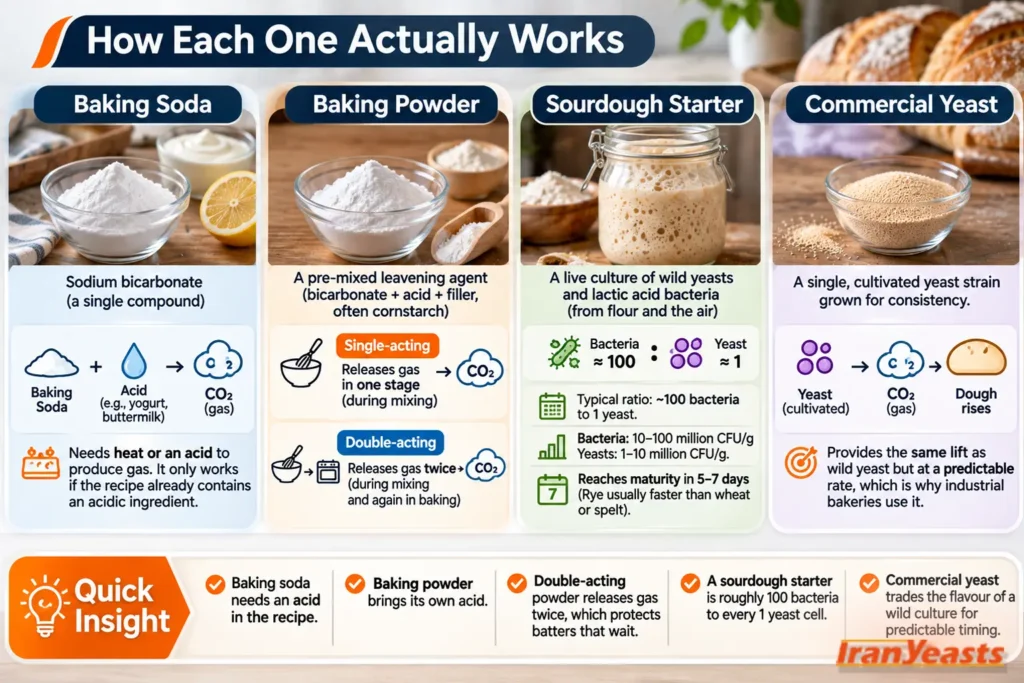
Baking soda is sodium bicarbonate, a single compound. The FDA lists it under 21 CFR 184.1736 as generally recognized as safe with no limitation other than current good manufacturing practice, and gives its CAS number as 144-55-8.
It needs heat or an acid to produce gas, and it carries no acid of its own. That is the critical point for formulation: baking soda only works if the recipe already contains something acidic such as yogurt, buttermilk, honey, molasses or cocoa. Without an acid partner it leaves an alkaline residue and an unpleasant taste rather than a risen crumb.
Baking Powder
Baking powder solves that problem by packaging the acid in advance. It contains a bicarbonate, a leavening acid and a filler, most often cornstarch. Because the acid is already present, baking powder works in formulas that contain no acidic ingredient at all.
Single-acting powder releases its gas in one continuous stage, at a rate set by the acid used. Double-acting powder releases gas twice: once during mixing and again during baking. The second release is what protects a batter that sits before it reaches the oven.
Sourdough Starter
A sourdough starter is a mixed culture of wild yeasts and lactic acid bacteria drawn from the flour itself and from the surrounding air. Research published in Microorganisms puts the bacteria-to-yeast ratio at typically 100 to 1, with bacteria at 10 million to 100 million colony-forming units per gram and yeasts at 1 million to 10 million.
The yeasts provide the lift and the bacteria provide the acidity that gives sourdough its flavor and its keeping quality. That same study notes most starters reach maturity between days 5 and 7, and rye tends to mature faster than wheat or spelt.
Commercial Yeast
Commercial yeast is a single cultivated strain grown for consistency. It does the same lifting job as the wild yeasts in a starter, but at a predictable rate that does not depend on what was living in the flour. That predictability is the entire reason industrial bakeries use it.
Quick insight
- Baking soda needs an acid in the recipe. Baking powder brings its own.
- Double-acting powder releases gas twice, which protects batters that wait.
- A sourdough starter is roughly 100 bacteria to every 1 yeast cell.
- Commercial yeast trades the flavor of a wild culture for predictable timing.
How Much of Each Leavening Agent Should You Use?
All four are dosed as a percentage of flour weight, and the ranges are not remotely similar. Chemical leaveners are used at several times the rate of yeast, because they produce their gas once and then stop, while yeast keeps working for as long as fermentation continues. The chemical leavener figures below are the commercial ranges published by BAKERpedia.
| Leavening agent | Typical dose on flour weight | Notes |
|---|---|---|
| Instant dry yeast | 0.6 to 1.5 percent | Set by the fermentation schedule, not the flour |
| Baking soda, cookies | 0.5 to 1 percent | Needs an acid present in the formula |
| Baking soda, acid batters | 2 to 3 percent | Brownies and gingerbread sit in this range |
| Baking soda, soda-acid biscuits | About 3 percent | BAKERpedia lists the same level for white bread |
| Baking powder, cakes | 3 to 5 percent | The most common commercial range |
| Baking powder, scones | Over 6 percent | Among the highest doses in normal baking |
Overdosing a chemical leavener is far less forgiving than overdosing yeast. Too much baking soda produces yellow or green discoloration, a strong chemical flavor, and a soapy taste, especially in formulas made with buttermilk. Too much baking powder causes bitterness, large bubbles and surface blistering. Too little of either gives a tough, dense crumb.
Quick tip
Chemical leaveners have a much narrower working window than yeast. With yeast you can often correct a slightly wrong dose by adjusting fermentation time. With baking soda or baking powder, the reaction has already finished by the time you notice, and the batch cannot be rescued.
Our yeast dosage guide sets out the yeast side of this in full, including how the schedule and the dough temperature move the number.
Can You Substitute One Leavening Agent for Another?
Mostly no, and the cases where it works are narrow. These are not four versions of the same thing. They operate on different timescales and produce different textures, so swapping one for another changes the product rather than just the process.
| Substitution | Works? | What actually happens |
|---|---|---|
| Baking powder for yeast in bread | No | No fermentation, no gluten development over time, dense crumb and no bread flavor |
| Yeast for baking powder in cake | No | Cake batter has no gluten structure to hold gas through a long rise |
| Baking soda for baking powder | Only with added acid | Soda alone leaves an alkaline residue and a chemical taste |
| Baking powder for baking soda | Usually yes, with adjustment | Powder is weaker per gram because it is diluted with acid and filler |
| Sourdough starter for commercial yeast | Yes, with a longer schedule | Expect several more hours of fermentation and a tangier result |
| Commercial yeast for sourdough starter | Yes for lift, no for flavor | You get the rise but lose the acidity that defines sourdough |
The pattern is that substitutions within a category usually work with adjustment, and substitutions across the biological and chemical line usually do not. A soda bread and a yeasted loaf are different products that happen to share a shape.
Even the swap that works best, a starter in place of commercial yeast, takes longer for a measurable reason. A 2021 review in Microorganisms reports that mature sourdough typically holds about 100 lactic acid bacteria for every yeast cell, so far fewer leavening organisms are doing the lifting.
This mirrors a point we make about a different pairing. Bread improver and yeast are also routinely treated as interchangeable and also are not, for the same underlying reason: our comparison of bread improver and yeast explains why one cannot do the other’s job.
Which Leavening Agent Suits Which Baked Product?
Most bakeries end up stocking more than one, because the product range decides the answer rather than a preference. The division follows gluten: if the product needs a developed gluten structure to hold gas over time, it needs biological leavening. If it does not, chemical leavening is faster and more consistent.
| Product | Usual agent | Why |
|---|---|---|
| Pan bread and sandwich loaves | Instant dry yeast | Needs sustained gas over a developed gluten network |
| Flatbreads such as naan and lavash | Instant dry yeast | Short fermentation still needs biological lift and flavor |
| Artisan and long-ferment loaves | Sourdough starter | Acidity, keeping quality and flavor depth |
| Cakes and sponges | Baking powder | No gluten structure to sustain a long rise |
| Cookies and biscuits | Baking soda | Fast release, and the formula usually has an acid |
| Muffins and quick breads | Baking powder | Mixed and baked immediately, no proofing step |
| Soda breads | Baking soda | Traditional formula built around buttermilk acidity |
How Do Storage and Shelf Life Differ for Distributors?
For a distributor the four products behave very differently in a warehouse, and this is the part most comparison articles leave out entirely. Shelf life, storage sensitivity and reorder rhythm are not alike across the group.
Yeast is the most demanding. It is a living product, it loses activity in heat and humidity, and it carries a meaningful expiry. Baking powder is chemically stable but loses potency slowly once exposed to moisture, because the acid and the base are sitting together in the same container. Baking soda is the most forgiving of the four and keeps almost indefinitely if sealed. A sourdough starter is not a stocked product at all, since the bakery maintains its own.
| Agent | Storage sensitivity | Stocking implication |
|---|---|---|
| Instant dry yeast | High, needs cool and dry conditions | Rotate stock, watch expiry, control the cold chain in summer |
| Baking powder | Moderate, moisture degrades it in the pack | Keep sealed, order in sizes the bakery uses quickly |
| Baking soda | Low, very stable when sealed | Can be held in larger quantities with less risk |
| Sourdough starter | Not applicable | Maintained in the bakery, not purchased |
That difference matters when a customer asks you to consolidate an order. Yeast and baking powder should be sized to turnover. Baking soda can be bought ahead. Our guide to storing bulk dry yeast covers the temperature and humidity limits in detail, and buyers sourcing yeast and baking powder together can see the available specifications from Irany Yeasts.
Author's Suggestion
When a bakery asks for "something to make it rise," ask two questions first: what are you baking, and how long does the dough have before it goes in the oven? Those two answers point to the right leavening agent faster than any product sheet, and they prevent the classic mistake of a loaf made with baking powder that never tastes like bread.
Conclusion
The four leavening agents split cleanly in two. Yeast and sourdough starter are biological, slow and flavor-building, and they suit products with a gluten structure that can hold gas over time. Baking soda and baking powder are chemical, fast and flavor-neutral, and they suit batters that go straight to the oven.
Substitutions within each half usually work with an adjustment. Substitutions across the line usually produce a different product rather than the same one by another route. For distributors the practical difference is storage, since yeast demands the most care and baking soda the least. Buyers sourcing more than one are welcome to request specifications.
References
- BAKERpedia. (n.d.). Baking powder. Retrieved November 10, 2026, from https://bakerpedia.com/ingredients/baking-powder/
- BAKERpedia. (n.d.). Baking soda. Retrieved November 10, 2026, from https://bakerpedia.com/ingredients/baking-soda/
- BAKERpedia. (n.d.). Sourdough starter. Retrieved November 10, 2026, from https://bakerpedia.com/ingredients/sourdough-starter/
- Lau, S. W., Chong, A. Q., Chin, N. L., Talib, R. A., & Kadir Basha, R. (2021). Sourdough microbiome comparison and benefits. Microorganisms, 9(7), 1355. https://doi.org/10.3390/microorganisms9071355
- U.S. Food and Drug Administration. (n.d.). 21 CFR 184.1736: Sodium bicarbonate. Electronic Code of Federal Regulations. https://www.ecfr.gov/current/title-21/chapter-I/subchapter-B/part-184/subpart-B/section-184.1736
Frequently Asked Questions
The questions below come up repeatedly from bakery production teams and from distributors stocking more than one leavening agent. Each answer leads with the direct rule, then the condition it depends on.
What is the difference between yeast and baking powder?
Yeast is a living organism that releases carbon dioxide slowly over one to eighteen hours and builds flavor as it works. Baking powder is a chemical system that releases gas within minutes of mixing and adds no flavor. Yeast suits breads with a developed gluten structure, baking powder suits cakes and quick breads that go straight into the oven.
Can I use baking powder instead of yeast in bread?
No. Baking powder releases all its gas within minutes, so there is no fermentation period and no gluten development over time. The result is dense, closer to a soda bread than a loaf, and it lacks the flavor that fermentation produces. The two are not interchangeable in bread.
What is the difference between baking soda and baking powder?
Baking soda is sodium bicarbonate alone and needs an acid already present in the recipe to work. Baking powder contains a bicarbonate, a leavening acid and a filler, so it works in formulas with no acidic ingredient. Baking powder is also weaker per gram, because it is diluted with the acid and the filler.
How much baking powder should I use per kg of flour?
For cakes, 3 to 5 percent of flour weight is the usual commercial range, which is 30 to 50 g per kg of flour. Scones can take over 6 percent. Too much causes bitterness, large bubbles and surface blistering, and too little gives a tough, dense crumb.
How much baking soda should I use?
It depends on the product. Cookies typically use 0.5 to 1 percent of flour weight, acid batters such as brownies and gingerbread use 2 to 3 percent, and soda-acid biscuits use about 3 percent. Baking soda only works where the formula already contains an acid.
Is sourdough starter stronger than commercial yeast?
No, it is slower. A starter is a mixed culture with roughly 100 lactic acid bacteria to every yeast cell, so it carries far fewer leavening organisms per gram than commercial yeast. Expect several additional hours of fermentation, with the trade being greater flavor depth and better keeping quality.
Can I substitute baking powder for baking soda?
Usually yes, but you need more of it, because baking powder is diluted with its acid and filler. The reverse substitution does not work without adding an acid to the formula, since baking soda alone leaves an alkaline residue and a chemical taste.