

Ask ten bakers how much instant dry yeast belongs in 100 kg of flour and you will get ten answers. Most of them are correct, because the right dose depends on the product, the fermentation schedule and the temperature of the bakery floor.
The difficulty is that almost nothing published on this question is written for production. Online calculators convert teaspoons for single home loaves. Forum threads argue about pizza. Neither helps a production manager who needs a repeatable number for a 100 kg mix, or a distributor fielding the same question from twenty bakery customers.
This guide sets out the working ranges by product type, the arithmetic that lets you scale them, the conversions between fresh, active dry and instant forms, and the temperature and sugar adjustments that decide whether your dose holds in practice.
Looking to Import Iranian Premium Yeast at Wholesale Scale?
Get expert guidance on product selection, packaging, certification documents, export paperwork, pricing, and international shipping directly from our export team.
Iranian Yeast Dosage Rates Per 100 kg of Flour
There is no single published standard for instant dry yeast dosage, and any supplier who gives you one number for every product is guessing. What exists instead is a set of working ranges that experienced bakeries converge on, expressed as a percentage of flour weight. Iranian yeast is dosed on the same basis as any other instant dry yeast, because dosage is set by the product and the schedule rather than by the origin of the yeast. As a reference point, Lesaffre puts a straightforward conversion at roughly 10 g of instant dry yeast per kilogram of flour, which is 1 percent of flour weight, while noting that it is a starting point rather than a fixed rule.
The table below gives the ranges most commonly used as starting points in commercial production. Treat them as a first mix to calibrate against, not as a specification. Every figure assumes instant dry yeast added directly to the flour, with dosage adjusted afterwards based on the proof time you actually observe.
| Product and schedule | Instant dry yeast (% of flour) | Grams per 100 kg flour | Typical bulk ferment |
|---|---|---|---|
| Pan and sandwich bread, no-time dough | 1.0 to 1.5% | 1,000 to 1,500 g | 0 to 30 min |
| Flatbread (naan, lavash, barbari), fast turnaround | 0.8 to 1.2% | 800 to 1,200 g | 30 to 60 min |
| Lean bread, straight dough | 0.6 to 1.0% | 600 to 1,000 g | 1.5 to 2 h |
| Pizza dough, same day | 0.3 to 0.6% | 300 to 600 g | 4 to 8 h |
| Lean bread, long or retarded ferment | 0.1 to 0.3% | 100 to 300 g | 12 to 18 h |
| Pizza dough, 24 to 72 h cold ferment | 0.05 to 0.2% | 50 to 200 g | 24 to 72 h at 4 C |
| Sweet and enriched dough, osmotolerant grade | 1.0 to 3.0% | 1,000 to 3,000 g | 1 to 2 h |
The spread across that table is thirty-fold, from 50 g to 3,000 g per 100 kg of flour, which is why a single recommended dose is meaningless without the schedule attached. If you are still deciding which form of yeast to buy before you work out the dose, our guide to the main types of commercial yeast covers the trade-offs between fresh, active dry and instant.
Quick insight
- Lean bread on a straight dough sits at 600 to 1,000 g per 100 kg of flour.
- A 24 to 72 hour cold ferment drops as low as 50 to 200 g.
- Sweet dough on an osmotolerant grade runs 1,000 to 3,000 g.
- The fermentation schedule decides the number, not the brand of yeast.
Why Baker’s Percentage Is the Dosage Figure That Scales
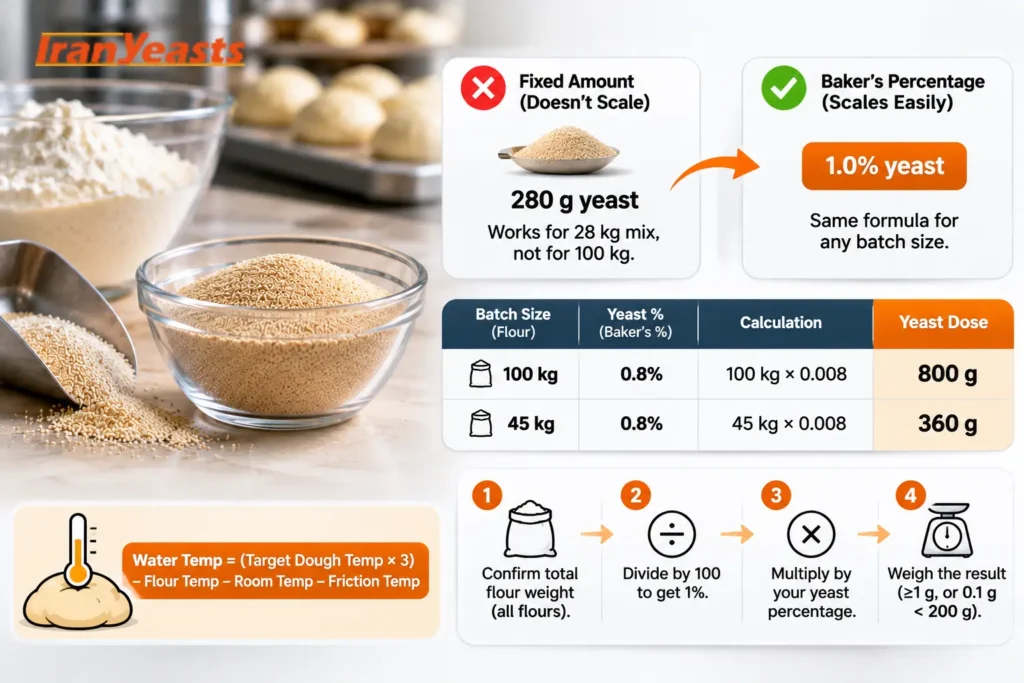
Baker’s percentage expresses every ingredient as a percentage of total flour weight, with flour itself always set at 100 percent. It is the only way to record a yeast dose that survives a change in batch size. A recipe written as “280 g of yeast” breaks the moment you move from a 28 kg mix to a 100 kg mix. A recipe written as “1.0 percent yeast” does not.
The arithmetic is deliberately simple, which is the point. It also means the same formula sheet works for a test bake and for full production, and it travels between bakeries without translation. Dough temperature is the companion variable, and the professional method for controlling it is the desired dough temperature calculation, which multiplies your target dough temperature by three for a straight dough and subtracts the flour, room and friction temperatures to give the water temperature you need.
To convert a baker’s percentage into a weighed dose for any batch size:
- Confirm the total flour weight in the mix, counting all flours but not water, salt or yeast.
- Divide the flour weight in kilograms by 100 to get the weight of one percent.
- Multiply that figure by your target yeast percentage.
- Weigh the result on a scale accurate to at least 1 g, and to 0.1 g for doses under 200 g.
Worked through on a 100 kg mix at 0.8 percent: one percent of 100 kg is 1 kg, so 0.8 percent is 800 g of instant dry yeast. On a 45 kg mix at the same 0.8 percent, one percent is 450 g, so the dose is 360 g. The percentage stays fixed, the weighed amount moves with the batch.
Converting Between Fresh, Active Dry and Instant Dry Yeast
Most dosage confusion comes from recipes written for a different form of yeast. Fresh yeast carries roughly 70 percent water, while instant dry yeast is dried to around 5 percent moisture, so the same leavening power arrives in a much smaller weight. Converting between forms is the single most common reason a dose comes out wrong on the first mix.
| Converting from | Converting to | Multiply weight by | Practical note |
|---|---|---|---|
| Fresh (compressed) | Instant dry | 0.33 (divide by 3) | 30 g fresh is about 10 g instant |
| Instant dry | Fresh (compressed) | 3.0 | 800 g instant is about 2,400 g fresh |
| Active dry | Instant dry | 1.0 as a starting point | Some makers advise cutting instant by 25% |
| Instant dry | Active dry | 1.0 as a starting point | Allow 15 to 20 min extra proof time |
The fresh to instant ratio of three to one is the figure Lesaffre publishes and the one most widely used in industry. The active dry relationship is less settled: King Arthur Baking treats active dry and instant as interchangeable one to one, with extra rise time allowed for active dry, while several manufacturers recommend reducing the instant dose by about a quarter. Run a single test mix rather than assuming either. Our full comparison of instant dry yeast and active dry yeast goes through the handling differences behind that gap.
How Dough Temperature and Fermentation Time Shift the Dose
Yeast dosage and dough temperature are two settings on the same dial. Warmer dough ferments faster at any given dose, which means a bakery that does not control dough temperature will chase its yeast percentage up in winter and down in summer, and never settle on a stable number. Fixing the temperature first makes the dose repeatable.
The figures worth holding on to are narrow. Wheat doughs should generally finish mixing between 24 C and 26 C (75 F to 78 F). Yeast works across roughly 21 C to 38 C (70 F to 100 F), with peak growth in the mid 30s C, although fermenting that warm costs flavour because the organic acids that build taste need cooler conditions. Water above about 59 C (139 F) kills yeast outright, which is why hot tap water is never a shortcut for a slow winter dough.
| Situation | What happens to fermentation | Dosage response |
|---|---|---|
| Dough finishes mix below 22 C | Proof times run long and uneven | Correct water temperature first, raise dose only if the schedule is fixed |
| Dough finishes mix above 28 C | Over-proofing, weak structure, yeasty aroma | Lower water temperature, then cut the dose by 10 to 20% |
| Bakery ambient swings season to season | Same dose gives different proof times | Recalculate water temperature monthly, hold the percentage fixed |
| Schedule lengthened (retard or cold ferment) | Much more total fermentation available | Cut the dose sharply, often to a quarter or less |
When proof times drift without an obvious cause, dosage is usually the symptom rather than the illness. Our guide to common yeast problems in baking works through the other variables worth eliminating before you change the yeast percentage.
Quick tip
Correct the water temperature before you touch the yeast percentage. A dough finishing above 28 C will over-proof on a dose that works perfectly at 25 C, and raising or cutting yeast to compensate just hides the real variable.
High-Sugar Doughs: Where Standard Dosage Stops Working
Sugar is not simply yeast food. Past a certain level it draws water out of the yeast cell and slows fermentation, which is why sweet doughs behave so differently from lean ones. Raising the yeast percentage is the instinctive response, and it is the wrong one past a point, because the problem is osmotic stress rather than cell count.
Research published in Foods in 2022 measured this directly. Using compressed yeast at 8 percent of flour dry matter, carbon dioxide production over three hours at 30 C rose when a little sugar was added and then fell steadily as sugar climbed further.
| Sucrose (% of flour dry matter) | Total CO2 after 3 h at 30 C |
|---|---|
| 0% | 107.9 mL |
| 7% | 203.7 mL |
| 14% | 157.7 mL |
| 21% | 94.3 mL |
At 21 percent sucrose the dough produced less gas than dough with no added sugar at all, and the finished products were measurably lower in height. The practical threshold most formulators work to is around 5 percent sugar on flour weight, above which an osmotolerant grade is the correct answer rather than more standard yeast. Osmotolerant yeast is manufactured with osmoprotectant salts added at roughly 0.3 to 1.0 percent and is typically dosed at 1 to 3 percent in baker’s percentage, performing in sugar levels as high as 25 percent.
If your range includes both lean bread and sweet buns, you are running two different yeast specifications, not one dose with two percentages. Buyers sourcing both grades together can see the available specifications from Iran yeast and match the osmotolerant grade to the enriched lines while keeping the standard grade for everything else.
Quick insight
- Above roughly 5 percent sugar on flour weight, standard yeast slows down.
- Carbon dioxide output peaked at 7 percent sucrose and fell by more than half at 21 percent.
- Adding more standard yeast does not solve osmotic stress.
- Switch to an osmotolerant grade dosed at 1 to 3 percent instead.
Scaling a Test Bake to a 100 kg Production Batch
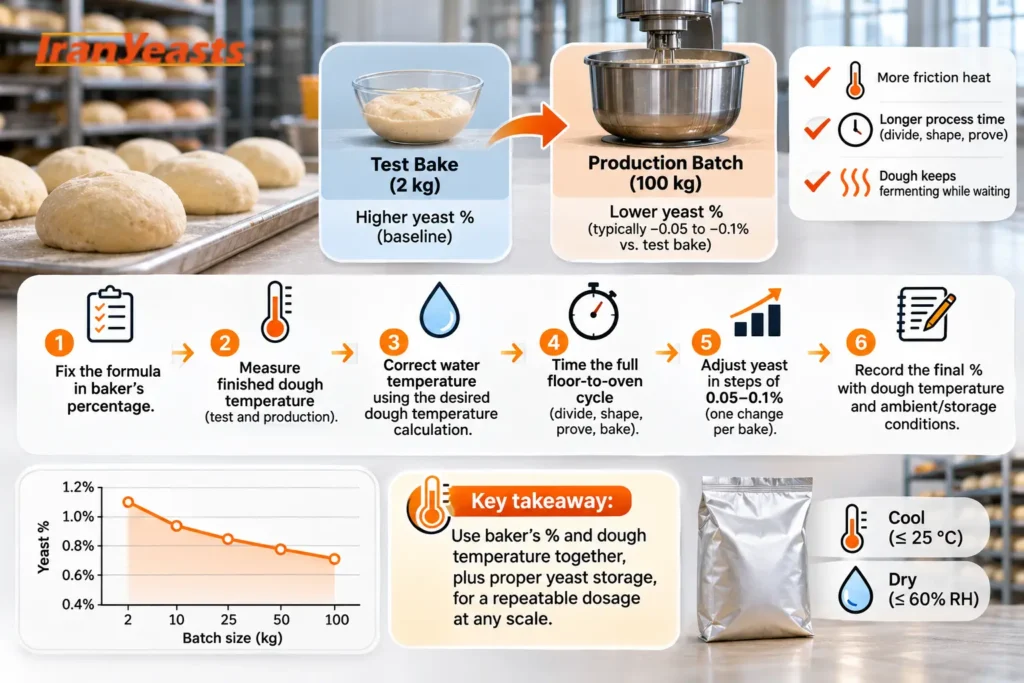
A dose that works in a 2 kg test mix rarely transfers untouched to 100 kg. Larger mixes generate more friction heat, hold that heat longer, and take longer to divide and shape, which means the dough carries on fermenting while it waits. The percentage usually needs to come down as the batch goes up, not stay level.
A reliable scaling sequence:
- Fix the formula in baker’s percentage, never in grams, before scaling anything.
- Measure the finished dough temperature on the test mix and on the production mix, and expect the production figure to run warmer.
- Correct the production water temperature using the desired dough temperature calculation before touching the yeast.
- Time the full floor-to-oven cycle at scale, including dividing, shaping and any queue at the prover.
- Adjust the yeast percentage in steps of 0.05 to 0.1 percent, changing one variable per bake.
- Record the final percentage against the dough temperature and the ambient conditions it was validated in.
That last step matters more than it looks. A yeast percentage recorded without the dough temperature it was validated at is an incomplete instruction, and the next person to run the line will not be able to reproduce it. Storage conditions belong in the same record, since yeast held badly will not perform at its stated dose. Our guide to storing bulk dry yeast covers the temperature and humidity limits that keep a validated dose valid.
Dosage Problems and How to Diagnose Them
Most dosage complaints trace back to one of six causes, and almost none of them are solved by adding more yeast. Work through the symptom first, because the correct fix is frequently a temperature or handling change rather than a formula change.
| Symptom | Likely cause | What to do |
|---|---|---|
| Dough over-proofs or collapses before baking | Dose too high, or dough finishing mix too warm | Correct water temperature, then cut the dose 10 to 20% |
| Proof is slow or never completes | Dose too low, dough too cold, or yeast activity reduced | Run a proof test on the yeast, recalculate water temperature |
| Strong yeasty aroma or aftertaste | Excess yeast relative to the fermentation time | Reduce the dose and lengthen bulk fermentation |
| Results vary batch to batch | Yeast scooped by volume rather than weighed | Weigh on a calibrated scale, to 0.1 g under 200 g |
| Sweet dough rises then stalls | Osmotic stress on a non-osmotolerant yeast | Switch to an osmotolerant grade at 1 to 3% |
| Same formula slow in winter, fast in summer | Uncontrolled ambient and water temperature | Recalculate water temperature seasonally, hold the dose |
One cause deserves separating from the rest. If a dose that worked for months begins under-performing with no change in temperature or method, the yeast itself may have lost activity, which is a different question from how much to use. The distinction between yeast shelf life and the printed expiration date explains how to test for it before you start adjusting the formula.
Frequently Asked Questions
The questions below come up repeatedly from bakery production teams and from distributors answering on their behalf. Each answer leads with the direct figure, then gives the condition it depends on.
How much instant dry yeast do I need per 100 kg of flour?
Between 50 g and 3,000 g, depending entirely on the product and the fermentation schedule. For a standard lean bread on a straight dough of 1.5 to 2 hours, 600 to 1,000 g per 100 kg of flour is the usual starting range, which is 0.6 to 1.0 percent of flour weight. A 24 hour cold-fermented pizza dough may need only 50 to 200 g, while an enriched sweet dough on an osmotolerant grade can take 1,000 to 3,000 g.
How much instant dry yeast for 50 kg of flour?
What is the correct yeast to flour ratio for bread?
How do I convert fresh yeast to instant dry yeast?
Can I substitute active dry yeast for instant dry yeast one to one?
Does dough temperature change how much yeast I should use?
Why does my sweet dough need a different yeast dose?
Conclusion
Yeast dosage is not a single number and never has been. It is a percentage of flour weight, chosen against a fermentation schedule and held steady by controlling dough temperature. Record it in baker’s percentage, validate it at a known dough temperature, and it will reproduce across batch sizes and across seasons.
When a dose stops working, check temperature, handling and yeast activity before changing the formula. Most dosage problems are not dosage problems. Bakeries and distributors sourcing instant dry yeast in bulk are welcome to request a sample and run their own calibration mixes against the ranges set out above.
References
All figures cited in this guide are drawn from the following sources.
References
- BAKERpedia. (n.d.). Osmotolerant yeast. Retrieved November 1, 2026, from https://bakerpedia.com/ingredients/osmotolerant-yeast/
- King Arthur Baking Company. (n.d.). Dough temperature. Retrieved November 1, 2026, from https://www.kingarthurbaking.com/pro/reference/dough-temperature
- King Arthur Baking Company. (2023, May 10). The comprehensive guide to baking with yeast. https://www.kingarthurbaking.com/blog/2023/05/10/guide-to-baking-with-yeast
- Lesaffre Australia. (n.d.). Instant dry yeast (IDY) and compressed yeast: A baker’s guide. Retrieved November 1, 2026, from https://lesaffre.com.au/insights/idy-vs-compressed-yeast
- Timmermans, E., Bautil, A., Brijs, K., Scheirlinck, I., Van der Meulen, R., & Courtin, C. M. (2022). Sugar levels determine fermentation dynamics during yeast pastry making and its impact on dough and product characteristics. Foods, 11(10), 1388. https://doi.org/10.3390/foods11101388