


A loaf that won’t rise is almost never a mystery once you know where to look. Dead yeast, water at the wrong temperature, and salt added in the wrong place cause most of the failures bakers blame on bad luck.
The frustrating part is that dough can look fine for a while before the problem shows up, so by the time you notice a flat or dense loaf, the mistake happened earlier in the process.
This guide walks through the yeast problems that come up most often in baking, how to tell them apart, and what actually fixes each one.
Looking to Import Iranian Yeast at Wholesale Scale?
Get expert guidance on yeast type, packaging format, export documentation, pricing, and international shipping directly from our export team.
Yeast Problems in Baking: Why Good Yeast Still Needs the Basics Right
Even a reliable, well-made yeast like Iranian instant dry yeast will fail in a dough if the water is too hot, the salt touches it directly, or it sits past its usable date. The problems in this guide are process problems, not quality problems, and almost all of them trace back to one of three things: dead or weak yeast, the wrong environment for fermentation, or an ingredient interfering with it. If you’re not sure which yeast type a recipe calls for, types of yeast and when to use each is a useful starting point.
Problem 1: Dough Is Not Rising at All
This is the most common complaint, and it almost always comes down to yeast that never activated in the first place.
Why Dough Does Not Rise
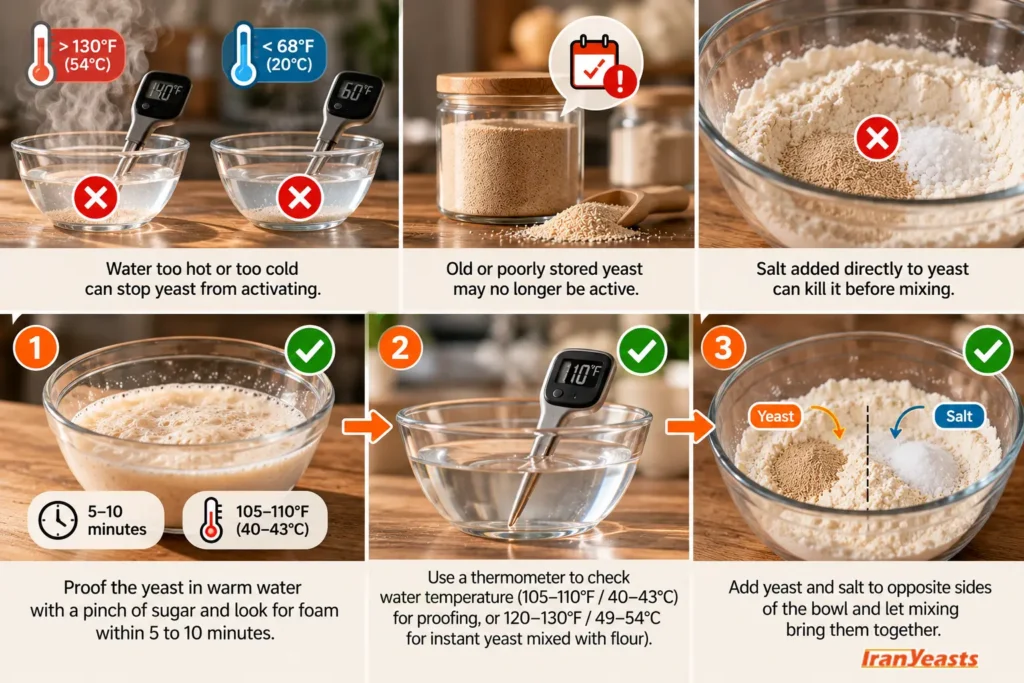
- Water too hot or too cold: Water above about 130°F (54°C) starts to damage yeast, and at about 140°F (60°C) it dies, according to the Exploratorium’s guide to yeast temperature ranges. Water below about 68°F (20°C) activates it too slowly to notice.
- Old or poorly stored yeast: Yeast kept somewhere warm or humid, or used well past its date, may no longer be active.
- Salt added directly to the yeast: Salt in direct contact draws water out of the yeast cells and can kill them before mixing even starts.
How to Fix Dough That Will Not Rise
- Proof the yeast before committing a full batch: Stir a teaspoon of yeast into water at about 105 to 110°F (40 to 43°C) with a pinch of sugar, and look for foam within 5 to 10 minutes.
- Check water temperature directly: Use a thermometer rather than guessing by touch. Instant yeast mixed straight into the flour tolerates warmer water, about 120 to 130°F (49 to 54°C), because the flour buffers it.
- Keep salt and yeast apart until mixing: Add yeast to the flour on one side of the bowl and salt on the other, and let mixing bring them together.
Problem 2: Dough Rises Too Slowly
Slow dough is not always a failure in progress. Often it just needs more time or a warmer spot, but a few specific causes are worth ruling out.
Why Dough Rises Slowly
- A cold or drafty kitchen: A room below about 75°F (24°C) noticeably slows fermentation.
- Too much sugar: Sugar above roughly 10 percent of the flour weight pulls water away from the yeast by osmosis and slows it down.
- Water quality: Very hard, very soft, or heavily chlorinated water can slow fermentation or weaken the dough.
How to Speed Up a Slow Rise
- Find a warmer spot: An oven with only the light on, or a spot near (not on) a warm appliance, usually adds enough warmth.
- Plan for sweet doughs: Recipes with more than about 10 percent sugar by flour weight generally need extra yeast, an osmotolerant yeast, or more time, rather than a rescue mid-rise.
- Be patient before troubleshooting: In a cold kitchen, dough is almost always slow rather than dead, so give it time before deciding the yeast failed.
Problem 3: Bread Is Dense or Heavy
Dense bread usually points to underproofing, though a few other causes produce a similar result.
Why Bread Turns Out Dense
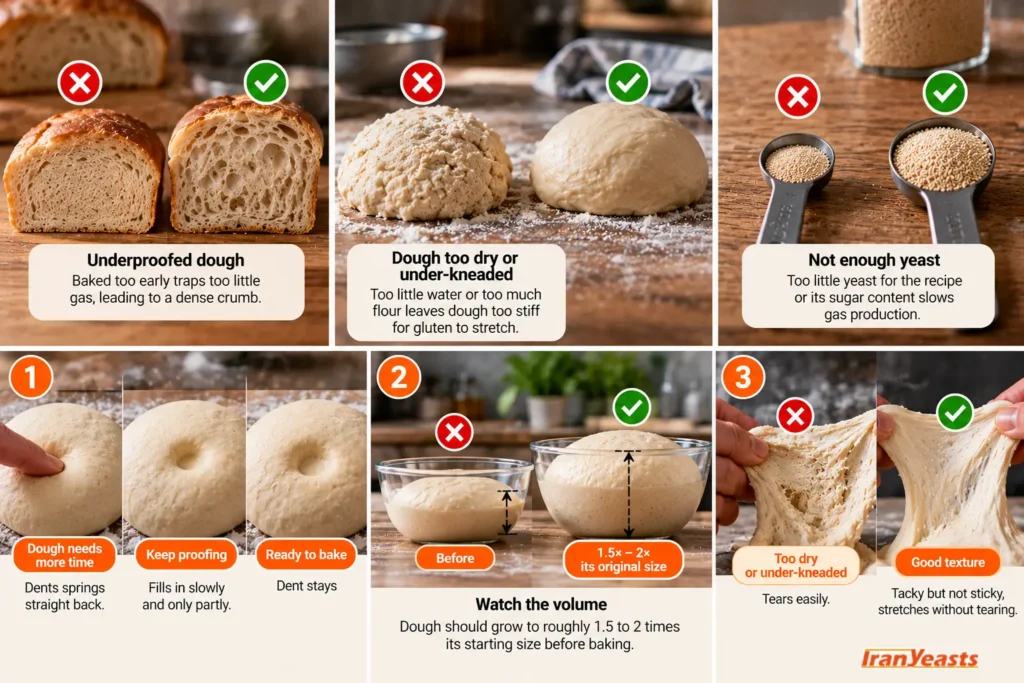
- Underproofed dough: Dough baked before it has expanded enough traps too little gas to produce an open crumb.
- Dough too dry or under-kneaded: Too little water, or too much flour, leaves dough too stiff for gluten to stretch around the gas the yeast produces.
- Not enough yeast: Too little yeast for the recipe or its sugar content slows gas production overall.
How to Fix Dense Bread
Use the poke test: press a floured finger about half an inch into the dough. If the dent springs straight back, the dough needs more time. If it fills in slowly and only partly, or stays, the dough is ready to bake.
- Watch the volume: Dough should grow to roughly 1.5 to 2 times its starting size before baking.
- Check the texture: A tacky but not sticky dough that stretches without tearing has developed enough gluten to hold gas.
Problem 4: Bread Collapses or Has a Sunken Top
This is usually the mirror image of problem 3: the dough went too far rather than not far enough.
Why Bread Collapses
- Overproofed dough: Dough left to rise well past its peak weakens its gluten until it can no longer hold its shape.
- Too much yeast: More yeast than the recipe needs can push fermentation past what the dough can support.
- Proofing somewhere too warm: A warm spot speeds fermentation past the intended proofing time without the baker noticing.
How to Prevent a Collapsed Loaf
Run the same poke test. Dough that feels fragile, looks puffy, or deflates when poked or moved is overproofed. If you catch it in time, gently reshape it and give it a shorter second rise rather than baking it as is.
- Track proofing time, not just volume: Set a timer, since overproofing often happens simply from forgetting the dough.
- Adjust for warm conditions: A warm kitchen in summer, or a warmed oven used for proofing in winter, can speed fermentation enough to overshoot, so check more often.
Quick Reference: Yeast Problems, Causes and Checks
| Symptom | Most Likely Cause | First Thing to Check |
|---|---|---|
| No rise at all | Dead yeast from heat, age, or direct salt contact | Proof a sample in warm water with sugar |
| Very slow rise | Cold kitchen or a sweet dough | Room temperature and the recipe sugar ratio |
| Dense, heavy loaf | Underproofed dough, or dough too dry | Poke test and dough volume |
| Collapsed or sunken top | Overproofed dough or too much yeast | Poke test and proofing time |
How to Prevent Yeast Problems Before They Start
Most of these issues are easier to prevent than to fix mid-bake. Buying yeast with a dependable shelf life matters as much as technique, a topic covered in yeast shelf life vs. expiration date. Bakeries choosing between yeast types should also read instant dry yeast vs. active dry yeast, since the two respond differently to proofing and mixing.
- Use a thermometer: Check both water temperature and the proofing environment rather than guessing.
- Store yeast properly: Keep yeast cool and dry and reseal opened packs tightly. For larger stock, see how to store bulk dry yeast.
- Measure by weight: Weigh flour, water, salt, and sugar, since volume measures vary more than they seem to.
- Read the dough, not just the clock: The poke test, dough volume, and texture together give a clearer picture than any single signal.
Yeast Supply for Bakeries Buying at Volume
A single bad batch is frustrating at home and costly at scale. The more you produce, the more consistent sourcing matters, so production problems can be ruled out as an ingredient issue before anything else is blamed. How to evaluate a bulk yeast supplier covers what to check before you commit.
Irany Yeasts supplies Iranian dry yeast in bulk to bakeries, distributors, and food brands, and the export team can help match yeast type and pack format to your production. Bakeries building their own branded line can also look at private label yeast manufacturing.
Conclusion
Most yeast problems in baking come down to a small set of causes: dead yeast from heat or age, salt or sugar interfering with fermentation, or dough baked before or after its proofing window. Once you can name the symptom, the fix is usually simple.
A thermometer, the poke test, and yeast with a shelf life you trust will prevent more failed loaves than any single technique.
References
- King Arthur Baking. (2022). How to tell if bread dough has risen enough. https://www.kingarthurbaking.com/blog/2022/08/22/how-to-tell-if-bread-dough-has-risen-enough
- Exploratorium. (n.d.). Yeast is fussy about temperature. https://www.exploratorium.edu/explore/cooking/yeast-temperature
- Bob's Red Mill. (n.d.). What temperature kills yeast. https://www.bobsredmill.com/articles/what-temperature-kills-yeast
- The Perfect Loaf. (n.d.). How to use the dough poke test. https://www.theperfectloaf.com/how-to-use-the-dough-poke-test/
- Taste of Home. (n.d.). Bread not rising? Here's what you can do about it. https://www.tasteofhome.com/article/9-reasons-your-bread-isnt-rising-and-what-to-do-about-it/
Frequently Asked Questions
Find answers to common questions about yeast problems in baking, from dough that will not rise to loaves that collapse.
Why isn't my dough rising at all?
The most common cause is dead yeast, usually from water that was too hot, salt added directly to the yeast, or yeast that was too old or poorly stored.
What water temperature kills yeast?
Yeast starts to suffer above about 130°F (54°C) and dies at about 140°F (60°C). For activating dry yeast in water, about 105 to 110°F (40 to 43°C) is ideal.
Can salt really kill yeast?
Yes, in direct contact or high concentration. Salt draws water out of yeast cells through osmosis, which is why recipes keep salt and yeast apart until mixing.
How do I know if my dough is underproofed or overproofed?
Use the poke test. A dent that springs straight back means underproofed, a dent that fills in slowly or stays means ready, and dough that feels fragile or collapses when poked is overproofed.
Does too much sugar affect yeast?
Yes. Sugar above roughly 10 percent of the flour weight draws water away from the yeast and slows fermentation, so sweet doughs often need more yeast, an osmotolerant yeast, or more time.
Why did my bread collapse after rising well?
It was most likely overproofed, so its gluten weakened past the point it could hold its shape, often from too much yeast or too warm a proofing spot.
Is it better to underproof or overproof bread?
Slightly underproofed is generally the safer mistake. Underproofed dough still bakes with reasonable structure, while overproofed dough has weakened gluten that cannot be fully corrected.