

Most sourcing mistakes do not happen because a buyer chose the wrong product. They happen because a buyer chose the wrong supplier , and only discovered this after the first container arrived with inconsistent fermentation results, incomplete documentation, or packaging that failed during transit.
In the bulk food ingredient trade, the pressure to move quickly is real. A new supplier responds fast, the price looks good, and a sample passes the initial test. The due diligence that should happen before a commercial order is compressed or skipped entirely. Three shipments later, the problems surface.
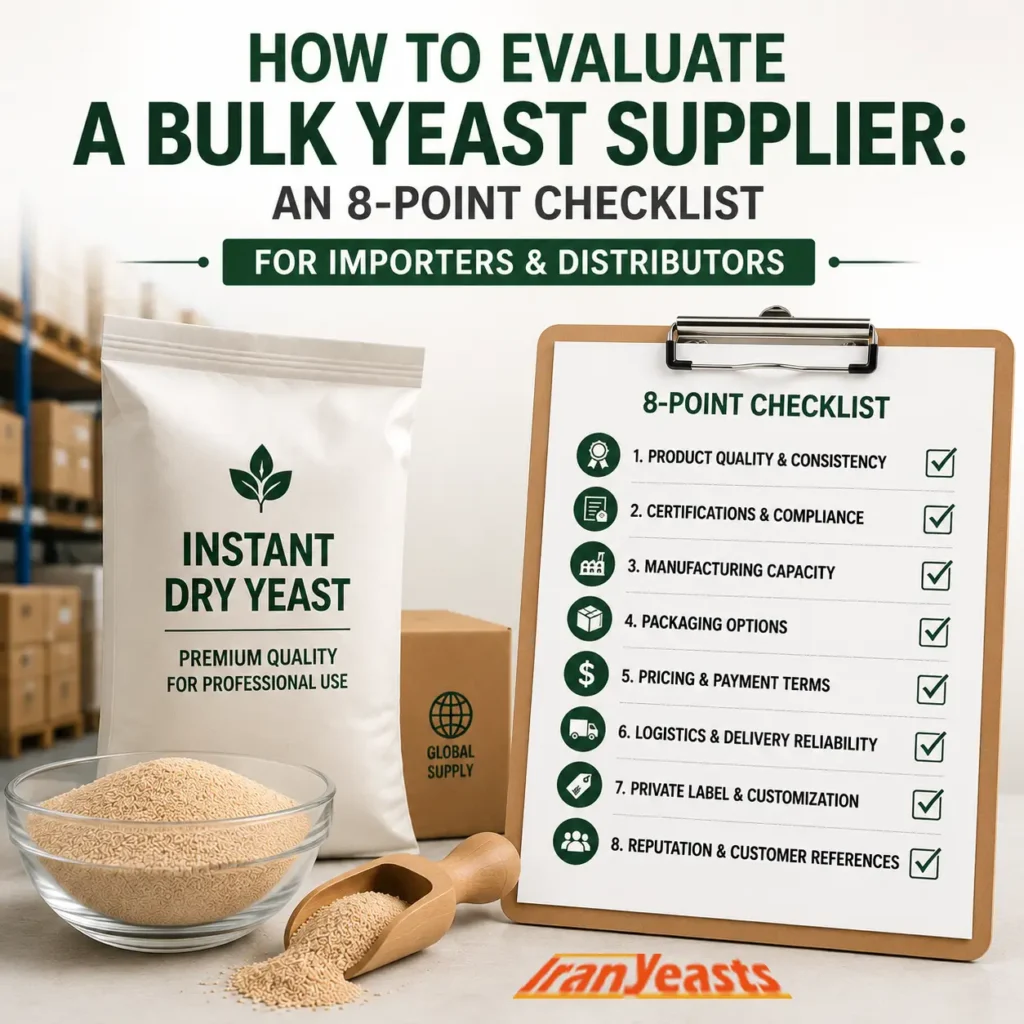
This checklist gives importers and distributors a structured framework for evaluating any bulk yeast supplier before placing a commercial order , covering technical specification, certification depth, batch-level quality control, logistics infrastructure, and the red flags that experienced procurement managers learn to recognize only after they have already paid for one expensive lesson.
Looking to Import Iranian Instant Dry Yeast at Wholesale Scale?
Get expert guidance on product selection, packaging, export documentation, pricing, and international shipping directly from our export team.
How to Evaluate a Bulk Yeast Supplier: The 8 Criteria That Separate Reliable Partners from Risk
The eight criteria below are ordered by where evaluation failures most commonly occur, not by which sounds most important in a brochure. Most buyers check certifications. Fewer buyers check batch-level testing frequency. Fewer still ask about what happens when something goes wrong after delivery.
Criterion 1 , Verify the Technical Specification Before Anything Else
A supplier’s specification sheet is the starting point, not the finish line. The specification tells you what the supplier claims about the product. Your job as a buyer is to confirm that the claim is testable, that you know what test it refers to, and that the sample you receive actually reflects what the commercial shipment will contain.
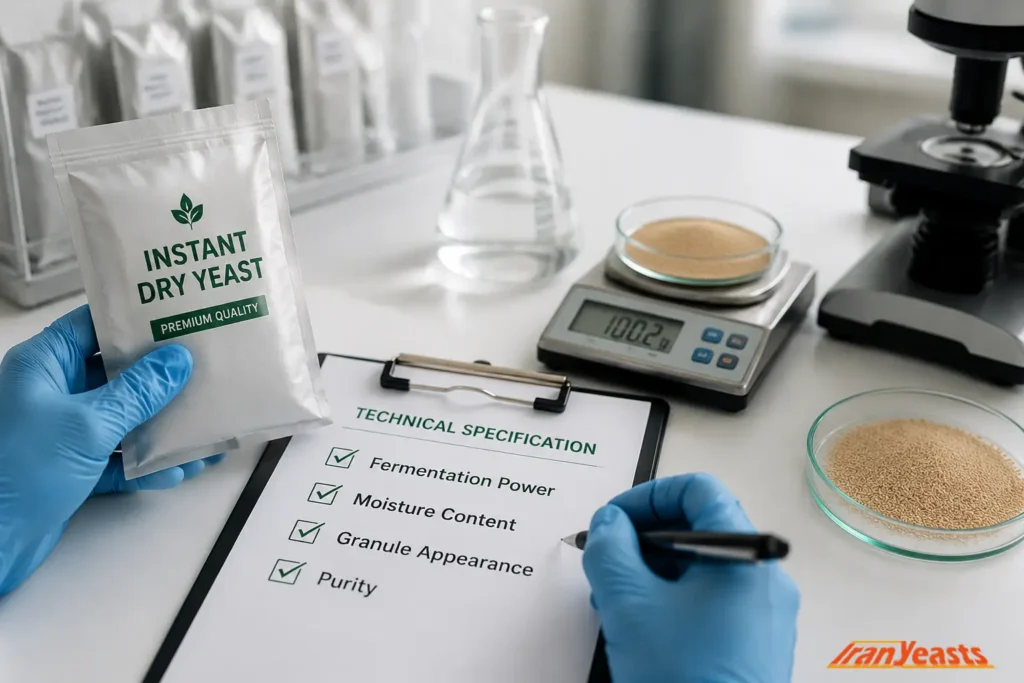
For instant dry yeast, the three specifications that matter most for commercial buyers are:
Fermentation Power (gassing power).
This is the primary performance metric for baker’s yeast , the volume of carbon dioxide the yeast can produce per gram in a standard test, expressed in milliliters of CO2. Export-grade instant dry yeast should carry a minimum Fermentation Power of 1,350. Any supplier quoting a lower figure, or unable to provide a figure at all, is telling you something important about their product. Ask specifically: what is the Fermentation Power on your current export batch, and is it documented in the Certificate of Analysis?
Moisture content
. Instant dry yeast should measure between 4 and 6 percent moisture. Higher moisture content affects both shelf life and fermentation performance under storage. A supplier unable to specify moisture content cannot guarantee shelf life.
Granule appearance and purity.
Uniform, off-white to cream-colored fine granules. Any discoloration, clumping, or irregular granule size indicates either poor drying process control or moisture ingress during storage or transit.
The right way to verify any specification claim is to request the Certificate of Analysis for a recent production batch, not the generic product brochure. The COA should be batch-specific, dated, and should include numerical test results, not just “pass” or “compliant” notations. For a full breakdown of what Iranian instant dry yeast delivers on these specifications, see our post on Iranian instant dry yeast for bulk importers.
Criterion 2 , Certification Documentation: What to Request and What to Actually Check
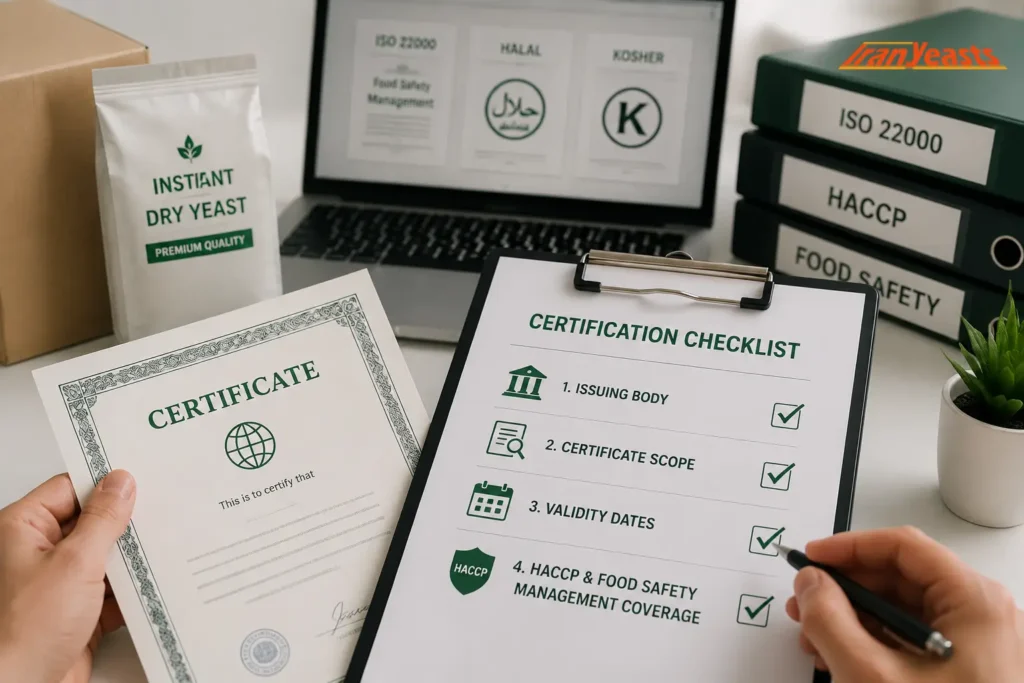
Certifications are the most commonly referenced evaluation criterion and the most commonly misread. Having a certificate is not the same thing as having current, scope-appropriate, market-accepted certification. There are four things to check on every certificate a supplier provides.
Issuing body.
The certificate is only as useful as the issuing organization’s recognition in your destination market. A Halal certificate issued by an obscure domestic body may carry no weight with customs authorities or wholesale buyers in your target country. For Gulf markets, Central Asia, Pakistan, and Afghanistan, Halal certificates issued by nationally recognized standards bodies (such as ISIRI for Iranian products) carry the broadest acceptance. For a detailed explanation of which Halal certifying bodies are recognized in which markets, see our post on Halal-certified yeast export from Iran.
Certificate scope.
Does the certificate cover the specific product you are ordering, from the specific facility that will produce your order? A facility-level certificate is broader and more meaningful than a product-level certificate issued for a different SKU. Confirm the scope language on the certificate itself, not on what the sales representative tells you verbally.
Validity dates.
Certificates have expiry dates. An expired Halal or HACCP certificate is worthless at customs clearance. Check the issue date and expiry date on the physical document. For a shipment that will take three to four weeks to reach your destination, a certificate expiring in six weeks is a compliance risk.
HACCP and food safety management coverage
. HACCP certification confirms the supplier operates a documented Hazard Analysis and Critical Control Points system across their production process. This is a baseline procurement requirement for most regulated food ingredient buyers, not an optional bonus. ISO 22000 certification , the international food safety management standard , extends this further and is increasingly expected by buyers in European and Gulf markets.
Standard documentation a reliable yeast supplier should provide without being asked: Halal certificate, HACCP certificate, Certificate of Analysis (batch-specific), Certificate of Origin, and Safety Data Sheet (MSDS/SDS). If any of these requires a special request or a delay, that is a process gap worth noting.
Criterion 3 , How Batch-Level Quality Testing Reveals a Supplier's Actual Process
This is the criterion most buyers overlook and the one that most often explains why a supplier’s commercial shipments underperform relative to their samples.
A sample is a single data point. It tells you what one batch was capable of producing under controlled conditions, often selected specifically for sampling purposes. The question that matters for commercial procurement is: does every batch get tested to the same standard?
Ask the following questions directly and evaluate the answers carefully:
What tests are conducted on every production batch before shipping?
The answer should include at minimum: fermentation power testing, moisture content measurement, microbial testing (total plate count, coliform, salmonella), and appearance/sensory inspection. If the answer is “we test periodically” or “we test upon request,” the supplier does not have a functioning batch-level quality system.
Is a Certificate of Analysis generated for every batch?
The COA should be generated from actual batch test results, not copied from a standard template. Batch-specific COAs include production dates, batch numbers, and individual test results. A COA that lacks these details is a template, not a genuine quality record.
How quickly can you provide the COA for the batch being shipped?
A supplier with a functioning quality system can provide the COA immediately upon request, because testing happens before the product is packaged and approved for shipping. A delay of days suggests testing happens retrospectively or not at all.
What is your corrective action process if a batch fails testing?
This question separates quality-conscious suppliers from those who treat testing as a formality. A reliable supplier has a documented process: batch quarantine, root cause investigation, and corrective action before the next production run. A supplier who cannot answer this question has never been tested on it.
Criterion 4 , Packaging Capability and Shelf Life Guarantees
For bulk yeast importers, packaging is not a cosmetic decision. It directly determines shelf life, transit survival, and whether the product your customers receive performs the way the spec sheet says it should.
The key variables to confirm with any supplier:
Vacuum sealing quality.
Vacuum-sealed yeast packaging should show no signs of air infiltration on arrival. Any puffing or softness in the vacuum pack indicates a seal failure that began during production or transit, compromising the shelf life claim. Ask the supplier: what equipment is used for vacuum sealing, and how is seal integrity tested before products leave the facility?
Shelf life by packaging format.
Shelf life is not a single number , it varies significantly by packaging type. Open bulk bags (10 to 20kg) typically carry 6 to 12 months shelf life. Vacuum-sealed sachets and retail packs carry 12 to 18 months. Vacuum-sealed bulk bags carry up to 24 months under proper storage. A supplier who quotes a single shelf life figure regardless of packaging format either does not understand the difference or is not being precise about their product.
Packaging format availability.
The right packaging format for your market depends on your distribution channel and your end customers. For consumer retail in Middle Eastern markets, 10g to 11g sachets are the dominant format. For commercial bakeries, 10kg to 20kg vacuum bags are standard. Confirm the supplier can produce the format you need, not just the format they typically stock. For a breakdown of how packaging format affects landed cost and import planning, see our detailed post on bulk dry yeast price from Iran in 2026.
Criterion 5 , Logistics Infrastructure and Transit Track Record
A supplier with an excellent product and poor logistics is not a reliable supplier. The two parts of the transaction are inseparable.
The questions to ask at the logistics stage:
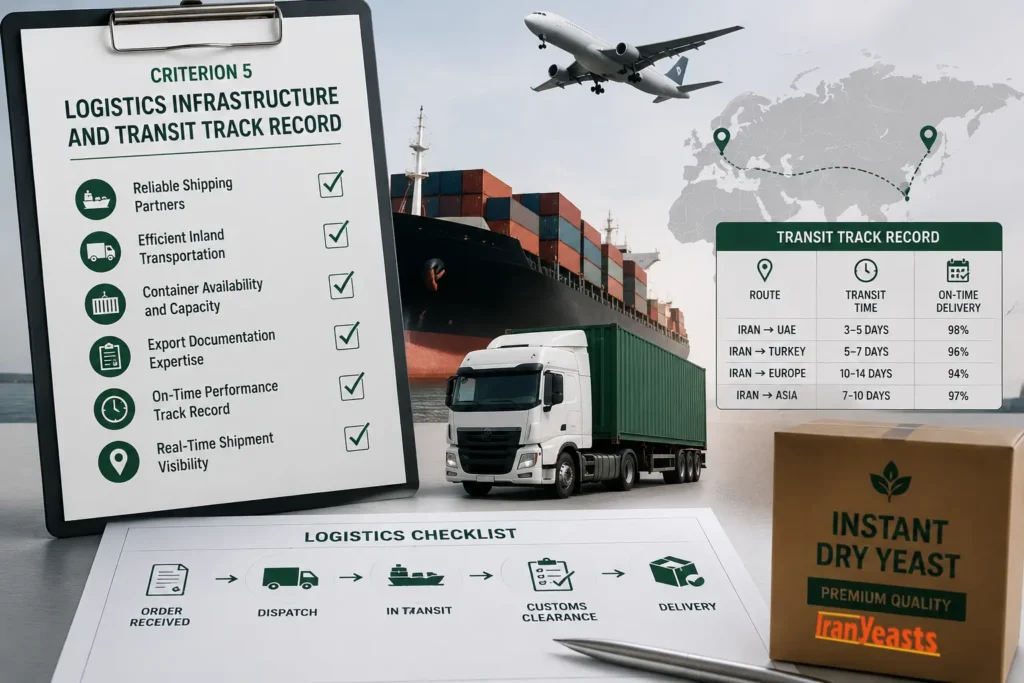
Which ports or land borders do you export through, and what is your typical transit time to my destination?
This should produce a specific, confident answer from any experienced exporter, not a vague estimate. IranYeasts, for example, ships via Bandar Abbas and Deyreh for sea freight, and via established land routes to Iraq, Afghanistan, and Pakistan. Transit to Gulf ports runs 3 to 5 days. Land freight to Iraq takes 5 to 10 days. A supplier who cannot give you specific transit ranges has not shipped to your destination market before.
Who coordinates customs documentation on the export side?
Export documentation includes the Certificate of Origin, Commercial Invoice, Packing List, Bill of Lading or CMR, and all relevant food safety and Halal certification paperwork. A supplier who handles this internally, rather than leaving it entirely to a freight forwarder, is less likely to encounter documentation gaps that delay clearance at your end. For a step-by-step walkthrough of the import logistics process from a buyer’s perspective, see our guide on how to import yeast from Iran for distributors.
Is cargo insurance included, and what is the claims process if product arrives damaged or compromised?
The answer should be specific. A supplier who says “the buyer is responsible from the port of loading” under FOB terms is technically correct, but a supplier who provides cargo insurance to destination and a documented quality guarantee gives the buyer meaningfully less financial exposure on a first shipment with a new partner.
What is your export track record?
Number of countries supplied, number of active buyer relationships, and years of exporting experience are all indicators of logistics competence. These figures can be verified through shipping records on trade intelligence platforms, not just taken at face value from a sales pitch.
Criterion 6 , Private Label Capability and MOQ Structure
This criterion applies specifically to distributors who are building or planning to build their own brand rather than reselling a supplier’s existing brand. But even buyers who currently resell should understand this capability, because private label is the most logical next step as their volume grows.
Questions to ask:
What is the minimum order quantity for private label production, and does it vary by packaging format?
MOQ for private label yeast varies dramatically by supplier. Large producers with established brands may require 20 to 50 tons before running a custom private label batch. Regionally focused suppliers often offer lower thresholds. IranYeasts‘ private label MOQ is 5 metric tons across all seven packaging formats , accessible for a mid-sized distributor entering a new market without a large upfront commitment.
Does Halal certification apply to private label production runs?
Not all suppliers maintain certification coverage for OEM production under a buyer’s brand name. This is a specific question to ask and confirm in writing, because a distributor who sells yeast under their own brand needs the Halal documentation to be valid for that product, not just for the supplier’s branded version. For a full guide to private label yeast manufacturing from inquiry to finished product, see our dedicated post on private label yeast manufacturing.
Can you provide packaging samples in my artwork before a full production run?
- Pre-production packaging samples allow the buyer to approve label placement, print quality, and physical finish before committing to a full batch. Any supplier offering a private label who does not offer this step is asking the buyer to take a risk they should not have to take.
Criterion 7 , Payment Terms, Pricing Transparency, and Financial Risk
Pricing and payment terms deserve scrutiny beyond simply comparing the per-ton figure on a quote.
Is pricing provided in writing, with a defined validity period?
A supplier who quotes prices verbally or via informal message, without a formal pro-forma invoice, is not operating a professional export process. All pricing should be confirmed in a formal pro-forma invoice that specifies: price per unit and total value, Incoterm and named port, payment terms, and the period during which the price is valid. This protects both parties and eliminates the misunderstandings that cause disputes.
What Incoterm is being quoted, and what costs does the buyer carry from that point?
A FOB price does not include freight or insurance. A CIF price includes both to the named destination port, but the buyer then takes responsibility for customs clearance and inland delivery. Understanding what the quoted number actually covers is essential for accurate landed cost comparison between suppliers. The price comparison should always be on a landed cost basis, not a raw FOB basis. For a structured explanation of how FOB and CIF affect total landed cost with a worked example, see our post on bulk dry yeast price from Iran in 2026.
What are the payment terms, and are they negotiable for established buyers?
Standard terms in the Iranian yeast export trade are 30 percent upfront and the balance before loading. For a new buyer, this is a reasonable risk structure for both parties. For buyers with an established order history, terms are typically open to discussion. A supplier who requires 100 percent upfront payment from all buyers, including established ones, is either financially distressed or not operating a professional commercial relationship.
Criterion 8 , Eight Red Flags That Signal a Supplier Is Not What They Claim
Experienced procurement managers develop an instinct for these signals. For buyers earlier in their sourcing career, here is what to watch for.
No batch-specific Certificate of Analysis available.
If the supplier provides a generic product specification sheet rather than a COA generated from actual batch testing, they do not have a functioning quality system. Walk away.
Certificates that cannot be independently verified.
A legitimate Halal or HACCP certificate includes the issuing body’s contact information. If you cannot independently verify the certificate’s authenticity by contacting the issuing organization directly, the document is unreliable.
Reluctance to answer specific questions about testing frequency.
Vague answers to direct questions about batch testing (“we follow all standards,” “quality is our priority”) are a substitute for factual answers. A supplier with a real quality process can describe it in specific, operational terms.
Sample performance that differs materially from commercial shipment performance.
If your first commercial shipment produces significantly different fermentation results from the sample, the supplier is not controlling their production process consistently, or the sample was specifically selected rather than representative of standard output.
Pricing that changes significantly between inquiry and pro-forma invoice.
Price drift between an initial verbal quote and a formal invoice is a negotiating tactic or a sign of disorganized operations. Neither is acceptable in a long-term supplier relationship.
No clear answer on what happens if a quality problem occurs post-delivery.
A reliable supplier has a documented claims and resolution process. If the answer is “we will discuss it if that happens,” the buyer carries all the post-delivery risk.
Export documentation prepared only upon request, not as standard.
Complete export documentation should be prepared as a standard part of every shipment, not assembled after a buyer asks for it. A supplier who treats documentation as optional is likely to produce gaps that cause customs delays at your end.
No active export track record to markets similar to yours.
Claimed export capability is not the same as demonstrated export capability. Ask for specific destination markets supplied, approximate shipment frequency, and whether references from existing buyers in your region are available.
Final Thoughts
Supplier evaluation in the bulk yeast trade is not complicated, but it requires asking the right questions before a commercial relationship begins rather than after a problem has already cost money. The checklist above covers the criteria that matter most, applied specifically to the characteristics of instant dry yeast as a commercial export product.
The buyers who consistently find reliable yeast suppliers are not the ones who move fastest. They are the ones who ask the most precise questions, check the documents that everyone else takes for granted, and treat the sample evaluation as the beginning of due diligence rather than the end of it.
References
- Source86. (2026, April 22). What to look for in a bulk ingredient supplier: A CPG buyer's checklist. Source86 Ingredient Sourcing Intelligence.
- Baobab Foods. (2026, June). Supplier qualification in 2026: What CPG brands should be asking. Baobab Foods Quality and Procurement.
- AK Agricultural Supplies. (2025, November 9). The complete food buyer's checklist: What to ask before you buy. AK Agricultural Supplies Procurement Blog.
- Southeast Asia Food Group. (2024, April 5). What to look for in a reputable food ingredients supplier. SAFG Procurement Guides.
- Global Resources Direct. (2025). How to choose the right food ingredients supplier. Global Resources Direct Sourcing Blog.
Frequently Asked Questions
Find answers to common questions about Iranian instant dry yeast, including certifications, bulk orders, private labeling, export logistics, and delivery worldwide
What is the most important thing to check when evaluating a bulk yeast supplier?
Batch-level quality documentation is the most revealing indicator. Any supplier can produce a good sample. The question is whether every commercial batch is tested to the same standard and whether those results are documented in a batch-specific Certificate of Analysis provided with every shipment. A supplier who cannot answer this question with operational specifics does not have a functioning quality system.
What certifications should a yeast supplier have for Middle Eastern and Gulf markets?
The baseline certifications for these markets are Halal (issued by a recognized national standards body), HACCP, and a food safety management standard such as ISO 22000. For Iranian-origin yeast, the Halal certificate is issued by ISIRI and is accepted across GCC markets, Iraq, Pakistan, and Central Asian destinations without supplementary documentation.
How do I verify that a Halal certificate is genuine?
Every legitimate Halal certificate includes the name, logo, and contact details of the issuing organization. Contact the issuing body directly using the contact information printed on the certificate, not information provided by the supplier, to verify the certificate number and its current validity. A genuine certificate can always be independently verified.
Should I request a sample before placing a bulk yeast order?
Yes, without exception. A sample allows you to test fermentation performance in your own facility or with your bakery customers under real production conditions, review the Certificate of Analysis and compare it against the actual product performance, and confirm packaging quality and shelf life claims before committing to a full commercial order. Any supplier who discourages sample requests before a first commercial order should be treated with caution.
What is a reasonable MOQ for a first private label yeast order?
This varies significantly by supplier. Large international producers may require 20 tons or more for a custom private label run. IranYeasts offers private label yeast production from a 5 metric ton minimum order, across seven packaging formats including consumer sachets. For a full breakdown of the private label process and what to expect, see our dedicated guide on private label yeast manufacturing.
What does "landed cost" mean and why does it matter more than the FOB price?
Landed cost is the total cost of receiving goods at your facility or destination port, including the FOB price, ocean freight, cargo insurance, destination port handling charges, import duties, and inland delivery. Two suppliers with similar FOB prices can produce very different landed costs depending on their freight routes and transit distances. For buyers in the Gulf sourcing from Iran versus other origins, the freight and transit differences often make landed cost meaningfully lower for Iranian supply even when FOB prices are comparable.
What are the biggest red flags when evaluating a yeast supplier?
The most significant red flags are: no batch-specific Certificate of Analysis available; certifications that cannot be independently verified; reluctance to answer specific questions about testing frequency; significant price changes between verbal quote and formal pro-forma invoice; and no clear documented process for handling post-delivery quality claims.
How do I compare instant dry yeast specs between suppliers?
Compare on three specific numbers: Fermentation Power (minimum 1,350 for export-grade instant dry yeast), moisture content (maximum 5.5 percent), and shelf life at your required packaging format. Do not compare on vague quality claims. For a detailed comparison of instant dry yeast versus active dry yeast specifications from a buyer’s perspective, see our post on instant dry yeast vs active dry yeast for export.