

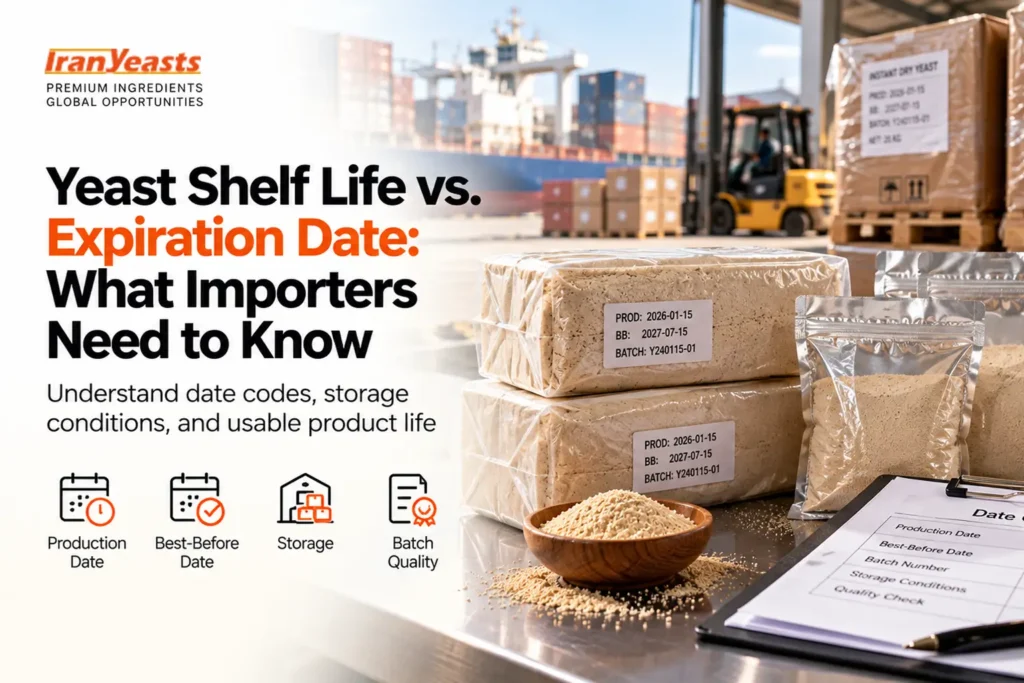
A yeast shipment can be fully in date and still arrive half used up. The date printed on the pack and the shelf life the supplier quotes sound like the same thing, but they answer different questions, and importers who treat them as one lose money in transit and in storage.
Dry yeast also does not expire the way milk does. Its activity fades gradually, which means the date is a quality marker, not a cliff.
This guide explains the difference between shelf life and expiration date, what to check on arrival, and how to manage yeast stock so dates work for you.
Looking to Import Iranian Yeast at Wholesale Scale?
Get expert guidance on yeast type, packaging format, export documentation, pricing, and international shipping directly from our export team.
Yeast Shelf Life vs. Expiration Date for Iranian Yeast: The Core Difference
Shelf life is the period a product is expected to stay within its quality specification under stated storage conditions. The date on the pack is one supplier’s marker for the end of that period. For bulk Iranian yeast, such as the instant dry yeast described in why Iranian instant dry yeast is a top choice for bulk importers, the two numbers only line up if the yeast is stored the way the supplier assumed. The table separates the terms importers most often mix up.
| Term | What It Means | What Importers Do With It |
|---|---|---|
| Shelf life | How long the product stays within spec under stated storage conditions | Compare suppliers and pack formats |
| Best-before date | The date after which the supplier no longer stands behind peak quality | Plan sales and usage around it |
| Expiration or use-by date | A stricter cutoff some suppliers or markets apply | Check whether the market requires it |
| Remaining shelf life on arrival | Time left on the clock when goods reach your warehouse | Set minimums in the purchase agreement |
What Shelf Life Really Means for Dry Yeast
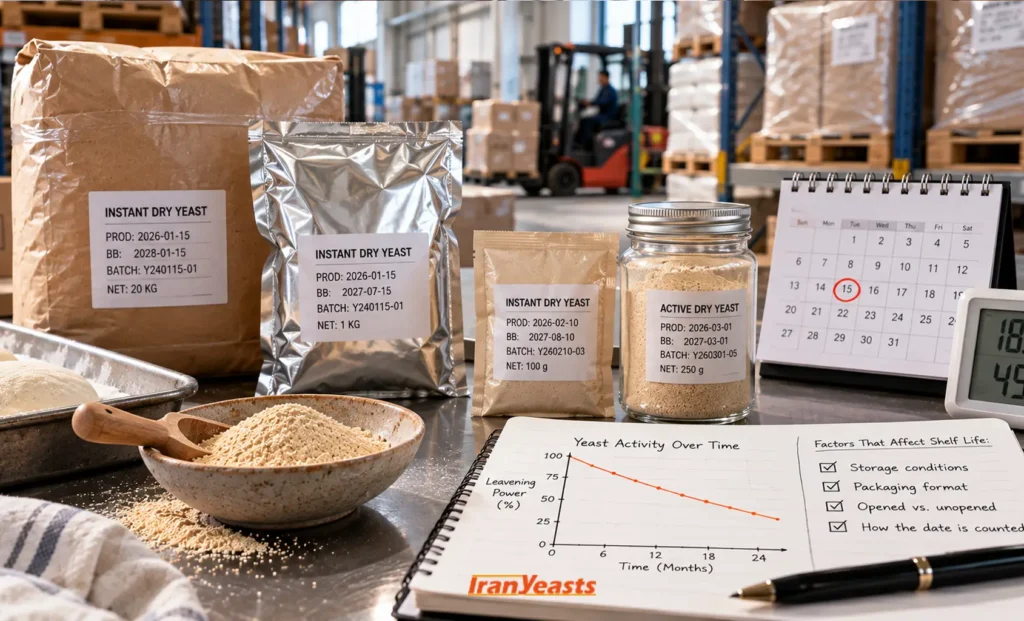
Dry yeast is dormant, not frozen in time. Its leavening power declines slowly, and how fast depends on the pack and on where it is kept.
A Performance Curve, Not a Cliff
Yeast usually does not stop working on a particular day. It loses activity gradually, so a lot near its date may still raise dough but need a higher dose or a longer proof. That is why the date is best read as a quality marker, not an on and off switch.
What Moves the Number
- Storage conditions: Cool, dry storage preserves activity. Heat and humidity shorten it.
- Packaging format: Vacuum or nitrogen-flushed packs generally outlast standard sealed packs.
- Opened vs. unopened: Dates apply to unopened packs. Red Star, for example, advises using an opened packet within about four weeks when refrigerated or frozen.
- How the date is counted: Some suppliers count from the packaging date, others from production, which changes the real end date.
Typical Shelf Life by Pack
- Red Star lists a best-by date two years from packaging for its dry yeast packets.
- Lesaffre’s industrial specification lists 2 years for 1 lb and 2 lb packs and 18 months for 50 lb bulk bags.
- IranYeasts‘ export specifications list 1.5 to 2 years for vacuum packs, 1 to 1.5 years for sachets, and 6 months to 1 year for standard sealed bags.
What a Date on the Pack Actually Tells You
Dates on food are mostly about quality, not safety. The US Department of Agriculture explains that product dating is not required by federal law except for infant formula, and that a Best If Used By date refers to quality rather than safety. The same logic applies to yeast: the date is the supplier’s quality promise, and its meaning depends on how it was set.
Date Traps to Check on Arrival
- Which date is it? Confirm whether the printed date is a production date, packing date, or best-before date. They are not interchangeable.
- Read the format: A date written 04/05/26 can mean April or May. Ask the supplier to state the format and match it to the lot code.
- Check the storage assumption: A two-year date assumes proper storage. Ask what temperature and humidity it assumes.
- Match lot codes: Make sure every pack in the shipment carries the date and lot code, since mixed lots complicate stock rotation.
On private label orders, the buyer’s brand is on the pack, so confirm early who prints the date and lot code. The process is covered in private label yeast manufacturing.
Remaining Shelf Life on Arrival: The Number Importers Overlook
Transit eats into shelf life. A pack with 18 months on the date can arrive with far less after production, loading, ocean freight, port dwell, and customs. This is why many buyers write a minimum remaining shelf life into the purchase agreement, and why it is worth reading alongside bulk dry yeast pricing from Iran, since a cheaper quote with shorter shelf life can cost more in the end.
- Check import rules: Some markets set a legal minimum. India’s FSSAI requires imported food to have at least 60 percent of its shelf life, or three months before expiry, whichever is less, remaining at the time of import. Confirm the current rule for your market with your customs broker.
- Set a contractual minimum: Agree in writing how many months or what percentage must remain at delivery.
- Plan the route: Fewer stops and faster customs clearance preserve more shelf life.
The full import sequence, from supplier selection to customs, is laid out in how to import yeast from Iran.
How to Manage Yeast Stock So Dates Work for You
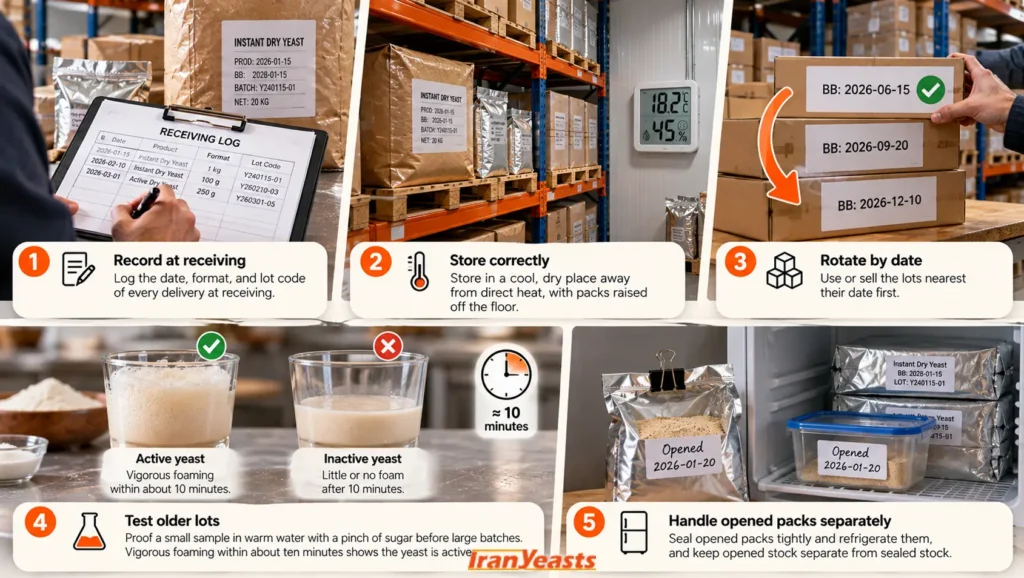
Good stock handling turns a printed date into a plan. The standard method is first expired, first out, which ships the stock closest to its date first rather than simply the oldest delivery.
- Record at receiving: Log the date, format, and lot code of every delivery at receiving.
- Store correctly: Store in a cool, dry place away from direct heat, with packs raised off the floor.
- Rotate by date: Use or sell the lots nearest their date first.
- Test older lots: Proof a small sample in warm water with a pinch of sugar before large batches. Vigorous foaming within about ten minutes shows the yeast is active.
- Handle opened packs separately: Seal opened packs tightly and refrigerate them, and keep opened stock separate from sealed stock.
What to Ask Your Supplier About Dates
A few direct questions show how seriously a supplier treats shelf life. They also fit the wider checklist in how to evaluate a bulk yeast supplier.
- Is the date counted from production or packaging?
- What storage conditions does the stated shelf life assume?
- What remaining shelf life can you guarantee on arrival at my port?
- How are lots and dates marked on the pack and on the paperwork?
- Can you send a sample from the lot I will receive?
Conclusion
Shelf life describes how long yeast should perform under the right conditions. The printed date is one supplier’s marker for the end of that period. Importers who read both, and check remaining shelf life on arrival, avoid paying for time they never get to use.
Set a minimum remaining shelf life in the contract, confirm how the date is counted, rotate stock by date, and proof older lots before big batches.
References
- U.S. Department of Agriculture, Food Safety and Inspection Service. (n.d.). Food product dating. https://www.fsis.usda.gov/food-safety/safe-food-handling-and-preparation/food-safety-basics/food-product-dating
- MRPeasy. (n.d.). FEFO (first expired, first out): What it is and how it works. https://www.mrpeasy.com/blog/fefo-first-expired-first-out/
- Lesaffre Yeast Corporation. (n.d.). Red Star all-natural active dry yeast. Red Star Yeast. https://redstaryeast.com/product/all-natural-active-dry-yeast-strip/
- Lesaffre Yeast Corporation. (n.d.). Red Star active dry yeast: Industrial specifications. https://lesaffrebaking.com/product/red-star-active-dry-yeast/
- Food Safety and Standards Authority of India. (n.d.). Food import clearance system: Frequently asked questions [PDF]. https://fics.fssai.gov.in/pdf/faqs_import.pdf
Frequently Asked Questions
Find answers to common questions about yeast shelf life and expiration dates, including how long dry yeast lasts, remaining shelf life on arrival, and how to test older lots.
What is the difference between yeast shelf life and expiration date?
Shelf life is how long yeast stays within its quality specification under stated storage conditions. The expiration or best-before date is the supplier’s printed marker for the end of that period.
Is yeast unsafe after its date?
Not usually. Dates on dry yeast are quality markers, and activity fades gradually, so older yeast mainly becomes weaker rather than unsafe.
How long does dry yeast last unopened?
It depends on the pack. Major brands list about two years for small packs and 18 months for large bulk bags, and vacuum packs from Iranian exporters list 1.5 to 2 years.
How long does yeast last once opened?
Much less. Red Star advises using an opened packet within about four weeks when refrigerated or frozen, so seal and chill opened packs promptly.
What is remaining shelf life on arrival?
It is the time left before the date when a shipment reaches your warehouse, after production, freight, and customs have used up part of the total.
How can I test whether older yeast still works?
Mix a small sample with warm water and a pinch of sugar. Vigorous foaming within about ten minutes shows the yeast is still active.
Does packaging affect the expiration date?
Yes. Vacuum and nitrogen-flushed packs protect against oxygen and moisture, so they generally carry longer dates than standard sealed packs.