

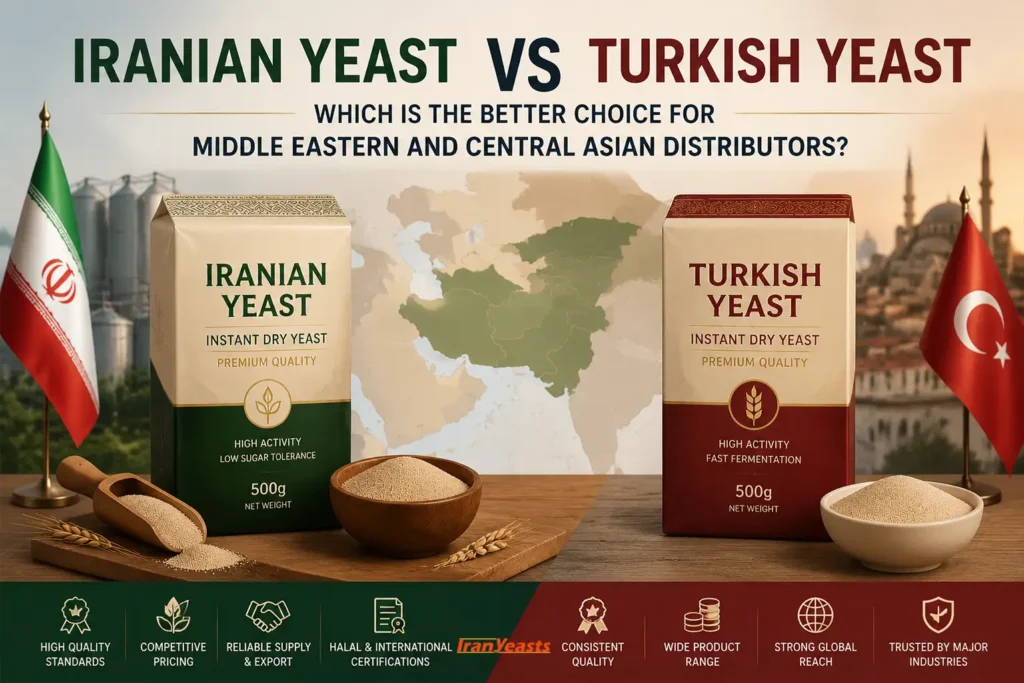
For a distributor sourcing instant dry yeast anywhere between the Gulf and Central Asia, two origins dominate the practical shortlist: Turkey and Iran. Both sit close enough geographically to offer fast transit. Both produce export-grade products at competitive pricing. Both carry decades of production experience.
The comparison rarely gets written honestly, because most of what exists online is either Turkish supplier marketing or generic sourcing guides with no real specification detail. Distributors end up choosing based on whichever sales representative responded first, not on a clear understanding of what actually differs between the two origins.
This post lays out the comparison directly: production scale, pricing, certification depth, logistics routes, private label flexibility, and where each origin genuinely has the advantage. The goal is a buying decision based on specifics, not branding.
Looking to Import Iranian Instant Dry Yeast at Wholesale Scale?
Get expert guidance on product selection, packaging, export documentation, pricing, and international shipping directly from our export team.
Turkey's Position in the Global Yeast Market: Scale and Brand Recognition
Turkey’s yeast industry is built around a small number of large, established producers, the most recognized being Pakmaya, which has been operating since the introduction of scientifically produced yeast to the Turkish market and now ranks among the three largest yeast companies globally. Pakmaya operates three yeast factories in Turkey and one in Romania, giving it substantial production scale and a brand name that carries real recognition across the Middle East, North Africa, and parts of Europe.
Turkish instant dry yeast is exported globally to over 134 countries, with thousands of documented export shipments moving through Turkish ports annually. This scale matters for buyers who need very large, consistent volumes from a single source with an established international brand attached to the product.
Turkish producers, particularly Pakmaya, also maintain a broad product range beyond basic instant dry yeast , including active dry yeast, fresh yeast, sugar-tolerant formulations, and bread improvers , which appeals to distributors who want a single supplier covering multiple ingredient categories.
Iran's Position: Regional Specialization and Logistics Proximity
Iranian yeast production has developed along a different model: smaller and mid-sized producers with deep specialization in instant dry yeast for regional export, rather than a small number of giant multi-category producers. IranYeasts, for example, operates with over a decade of focused export experience across 16 countries, with monthly capacity of 150 tons scalable to 250 tons depending on packaging configuration.
What distinguishes Iranian supply is not production scale relative to Turkey, but geographic and logistical proximity to a specific set of markets: Iraq, Afghanistan, Pakistan, the Gulf states, and Central Asian countries. Iran shares land borders or short sea routes with most of these markets, which Turkish exporters reach through longer and often more complex freight routes.
For buyers in these specific corridors, Iranian supply offers a structural transit advantage that Turkish producers, regardless of their scale, cannot replicate without relocating production closer to the destination market.
Price Comparison: Where the Real Numbers Land
Pricing is the factor distributors ask about first, and it deserves a precise answer rather than a vague claim of being “competitive.”
Iranian instant dry yeast
Iranian instant dry yeast from IranYeasts is priced at $1,500 to $2,600 per metric ton FOB Bandar Abbas, depending on packaging format, brand, and order volume. This range reflects the full spectrum from 10kg open bags at the lower end to fully vacuum-sealed sachet formats at the upper end.
Turkish instant dry yeast
Turkish instant dry yeast, sourced through major producers like Pakmaya, typically prices in a comparable or slightly higher range depending on packaging and certification level, reflecting Turkey’s larger production infrastructure and stronger international brand premium. Buyers sourcing through trading intermediaries rather than directly from Turkish factories often pay an additional margin layered on top of factory pricing.
The practical difference is not always in the headline FOB price , it is in the landed cost once freight, transit time, and currency exposure are factored in. A distributor in Iraq or the UAE comparing a Turkish FOB quote against an Iranian FOB quote needs to add freight from the relevant port and the associated transit risk to get an accurate comparison, not just compare the two numbers side by side.
Logistics and Transit Time: The Factor That Actually Decides Many Sourcing Decisions
For distributors operating on tight inventory cycles, transit time is frequently the deciding factor over price, particularly for a perishable-adjacent product like yeast where shelf life is finite from the moment of production.
From Iran (Bandar Abbas):
- To Gulf ports (UAE, Qatar, Oman): 3 to 5 days by sea
- To Iraq: 5 to 10 days by land freight
- To Afghanistan and Pakistan: 5 to 10 days by land freight
- To Central Asian markets: variable, typically faster via established overland routes than competing origins
From Turkey:
- To Gulf ports: typically 10 to 15 days by sea, depending on routing
- To Iraq: land freight options exist but are less centrally positioned than Iran’s direct border access
- To Central Asia: longer routes, often requiring transit through multiple countries
For a distributor whose business depends on consistent stock availability for bakery customers who cannot afford a stockout, this transit time difference is not a minor convenience. It directly affects how much safety stock a distributor needs to carry and how exposed they are to shipping delays.
Halal Certification: Depth and Market Acceptance
Both Turkish and Iranian yeast producers offer Halal certification, but the depth and regional acceptance of that certification varies by producer and issuing body, which matters significantly for distributors supplying Halal-regulated markets.
IranYeasts’ Halal certification is issued by ISIRI, Iran’s National Standards Organization, recognized by the Codex Alimentarius Commission as the country’s competent food safety authority. This certification is accepted without supplementary documentation across the Gulf states, Iraq, Pakistan, Afghanistan, and Central Asian markets , the exact corridor where Iranian logistics also have the strongest advantage.
Turkish producers, including Pakmaya, also maintain Halal certification, generally well recognized given Turkey’s own predominantly Muslim domestic market and decades of exporting into Halal-regulated markets. For buyers in markets with strict, specific certifying body requirements (certain GCC import authorities, for instance), it is worth confirming which Halal certifying body each supplier uses and whether that specific body has recognition in the buyer’s destination market, regardless of origin country.
For a full breakdown of what Iranian Halal certification covers and which markets accept it without additional documentation, see our post on Halal-certified yeast export from Iran.
Private Label and MOQ: Where Iranian Suppliers Often Have the Edge
This is one of the more consequential differences for mid-sized distributors specifically, rather than large-volume buyers.
Higher MOQ Requirements from Large Turkish Yeast Producers
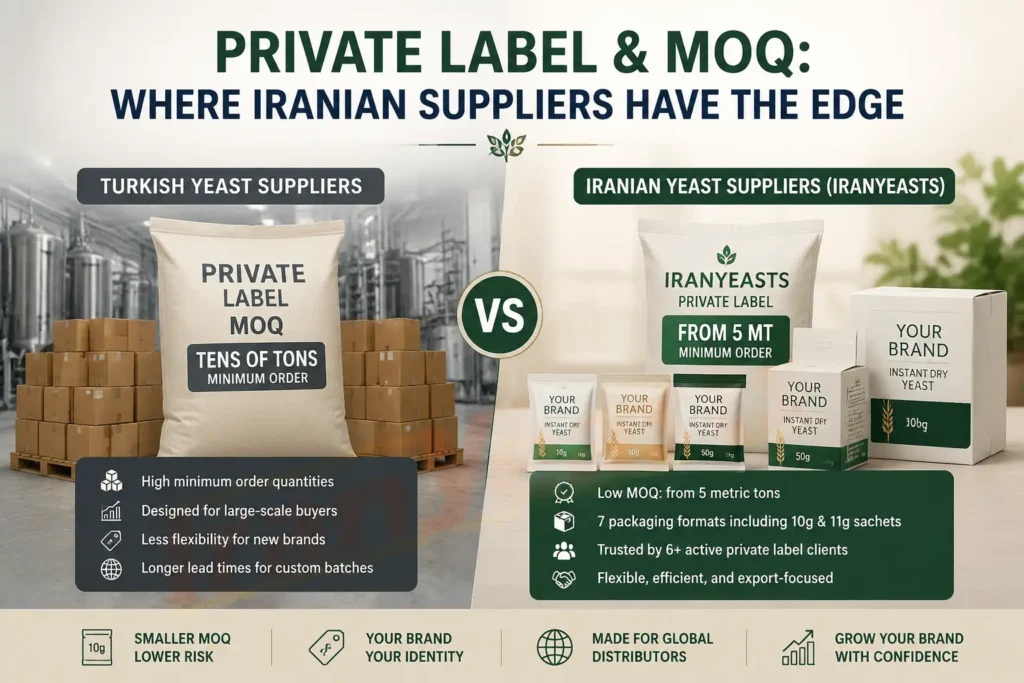
Large Turkish producers, given their scale and established brand equity, often set private label minimum order quantities significantly higher than smaller, regionally focused Iranian producers. A distributor wanting to launch their own yeast brand through a major Turkish manufacturer may face MOQ thresholds in the tens of tons before the producer is willing to run a custom private label production batch.
Flexible Private Label Yeast Production with Lower MOQ Options
IranYeasts offers private label production from a 5 metric ton minimum order quantity, across seven distinct packaging formats including the 10g and 11g consumer sachet format , a specification level many larger producers either do not offer at all or only offer at much higher MOQs. We currently produce private label yeast for 6 active clients across multiple countries. For a full breakdown of how private label yeast manufacturing works, including the process from inquiry to finished product, see our dedicated guide.
For a mid-sized distributor who wants to build their own brand without committing to a 20 or 30 ton initial production run, this MOQ gap is often the single deciding factor in choosing an Iranian supplier over a Turkish one.
Product Range and Specialization: What Each Origin Does Best
Turkish Yeast Suppliers Offer Broader Bakery Ingredient Solutions
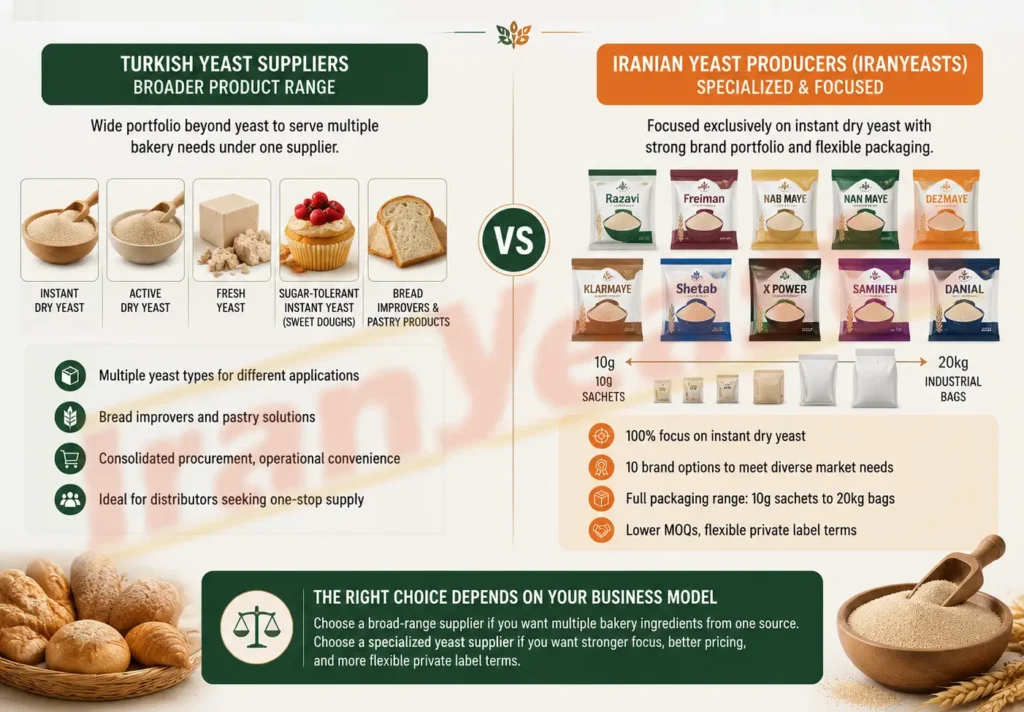
Turkish producers, particularly Pakmaya, offer a genuinely broader product catalog: instant dry yeast, active dry yeast, fresh yeast, sugar-tolerant instant yeast for sweet doughs, and a range of bread improvers and pastry products sold alongside the core yeast line. For a distributor who wants to consolidate procurement of multiple bakery ingredient categories under one supplier relationship, this breadth has real operational value.
Iranian Yeast Producers Focus on Specialized Instant Dry Yeast Supply
Iranian producers tend to specialize more narrowly. IranYeasts, for instance, focuses specifically on instant dry yeast across ten brand options (Razavi, Freiman, Nab Maye, Nan Maye, Dezmaye, Klarmaye, Shetab, X Power, Samineh, and Danial) and a full packaging range from 10g sachets to 20kg industrial bags, without diversifying into bread improvers or adjacent bakery categories.
The right choice here depends on whether a distributor wants a single supplier covering a wide ingredient category, or a specialized supplier with deeper focus, sharper pricing, and more flexible private label terms specifically on yeast.
Side-by-Side Comparison Summary
A practical comparison of Iranian and Turkish yeast based on pricing, supply, certifications, packaging, and export suitability.
| Factor | Iranian Yeast (IranYeasts) | Turkish Yeast (e.g., Pakmaya) |
|---|---|---|
| Production Model | Specialized, mid-scale, export-focused | Large-scale, multi-category producer |
| FOB Pricing Range | $1,500–$2,600/ton | Comparable, often slightly higher |
| Transit to Gulf Ports | 3–5 days sea | 10–15 days sea |
| Transit to Iraq, Afghanistan, Pakistan | 5–10 days land | Longer, less direct routing |
| Halal Certification | ISIRI, GCC and regional acceptance | Yes, broadly recognized |
| Private Label MOQ | From 5 metric tons | Often substantially higher |
| Product Range | Instant dry yeast, focused specialization | Broader: instant, active, fresh, improvers |
| Packaging Formats | 10g sachet to 20kg bulk, multiple PL formats | Wide range, strong retail brand presence |
| Brand Recognition | Regional, growing | Established, internationally recognized |
Which Origin Makes Sense for Your Business
The honest answer depends on what a distributor’s business actually needs.
Choose Turkish supply
if international brand recognition matters to your end customers, if you need a single supplier covering a wide range of bakery ingredient categories beyond yeast, or if your sourcing volume comfortably clears higher private label minimums.
Choose Iranian supply
if your market sits within the Gulf, Iraq, Afghanistan, Pakistan, or Central Asian corridor where transit time directly affects your inventory costs, if you are launching or expanding a private label brand and need accessible MOQ, or if competitive FOB pricing combined with shorter freight exposure matters more to your landed cost than brand name recognition.
Many distributors in practice carry both: a recognized international brand for customers who specifically request it, and a private label Iranian product for the volume of their business where price and margin matter more than brand prestige. This dual-sourcing approach is increasingly common across the markets both origins serve.
Final Thoughts
Iranian and Turkish yeast are not interchangeable commodities, despite both being food-grade instant dry yeast meeting similar technical specifications. The real differences sit in logistics geography, private label accessibility, and the trade-off between an established international brand and a specialized, regionally optimized supplier relationship.
For distributors operating in the corridor between the Gulf and Central Asia, the transit time and MOQ advantages of Iranian supply are difficult to overstate once they show up in actual landed cost and inventory planning. We would encourage any distributor evaluating both origins to request a sample and a formal quote from each, and compare landed cost and lead time directly rather than relying on brand reputation alone.
References
- Pakmaya. (2025). Yeast products: Instant dry yeast, fresh yeast and bread improvers. Pak Ihracat A.S.
- Volza Trade Intelligence. (2025, November 25). Instant dry yeast exports from Turkey: Shipment data and buyer analysis. Volza Global Trade Data.
- Future Market Insights. (2025, March 17). Instant dry yeast market share and key player insights 2025–2035. Future Market Insights Inc.
- MarkNtel Advisors. (2025). Global dry yeast market size, share, demand and trend 2025–2030. MarkNtel Advisors Research.
- Cognitive Market Research. (2025). Global instant dry yeast market report: Competitive analysis and manufacturer profiles. Cognitive Market Research.
Frequently Asked Questions
Find answers to common questions about Iranian instant dry yeast, including certifications, bulk orders, private labeling, export logistics, and delivery worldwide
Is Turkish yeast better quality than Iranian yeast?
Quality is comparable when measured against the same specification benchmarks, particularly Fermentation Power and microbial testing. Both Turkish and Iranian producers manufacture to international food-grade standards. The meaningful differences are in logistics, MOQ structure, and certification acceptance by destination market, not in inherent product quality.
Why is Iranian yeast often cheaper than Turkish yeast for Gulf buyers?
Iranian FOB pricing is comparable to or modestly below Turkish pricing in many cases, but the larger cost advantage typically comes from shorter transit times and lower freight costs to Gulf, Iraqi, and Central Asian destinations, which reduces total landed cost even when FOB prices are similar.
Which origin has better Halal certification for GCC markets?
Both origins offer Halal certification with broad acceptance across GCC markets. Iranian Halal certification is issued by ISIRI and recognized under Codex Alimentarius frameworks. Buyers should confirm the specific certifying body’s recognition with their destination market’s import authority, as requirements can vary by country and product category regardless of origin.
Can I get private label yeast from Turkey at a low MOQ?
Large Turkish producers with established international brands often set private label MOQs significantly higher than smaller regional producers, sometimes in the tens of tons. Iranian suppliers, including IranYeasts, generally offer private label production starting from lower thresholds, around 5 metric tons.
How much faster is shipping from Iran compared to Turkey to Gulf markets?
Sea freight from Bandar Abbas to Gulf ports typically takes 3 to 5 days, compared to approximately 10 to 15 days from Turkish ports depending on routing. For overland markets like Iraq, Afghanistan, and Pakistan, Iran’s direct land border access provides a further logistics advantage.
Does Turkey or Iran offer a wider range of yeast products?
Major Turkish producers like Pakmaya offer a broader catalog including instant dry yeast, active dry yeast, fresh yeast, sugar-tolerant formulations, and bread improvers. Iranian producers tend to specialize more narrowly in instant dry yeast across multiple brands and packaging formats, without diversifying into adjacent bakery ingredient categories.
Should a distributor source from both Turkey and Iran?
Many distributors do exactly this: maintaining a recognized international brand for customers who specifically request it, while sourcing Iranian private label product for the bulk of their volume where price, MOQ flexibility, and shorter transit time matter more than brand prestige.