

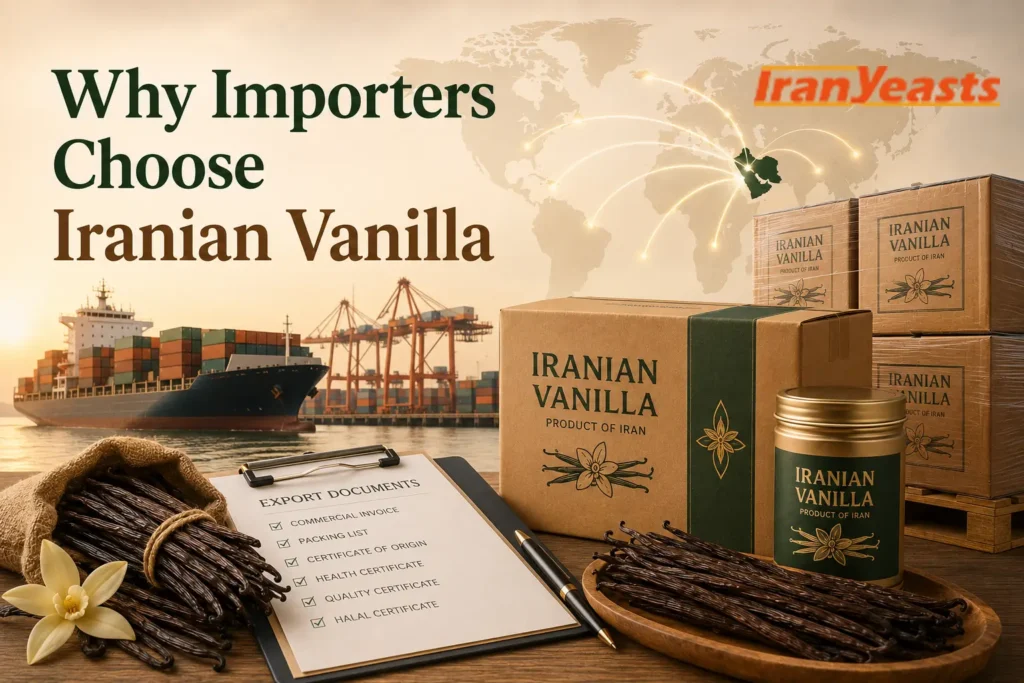
The decision to source vanilla flavoring from Iran rather than from the default choices of China or Europe is not made impulsively. Importers in the Gulf, Central Asia, South Asia, and beyond are experienced buyers. They have existing supplier relationships and established procurement routines. When they shift a portion of their sourcing toward Iranian vanillin, it is because the comparison across several concrete criteria resolves in Iran’s favor.
Understanding why that happens is useful for any importer currently in the evaluation phase. The reasons are not abstract competitive claims. They are specific, verifiable differences in price structure, logistics, certification, documentation, and supplier accessibility that show up in procurement decisions made by experienced buyers across 16 countries.
This post walks through the seven factors that most consistently drive the choice of Iranian vanilla among distributors, wholesalers, and food manufacturers who now source from Iran.
Looking to Import Iranian Instant Dry Yeast at Wholesale Scale?
Get expert guidance on product selection, packaging, export documentation, pricing, and international shipping directly from our export team.
Why Importers Choose Iranian Vanilla: The 7 Reasons That Appear Most Consistently
The seven reasons below are drawn from the operational reality of working with buyers across the Middle East, Central Asia, South Asia, Europe, and Oceania. They are not evenly weighted for every buyer. For a distributor in Iraq, transit time is often decisive. For a food manufacturer in the Gulf, Halal certification depth is the threshold criterion. For a distributor building a private label brand, MOQ accessibility matters most. Understanding which of the seven factors applies to your situation is the starting point for evaluating whether Iranian supply makes sense for your business.
Reason 1: Price Competitiveness That Holds Up After the Full Landed Cost Calculation
The first reason importers look at Iranian vanilla is price. The reason they stay is that the price competitiveness holds up after the full landed cost calculation, not just at the FOB level.
Iranian food-grade vanillin powder is priced within the global food-grade synthetic vanillin range of $15 to $35 per kilogram, with the specific price determined by purity grade, packaging format, and order volume. This range is comparable to Chinese suppliers and meaningfully below European producers for equivalent certification levels.
Where Iranian supply creates a distinct landed cost advantage is in freight. For buyers in the Gulf, Iraq, Central Asia, and South Asia, the combination of shorter sea and land freight routes from Bandar Abbas reduces freight cost by $100 to $200 per metric ton compared to Chinese FOB pricing. When freight, insurance, and transit time costs are added to the comparison, Iranian vanillin frequently lands at a lower total cost than a lower-headline-price Chinese alternative.
Iran’s agricultural exports reached USD 5.2 billion in the fiscal year ending March 2024, a 29 percent increase from the prior year, reflecting the competitive pricing that Iranian food products maintain even against well-established global alternatives. For buyers evaluating the pricing mechanics in detail, our post on factors affecting Iranian vanilla export price covers how each variable in the pricing calculation works.
Reason 2: Transit Proximity That Changes Inventory Economics for Gulf and Regional Buyers
For distributors serving commercial bakeries, confectionery manufacturers, and ice cream producers in the Gulf or Central Asian markets, transit time is not a soft preference. It is a hard variable that determines how much safety stock must be held and how much working capital is tied up in inventory at any given time.
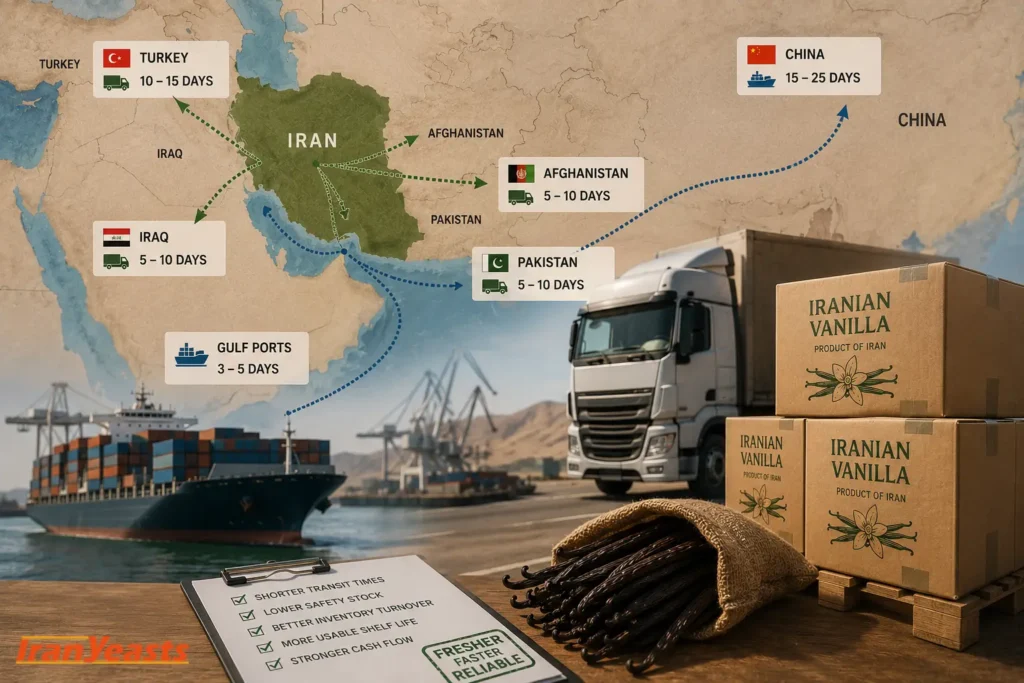
Sea freight from Bandar Abbas to major Gulf ports runs 3 to 5 days. Land freight to Iraq takes 5 to 10 days. Land freight to Afghanistan and Pakistan runs in a similar window. Compare this to 15 to 25 days of sea transit from Chinese ports and 10 to 15 days from Turkish ports.
The practical consequence is significant. A distributor in Dubai or Baghdad who sources from China must maintain 30 to 45 days of safety stock to cover transit variability and supply uncertainty. Sourcing from Iran reduces that requirement to 10 to 15 days for the same risk tolerance. The freed inventory capital can be deployed elsewhere, and the fresher product arriving at destination means more usable shelf life reaches the end customer.
This transit advantage is a structural feature of Iranian geography, not a supplier claim. Iran shares land borders or short sea routes with every major market in the Gulf-to-Central-Asia corridor. No Chinese, European, or Turkish supplier can replicate this without relocating production.
Reason 3: Halal Certification That Requires No Supplementary Steps at Destination
For any food ingredient sold into Gulf, Iraqi, Pakistani, or Afghani markets, Halal certification is not a preference. It is a legal import requirement and a commercial prerequisite. Importers who have worked with suppliers whose Halal certification required supplementary validation at destination have experienced the cost of delays in customs holds, re-inspection fees, and damaged customer relationships when product arrives late.
Iranian vanillin from IranYeasts carries Halal certification issued by ISIRI, Iran’s National Standards Organization, recognized by the Codex Alimentarius Commission as Iran’s competent food safety authority. This certification is accepted across GCC markets, Iraq, Afghanistan, Pakistan, and Central Asian markets without supplementary documentation requirements.
This matters practically because not all Halal certificates issued by all bodies are accepted in all markets without additional steps. An importer who discovers this problem after placing a commercial order faces a difficult situation. Importers who choose Iranian vanillin with ISIRI Halal certification for these specific markets eliminate this risk category entirely.
For a detailed breakdown of how the ISIRI Halal certification framework works, which markets accept it, and what to verify on any Halal certificate before placing an order, our post on Halal-certified yeast export from Iran covers the same certification framework applied across our export range.
Reason 4: Consistent Specification Verified at Batch Level, Not Just at Sample Stage
One of the most common complaints among importers who have worked with smaller or less organized suppliers is the gap between the sample and the commercial shipment. The sample performs well in fermentation or flavoring tests. The first commercial batch arrives and produces different results. The supplier is difficult to reach and the documentation for the commercial batch is incomplete or identical to the sample documentation.
This problem is not unique to any one country of origin. It is a supplier organization problem. The reason Iranian vanillin from IranYeasts avoids it is that batch-level testing is embedded in the production process, not performed as a response to a buyer complaint.
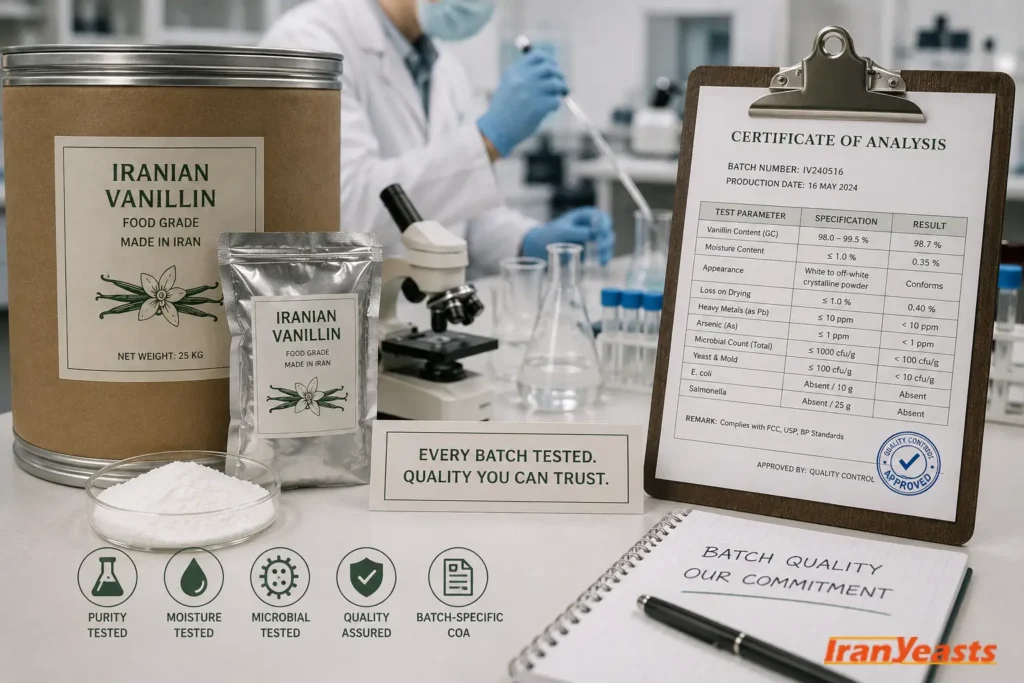
Every production batch of Iranian food-grade vanillin is tested for purity (minimum 98 to 99 percent vanillin content), moisture content, microbial load, and appearance before packaging is approved. The Certificate of Analysis generated from that testing is batch-specific, dated, and contains actual numerical results rather than generic pass or compliant notations. This document is included with every shipment.
Importers who have experienced the gap between a sample and a commercial shipment from other suppliers consistently identify batch-level COA documentation as a key reason they choose to stay with a supplier who provides it consistently. It is not a premium feature. It is a baseline quality management practice. But it is not universal in the vanillin supply market, and its consistent provision is a meaningful differentiator.
Reason 5: Private Label Access From a Volume That Mid-Sized Distributors Can Actually Commit To
Most mid-sized distributors reach a point in their market development where reselling a third-party brand at thin margins stops being the right business model. The next step, building a private label brand, requires a manufacturing partner willing to produce at the buyer’s own brand name from a minimum order volume that does not require committing to 20 or 30 tons of a new product before market reception is confirmed.
Large European vanillin producers require very high private label minimum order quantities before running custom production batches. The barrier to entry for private label through a European manufacturer is too high for a distributor who wants to test a new market segment.
Iranian vanillin from IranYeasts offers private label production from a 500 kilogram minimum order across multiple retail and industrial packaging formats. Custom logo printing, Arabic and English labeling, packaging design support, and barcode integration are all included in the standard private label service. Halal certification applies to private label production runs at the same standard as branded product.
For a distributor in Iraq, the UAE, or Uzbekistan who wants to launch a vanilla product under a locally recognized brand name rather than continuing to resell an imported brand, this accessibility at 500 kilograms is often the specific difference between a private label business being viable now versus deferred indefinitely.
Reason 6: Complete Documentation That Arrives as Standard, Not After a Request
This reason sounds operational rather than strategic, but importers who have experienced customs delays caused by missing, expired, or incorrectly formatted documentation understand how much commercial damage a single delayed shipment can cause when bakery clients are waiting for an ingredient.
Every IranYeasts vanillin export shipment includes as standard: Certificate of Analysis for the specific production batch, Halal Certificate (ISIRI), HACCP Compliance Certificate, Certificate of Origin, Commercial Invoice, Packing List, and Bill of Lading or CMR for land freight. These documents are prepared in parallel with production, so they are ready at the point of loading rather than assembled after a buyer request.
Importers who have worked with suppliers where documentation assembly required follow-up, where certificates had expired between issuance and shipment arrival, or where the Certificate of Origin required corrections that delayed customs clearance, consistently identify documentation reliability as a criterion when choosing between suppliers of comparable product quality and price.
The documentation package accompanying an Iranian vanillin shipment is not extraordinary. It is simply complete, current, and predictably available with every order. For buyers whose customers will not accept excuses for a delayed shipment, this predictability has real commercial value.
Reason 7: A Supplier Relationship Built on Sample First, Not Sales Pitch First
The final reason is the one most difficult to quantify but the one experienced buyers mention most consistently when asked what made them comfortable enough to place a first commercial order.
IranYeasts offers free samples by agreement to new buyers before any commercial commitment is made. The sample is accompanied by its own Certificate of Analysis so the buyer can verify that the sample specification matches what will be produced at commercial scale. Buyers are actively encouraged to run the product in their own facility or with their own bakery or confectionery clients before placing an order.
This approach reflects a specific understanding of how trust is built in the food ingredient trade. A buyer who has tested a product under real production conditions and seen the COA match the actual performance is buying with confidence rather than faith. A buyer who has been asked to commit to a commercial order before receiving a sample is assuming a risk they should not have to assume.
The sample-first approach is not universal among vanillin suppliers, particularly those operating through multiple layers of trading intermediaries. For buyers who have experienced the discomfort of a commercial order that performed differently from the sample, a supplier who inverts that sequence and leads with the product rather than the sales proposal stands out.
What Importers Who Choose Iranian Vanilla Typically Find After the First Order
The pattern among buyers who place a first order of Iranian vanillin is consistent enough to describe reliably.
The first order is almost always cautious. A 500 kilogram to 1 metric ton trial run, often below what would be commercially optimal at a volume discount. Documentation is reviewed carefully. The product is tested at the buyer’s facility or with a key bakery or confectionery client.
When the product performs to specification and the documentation is complete and accurate, the second order is larger. By the third order, the buyer has established a pricing bracket, confirmed the logistics route, and begun discussing whether private label makes sense for their market.
This progression from cautious trial to established supply relationship typically unfolds over two to four orders. It is not unusual for a buyer who started with a 500kg trial to be placing 5 to 10 ton repeat orders within 12 months. The variable that determines whether this progression happens is not primarily price. It is whether the product performs consistently, the documentation is reliable, and the supplier is responsive when questions arise.
Final Thoughts
The choice of Iranian vanilla among importers in 16 countries and counting is not an accident of geography or a temporary price advantage. It is the result of seven specific factors resolving consistently in favor of an Iranian supply relationship for buyers in particular geographic markets and business situations.
Not every importer is the right fit for Iranian supply. Buyers who need a globally recognized premium brand on the label, or who are sourcing for heavily regulated markets where additional certifications beyond ISIRI Halal are required, may find other origins better suited to their specific situation. Importers who are honest about this are the ones worth building long-term relationships with. The right supplier for your business is the one whose capabilities match your market’s actual requirements.
References
- IMARC Group. (2026). Iran agribusiness market size, share and forecast 2026–2034. IMARC Group Market Intelligence.
- Mordor Intelligence. (2026, January 15). Vanillin market size, share and forecast 2026–2031. Mordor Intelligence Research.
- Alibaba.com. (2025, December 1). Vanillin food grade supplier guide: Sourcing from top manufacturers. Alibaba Food and Beverage Intelligence.
- Bazargani Gholampour Trading Group. (2025, May 1). Export of food products from Iran: Markets, advantages and challenges. Gholampour International Trade Blog.
- Future Market Insights. (2026, May 8). Vanillin market trends, growth and forecast 2026–2036. Future Market Insights Inc.
Frequently Asked Questions
Find answers to common questions about Iranian instant dry yeast, including certifications, bulk orders, private labeling, export logistics, and delivery worldwide
Why do importers in the Gulf prefer Iranian vanilla?
The primary reasons are transit time (3 to 5 days from Bandar Abbas versus 15 to 25 days from Chinese ports), Halal certification accepted without supplementary steps across GCC markets, and competitive landed cost that frequently undercuts Chinese alternatives after freight is included.
Is Iranian vanillin Halal certified?
Yes. Iranian food-grade vanillin from IranYeasts carries Halal certification issued by ISIRI, Iran’s National Standards Organization, which is recognized by the Codex Alimentarius Commission. This certification is accepted across the GCC, Iraq, Pakistan, Afghanistan, and Central Asian markets.
What purity does Iranian vanillin come in?
IranYeasts exports food-grade vanillin at 98 to 99 percent vanillin content, verified by batch testing and documented in the Certificate of Analysis included with every shipment. For a full technical overview of what Iranian vanillin delivers, see our Iranian vanilla production overview.
Can I start with a small order before committing to a larger volume?
Yes. The minimum order quantity is 500 kilograms for standard bulk export orders. IranYeasts also provides free samples by agreement for new buyers before any commercial commitment. Testing the product in your own facility before placing an order is strongly encouraged.
Do importers receive complete documentation with their vanillin shipment?
Yes. Every shipment includes as standard: Certificate of Analysis, Halal Certificate, HACCP Certificate, Certificate of Origin, Commercial Invoice, Packing List, and Bill of Lading or CMR. All documents are prepared before shipment release, not assembled on request after departure.
Is private label production available?
Yes, from a 500 kilogram minimum order. Custom packaging, logo printing, multilingual labeling (Arabic, English, French, Persian), and packaging design support are all available. Halal certification covers private label production runs at the same standard as branded product.
How does Iranian vanillin compare to Chinese vanillin for Middle Eastern buyers?
For buyers in the Gulf, Iraq, and Central Asian markets, the landed cost advantage of Iranian supply comes primarily from freight savings of $100 to $200 per metric ton and significantly shorter transit times. Chinese vanillin dominates global production volume and sets the market price floor, but for this specific geographic corridor, Iranian supply offers a meaningfully better logistics and landed cost position.
What happens after the first order?
The pattern among buyers who place a first trial order is consistent: when the product performs to specification, documentation is complete, and the supplier is responsive, the second order is larger and the relationship deepens. Most buyers who start with a 500kg to 1 ton trial are placing 5 to 10 ton repeat orders within 12 months.