

A bakery chain expanding into three new cities recently discovered that its usual yeast supplier could not guarantee delivery volumes for the next two quarters, and the reason had nothing to do with that supplier’s reliability specifically.
Instant dry yeast has shifted from a commodity ingredient bakers assumed would always be available to a product category shaped by raw material costs, regional production shifts, and uneven supply across export corridors. Buyers who have not looked closely at where the broader market is heading risk locking into contracts that no longer reflect where pricing or availability is actually moving.
This article breaks down the current size and growth trajectory of the worldwide market for this ingredient, the regions driving demand, and what these shifts mean for anyone sourcing yeast in bulk in 2026.
Looking to Import Iranian Instant Dry Yeast at Wholesale Scale?
Get expert guidance on product selection, packaging, export documentation, pricing, and international shipping directly from our export team.
Where the Instant Dry Yeast Market 2026 Numbers Actually Stand
The global instant dry yeast market is estimated at 1.15 billion US dollars in 2026, with growth projected to reach 1.85 billion US dollars by 2033, a compound annual growth rate of roughly 6.9 percent. This places instant dry yeast among the faster-growing segments within the broader dry yeast category, ahead of the more modest growth rates typically reported for active dry yeast and fresh yeast formats combined.
Why This Segment Is Outpacing Broader Yeast Categories
Convenience is doing most of the work behind this growth. Instant dry yeast requires no proofing step before use, which matters increasingly to commercial bakeries running high-speed automated lines as well as smaller operations trying to reduce labor time per batch. That efficiency argument applies just as strongly to importers making a first-time switch, a comparison covered in more detail in Iran Instant Dry Yeast: Why It’s Becoming a Top Choice for Bulk Importers Worldwide.
How Instant Dry Yeast Compares to Active Dry Yeast in Current Demand
Growth in instant dry yeast has not eliminated demand for active dry yeast, but the two formats increasingly serve different buyers rather than competing head to head. Active dry yeast still holds a substantial share of the broader baker’s yeast category, largely because of legacy equipment and process familiarity in some large-scale bakeries built around it.
The practical differences between the two, and which one actually suits a given production line, come down to more than fermentation speed alone. A fuller breakdown of shelf life, handling requirements, and cost tradeoffs is available in Active Dry Yeast vs. Instant Dry Yeast for Export: What Every Importer and Distributor Should Know.
Regional Demand Is Not Growing Evenly
Global growth figures can hide a lot of regional variation, and instant dry yeast is a clear example. Demand is expanding fastest in regions where bakery infrastructure is still being built out, rather than in mature markets where consumption has plateaued.
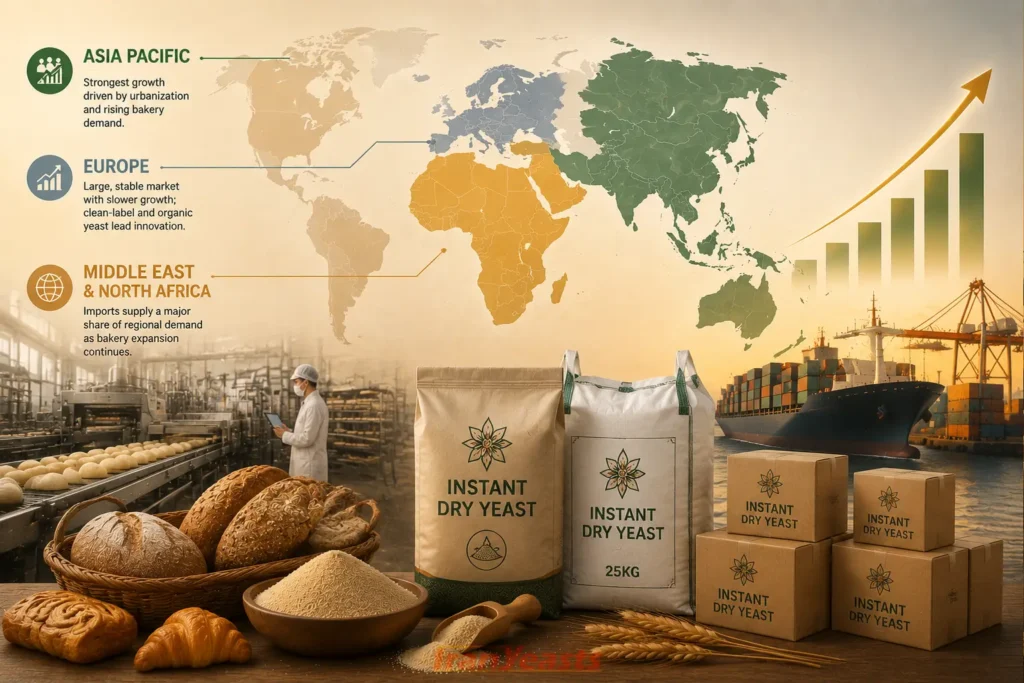
- Asia Pacific continues to add production and consumption capacity as urbanization drives packaged bakery demand.
- Europe remains a large, stable market but is growing more slowly, with clean-label and organic yeast variants absorbing most of the innovation spend.
- The Middle East and North Africa import a significant share of the yeast used in the region, since domestic production capacity has not kept pace with bakery expansion.
That last point matters directly for anyone sourcing into this region. A closer look at how demand, pricing, and supplier competition are actually playing out across MENA markets is available in Yeast Market in the Middle East.
What Is Actually Driving This Growth Through 2026 and Beyond
A handful of factors are consistently cited across current market analysis, and they broadly fall into three categories:
- Bakery expansion in emerging markets, where rising incomes are increasing demand for packaged and convenience bread products rather than only traditional home baking.
- Automation in commercial baking, where instant yeast’s no-proofing requirement fits high-speed production lines better than active dry or fresh formats.
- Import dependence in regions without domestic yeast production capacity, which keeps demand tied to reliable export relationships rather than local sourcing alone.
None of these drivers are new, but their combined effect is why growth in this segment has held up even as raw material and shipping costs have fluctuated elsewhere in the food ingredient supply chain.
What Rising Demand Means for Bulk Pricing in 2026
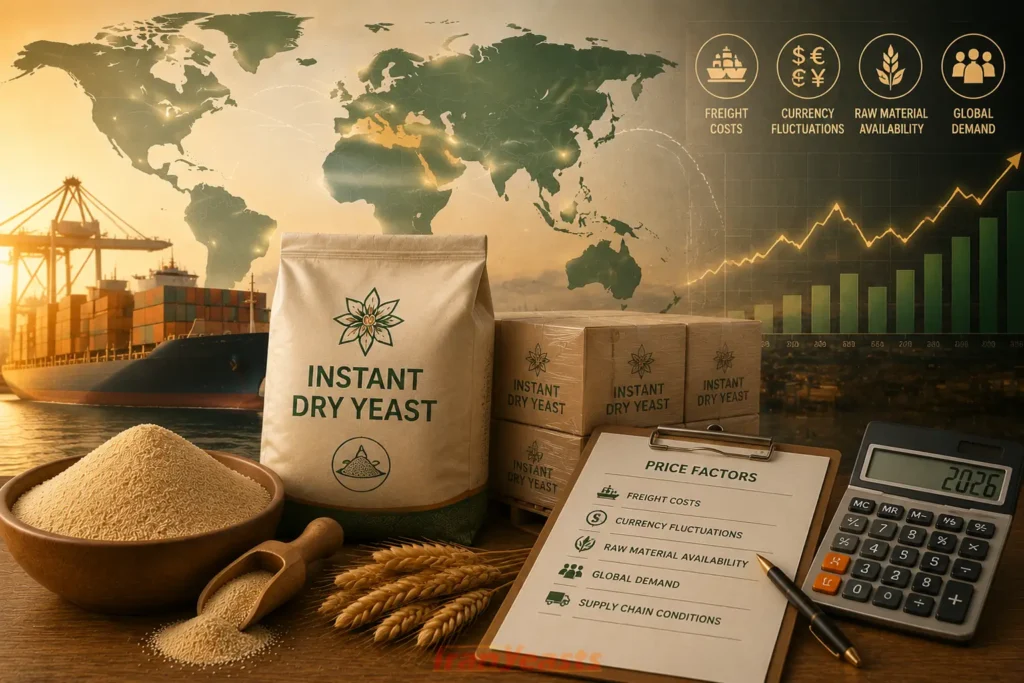
Growing demand does not automatically mean rising prices for every buyer, but it does mean pricing has become less predictable than it was a few years ago. Freight costs, currency fluctuations between exporting and importing countries, and raw material availability all move independently of underlying yeast demand, which is why two buyers placing similar orders in the same month can end up with noticeably different landed costs.
Understanding what actually moves the final price, separate from the base FOB or CIF quote a supplier first offers, is covered in Bulk Dry Yeast Price from Iran in 2025: FOB, CIF, and What Affects the Final Cost.
What This Growth Means for Buyers Evaluating New Suppliers
A growing, more competitive market is generally good news for buyers, but it also means more suppliers entering the space with inconsistent quality control or documentation practices. Growth attracts new entrants faster than it attracts experienced ones.
For a buyer weighing a new supplier relationship against an existing one, this is exactly the moment to apply more scrutiny rather than less. A structured framework for that evaluation, covering technical specification, certification, and logistics reliability, is laid out in How to Evaluate a Bulk Yeast Supplier.
Final Thoughts
The instant dry yeast market is growing for reasons that are unlikely to reverse in the near term: bakery infrastructure is still expanding in several large emerging markets, and automation continues to favor formats that skip the proofing step. For buyers, the practical takeaway is less about the headline growth number and more about what it signals for their own sourcing decisions.
A growing market brings more suppliers, more price variation, and more pressure to lock in reliable relationships before demand tightens further in import-dependent regions. Buyers who treat 2026 as a year to reassess supplier reliability, not just price, are better positioned than those waiting for a disruption to force the decision.
References
- Coherent Market Insights. (2026). Instant dry yeast market: Share, size and industry analysis. Coherent Market Insights Pvt. Ltd.
- IndexBox. (2026, May 3). Yeast ingredient market in Middle East: Prices, size, forecast, and companies. IndexBox Inc.
- MarketsandMarkets. (2026). Baker's yeast market report 2026-2031. MarketsandMarkets Research Pvt. Ltd.
- Mordor Intelligence. (2026, January 15). Bakers yeast market size, forecast, share analysis 2026-2031. Mordor Intelligence Pvt. Ltd.
- Future Market Insights. (2026, June 5). Dry yeast market size and demand forecast 2026-2036. Future Market Insights Inc.
Frequently Asked Questions
Find answers to common questions about Iranian instant dry yeast, including certifications, bulk orders, private labeling, export logistics, and delivery worldwide
How big is the global instant dry yeast market in 2026?
The global instant dry yeast market is estimated at approximately 1.15 billion US dollars in 2026, with projected growth to around 1.85 billion US dollars by 2033.
What is driving growth in the instant dry yeast market?
Growth is driven primarily by expanding bakery infrastructure in emerging markets, increasing automation in commercial baking that favors instant yeast’s no-proofing requirement, and import-dependent regions that rely on consistent export supply.
Is instant dry yeast growing faster than active dry yeast?
Instant dry yeast is currently reporting a stronger growth rate than the broader active dry yeast category, largely due to convenience and compatibility with high-speed automated bakery lines.
Which regions are driving the most demand for instant dry yeast?
Asia Pacific is expanding fastest due to urbanization and rising packaged bakery consumption, while the Middle East and North Africa remain heavily import-dependent, which keeps demand tied closely to export relationships.
Does rising market demand mean yeast prices will keep increasing?
Not necessarily on its own. Pricing is influenced by freight costs, currency movement, and raw material availability as much as by underlying demand, which is why landed costs can vary between buyers even in a growing market.
Should buyers expect more supplier options as the market grows?
Yes, but more options also means more variation in quality control and documentation practices among newer entrants, making supplier evaluation more important rather than less as the market expands.