

A bakery calls to reorder yeast and asks whether the improver is included. A distributor stocks both and cannot explain to a customer why they need each one. The mix-up is common, and it costs money in both directions: bakeries buy improver they do not need, or blame yeast for problems yeast cannot fix.
The two products are not alternatives. They do different jobs at different points in the same dough, and neither can stand in for the other at any dose. Knowing which one is responsible for which result is what lets a production manager fix a flat loaf in one trial instead of five, and lets an importer ship an improver blend that is actually legal at the destination.
This guide sets out what each one does, what is inside a typical improver, how their doses differ, what goes wrong when you use one without the other, and the regulatory limits that decide which improver you can ship into which market.
Key Takeaways
- Yeast makes the gas that raises bread. Bread improver makes no gas; it helps the dough hold that gas, handle well and stay soft longer.
- Neither product can replace the other. Improver without yeast gives no rise; yeast without improver can give low volume on weak flour.
- Improver is a blend of enzymes, oxidants, emulsifiers and other functional ingredients, usually dosed at 0.5 to 4.0 percent of flour weight.
- Regulatory limits apply to individual improver components, so the component list matters more than the brand.
- When troubleshooting, change one variable at a time and keep the yeast dose fixed while you trial an improver.
Looking to Import Iranian Yeast at Wholesale Scale?
Get expert guidance on yeast type, packaging format, export documentation, pricing, and international shipping directly from our export team.
Bread Improver vs Yeast: Two Different Jobs in the Same Dough
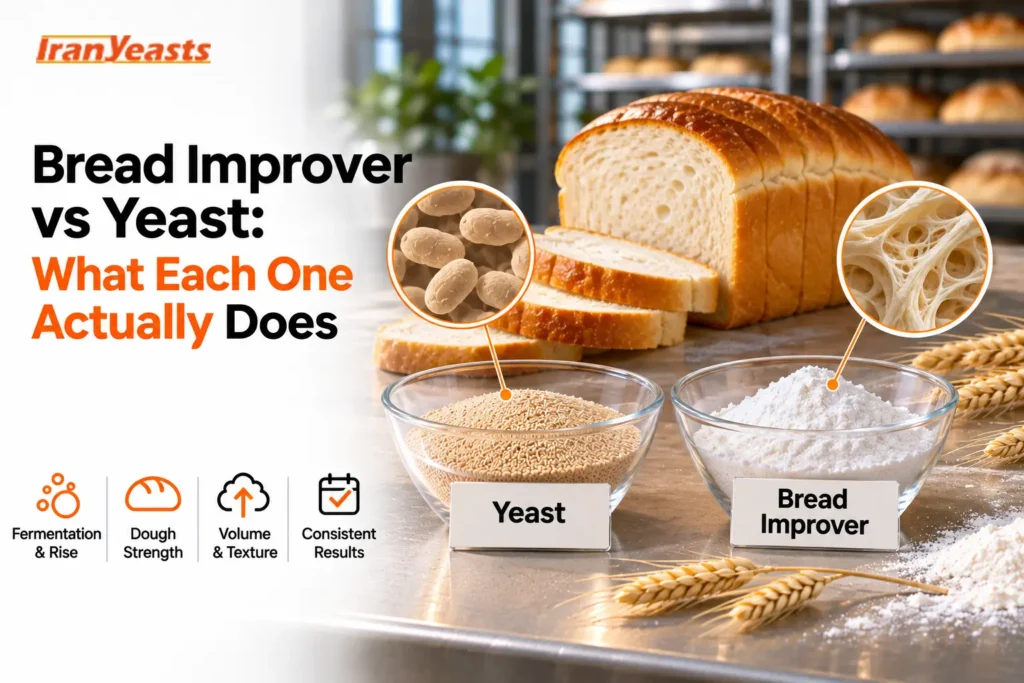
The difference between bread improver and yeast is simple: yeast produces the gas that makes bread rise, and bread improver helps the dough hold that gas. Yeast is a living organism. Like any instant dry yeast, Iranian instant dry yeast works by consuming sugars in the dough and producing carbon dioxide and alcohol. That gas is what lifts the loaf, and nothing else in the formula does that job.
Bread improver generates no gas at all. It is a blend of functional ingredients that changes how the dough behaves around the gas the yeast is producing: how much of it the gluten network can hold, how the dough handles on the line, how well it tolerates over-proofing, and how long the finished loaf stays soft.
Yeast makes the gas. Improver controls whether the dough can keep it. A bakery with weak flour and no improver loses volume because the gluten cannot hold what the yeast produces. A bakery with improver and dead yeast gets no rise at all, because there is nothing to hold.
| Function | Yeast | Bread improver |
|---|---|---|
| Produces carbon dioxide | Yes, this is its lifting role | No, none |
| Living organism | Yes | No, a blend of functional ingredients |
| Strengthens the gluten network | No | Yes, through oxidants and emulsifiers |
| Supplies extra sugars for fermentation | No, it consumes them | Yes, enzymes release sugars from starch |
| Affects dough machinability | Indirectly | Yes, directly |
| Delays staling | No | Yes, through emulsifiers and enzymes |
| Typical dose on flour weight | 0.6 to 1.5 percent | 0.5 to 4.0 percent |
| Can replace the other | Never | Never |
If you are still choosing which yeast format to buy before working out whether you need an improver at all, our guide to the main types of commercial yeast covers that earlier decision.
What Is Inside a Bread Improver?
Bread improver is a formulated blend, not a single substance, and two improvers from different suppliers can share a name while containing very different things. BAKERpedia lists the usual component classes as pH regulators, mineral yeast food, enzymes, redox agents, emulsifiers and vital wheat gluten.
Knowing which classes are in the blend you buy matters more than the brand on the sack, because regulatory limits and label declarations attach to individual components rather than to the blend. BAKERpedia puts the usual dough conditioner dose at 0.5 to 4.0 percent of flour weight, with whole wheat and high-fiber breads generally needing more to compensate for weaker gluten development.
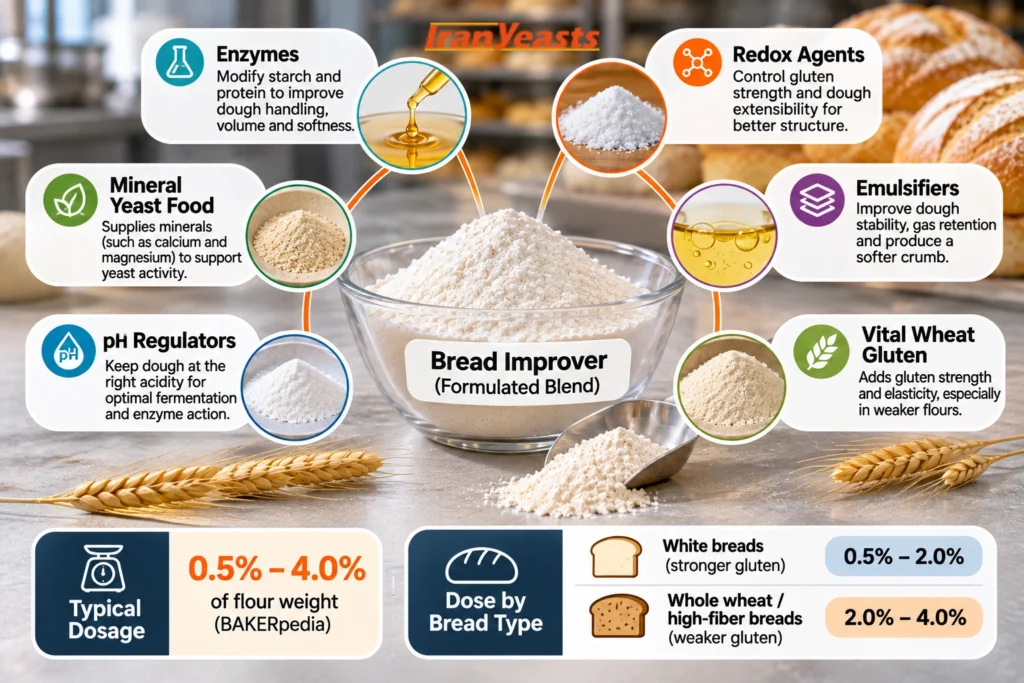
| Component class | What it does | Typical examples |
|---|---|---|
| Oxidizing agents | Strengthen gluten, increase volume and gas retention | Ascorbic acid, azodicarbonamide (where permitted) |
| Reducing agents | Relax gluten, cut mixing time, improve extensibility | L-cysteine, inactive yeast |
| Enzymes | Release sugars from starch, modify gluten and starch | Fungal alpha-amylase, xylanase |
| Emulsifiers | Strengthen dough, soften crumb, delay staling | Mono- and diglycerides, DATEM, SSL |
| Mineral yeast food | Supplies nutrients and adjusts water hardness | Calcium salts, ammonium salts |
| Vital wheat gluten | Raises protein content in weak flour | Dried wheat gluten |
| pH regulators | Hold the dough in the right acidity range | Food acids and buffering salts |
Quick Insight
- Improver is a blend, not one ingredient, and formulations differ widely between suppliers.
- Ask for the full component list, not just the brand name and the dose.
- Whole wheat and high-fiber lines usually need more improver than white bread.
How Do the Enzymes in Bread Improver Help Yeast?
Enzymes give yeast more sugar to ferment. They do not ferment anything themselves, but they turn starch into sugars the yeast you already added can use, so it keeps producing gas for longer. This is the part of an improver that interacts most directly with yeast, and the part most often misunderstood.
Flour starch is not directly fermentable by yeast. Alpha-amylase cuts damaged starch into dextrins and smaller sugars. Beta-amylase, which is naturally present in flour, breaks those dextrins down further into maltose. The yeast then uses its own maltase to convert maltose into glucose, which it ferments into carbon dioxide and alcohol.
There is such a thing as too much. New Zealand’s BakeInfo reference notes that excess alpha-amylase can completely liquefy starch, which in practice shows up as sticky dough and a gummy crumb. It also puts about 6 percent starch damage as roughly right for bread flour, the level that gives amylase something to work on without going too far.
Quick Tip
If a bakery reports slow proofing, check the yeast first and the enzyme level second. Adding more improver to fix a slow rise treats the symptom rather than the cause. Our guide to common yeast problems in baking sets out the order to rule causes out.
How Much Bread Improver and Yeast Should You Use?
Use instant dry yeast at roughly 0.6 to 1.5 percent of flour weight and bread improver at 0.5 to 4.0 percent, but do not compare the two numbers. Both are dosed on flour weight, which makes them look comparable on a formula sheet. The yeast figure is set by your fermentation schedule and dough temperature. The improver figure is set by your flour quality and your product.
| Basis | Instant dry yeast | Bread improver |
|---|---|---|
| Set by | Fermentation schedule and dough temperature | Flour strength and product type |
| Typical range | 0.6 to 1.5 percent of flour | 0.5 to 4.0 percent of flour |
| Per 100 kg flour | 600 to 1,500 g | 500 to 4,000 g |
| Effect of doubling the dose | Faster proof, risk of over-proofing and yeasty flavor | Stronger dough, risk of tight crumb and poor extensibility |
| Effect of leaving it out | No rise at all | Lower volume, weaker handling, faster staling |
One number inside the improver is far smaller than either of these. According to BAKERpedia’s ascorbic acid profile, ascorbic acid, the most common oxidizing agent, is used in bread and buns at levels up to about 150 ppm of flour weight, which is 0.015 percent. Early research in the 1930s found that as little as 20 to 30 mg per kilogram of flour raised bread volume by around 20 percent. Our instant dry yeast dosage guide sets out the yeast side of this calculation in full.
What Goes Wrong When You Use One Without the Other?
Each product fails in its own way, so the symptom tells you which one is missing or wrong. Reading it correctly saves the most common mistake: adjusting yeast to fix a dough-strength problem.
| Symptom | Likely cause | What to change |
|---|---|---|
| No rise at all | Yeast dead, omitted or killed by hot water | Test the yeast, check water temperature |
| Rises, then collapses in the oven | Gluten cannot hold the gas: weak flour or no improver | Add or increase improver, check flour protein |
| Good volume, stales within a day | No emulsifier or enzyme fraction in the formula | Use an improver with a crumb-softening component |
| Dough sticky and hard to machine | Excess alpha-amylase or over-dosed improver | Reduce improver, check the enzyme level |
| Tight, dense crumb despite full proof | Over-dosed oxidant, dough too strong | Reduce improver, lengthen bulk fermentation |
| Strong yeasty aroma | Too much yeast for the fermentation time | Reduce yeast, not improver |
The last row matters most for a yeast supplier fielding complaints. A yeasty aftertaste is a yeast dosage problem, and no amount of improver corrects it. The rows above it are improver problems that get misdiagnosed as yeast quality issues more often than anything else.
An Example From the Bakery Floor
Picture a bread bakery in Basra that switches to a cheaper, lower-protein flour during a supply shortage. Its loaves still rise well in the proofer, but they flatten in the oven and come out with a pale, tight top. The first instinct is to call the yeast supplier. The symptom says otherwise: the yeast produced the gas, and the weaker gluten could not hold it through oven spring. The fix is a flour test and an improver with an oxidizing component, while the yeast dose stays exactly where it was.
What Regulatory Limits Apply to Bread Improver Ingredients?
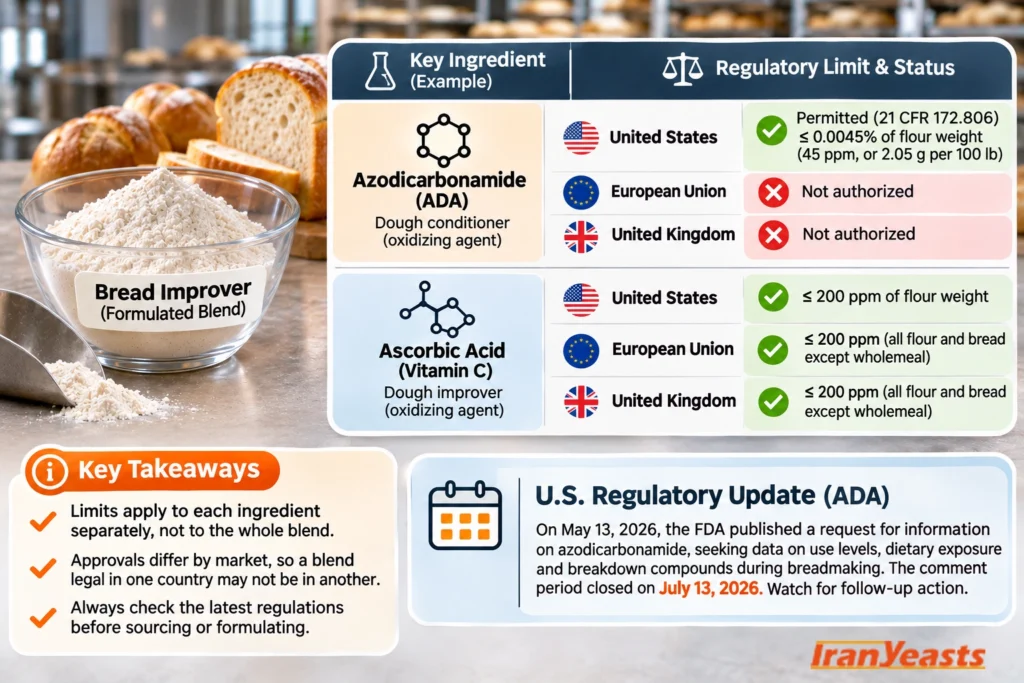
Limits apply to each improver component separately, and they differ from market to market. This is where improver and yeast diverge most sharply for a trader. Instant dry yeast is a single, widely accepted ingredient. Bread improver is a blend whose components carry different approvals in different countries, so a blend that is legal in one destination may not be in another.
Azodicarbonamide is the clearest example. In the United States, 21 CFR 172.806 permits it as an aging and bleaching ingredient in cereal flour and as a dough conditioner in bread baking, in a total amount not exceeding 0.0045 percent of flour weight. That is 45 parts per million, or 2.05 grams per 100 pounds of flour, and the ceiling covers the combined amount added at the mill and at the bakery. Azodicarbonamide is not authorized as a food additive in the European Union or the United Kingdom, so a blend containing it cannot be sold into those markets.
The US position is also under review. On May 13, 2026, the FDA published a request for information on azodicarbonamide as part of a post-market safety assessment, seeking data on use levels, dietary exposure and the compounds it breaks down into during breadmaking. The comment period closed on July 13, 2026. Buyers formulating now should watch for follow-up action rather than assume the current limit is permanent.
Ascorbic acid is treated more permissively. BAKERpedia reports a maximum of 200 ppm of flour weight in the United States, and 200 ppm in all flour and bread except wholemeal in the United Kingdom and the European Union.
Quick Insight
- Yeast is one ingredient. Improver is a blend with per-component limits.
- Azodicarbonamide is capped at 45 ppm of flour weight in the US, counting mill and bakery additions together, and is not authorized in the EU or UK.
- Ascorbic acid is capped at 200 ppm in the US, and at 200 ppm in the UK and EU except in wholemeal.
- Check the component list against each destination market before shipping.
How Do You Choose a Bread Improver for Your Flour and Market?
Choose the improver to fix your flour’s specific weakness. There is no universal blend, because the product exists to compensate for whatever the flour lacks. A blend that works in a Kabul bakery running local flour may be wrong for an Erbil bakery running imported flour at a different protein level. A practical selection sequence:
- Test the flour first, especially protein content and falling number, before choosing any blend.
- Identify the defect you are correcting: low volume, poor machinability, fast staling or short shelf life.
- Match the component class to that defect rather than buying a general-purpose blend.
- Check every component against the regulations of the destination market.
- Trial at the supplier’s recommended dose, then adjust in steps of 0.25 percent.
- Hold the yeast percentage fixed while you trial the improver, so you are changing only one variable.
That final step is the one bakeries skip most often. Changing yeast and improver in the same trial makes the result impossible to read, and the usual outcome is that both get blamed. Storage matters too, since improver held in heat and humidity loses enzyme activity much as yeast loses viability. Our guide to storing bulk dry yeast covers conditions that suit both products.
Author's Suggestion
If you distribute to bakeries, sell yeast and improver as a matched pair rather than two unrelated line items. Ask each customer for their flour protein level and main product before recommending a blend, and include the full component list with every improver shipment. It shortens complaint calls, and it keeps you from shipping a blend that the destination market does not allow.
Buyers sourcing yeast and improver together can browse the bread improvers in our shop or contact Irany Yeasts for specifications and export terms.
Conclusion
Yeast and bread improver are not competing products. Yeast makes the gas that lifts the loaf. Improver decides whether the dough can hold that gas, how it handles, and how long the result stays fresh. A bakery always needs the first, and needs the second depending on its flour.
For importers, the practical difference is regulatory. Yeast is one ingredient with broad acceptance. Improver is a blend whose components carry separate limits that vary by market, so the component list matters more than the brand. Test the flour, fix one variable at a time, and check every component against the destination market before you ship.
References
- BAKERpedia. (n.d.). Ascorbic acid. https://bakerpedia.com/ingredients/ascorbic-acid/
- BAKERpedia. (n.d.). Dough conditioners. https://bakerpedia.com/ingredients/dough-conditioners/
- Baking Industry Research Trust. (n.d.). Enzymes in breadmaking. BakeInfo. https://www.bakeinfo.co.nz/facts/bread/bread-ingredients/enzymes-in-breadmaking/
- U.S. Food and Drug Administration. (2026, May 13). Azodicarbonamide (ADA); Request for information. Federal Register, 91, 27060. https://www.federalregister.gov/documents/2026/05/13/2026-09508/azodicarbonamide-ada-request-for-information
- U.S. Food and Drug Administration. (n.d.). 21 CFR 172.806: Azodicarbonamide. Electronic Code of Federal Regulations. https://www.ecfr.gov/current/title-21/chapter-I/subchapter-B/part-172/subpart-I/section-172.806
Frequently Asked Questions
Quick answers to common questions about bread improver and yeast, from what each one does to dosage and regulatory limits.
What is the difference between bread improver and yeast?
Yeast produces the carbon dioxide that makes bread rise. Bread improver produces no gas at all. It is a blend of enzymes, oxidants, emulsifiers and other functional ingredients that changes how well the dough holds the gas the yeast creates, how it handles on the line, and how long the loaf stays soft. Neither can replace the other.
Can I use bread improver instead of yeast?
No. Improver contains no living organism and generates no gas, so dough made with improver and no yeast will not rise. The reverse fails for a different reason: yeast without improver still rises, but weak flour may not hold the gas, which gives lower volume and faster staling.
What is bread improver made of?
It is a blend, not a single substance. The usual component classes are pH regulators, mineral yeast food, enzymes, redox agents, emulsifiers and vital wheat gluten. Formulations differ widely between suppliers, so ask for the component list rather than relying on the product name.
How much bread improver should I use per kg of flour?
Most blends are used at 0.5 to 4.0 percent of flour weight, which is 5 to 40 g per kilogram of flour, or 500 to 4,000 g per 100 kg. Whole wheat and high-fiber breads generally need the higher end. Always start at the supplier’s stated dose for your specific blend.
Do I still need bread improver if I use good quality yeast?
It depends on your flour, not your yeast. Improver corrects flour weakness and extends shelf life, and good yeast does not change either of those things. Strong flour on a long fermentation may need no improver at all. Weak flour on a short schedule usually does.
Is azodicarbonamide allowed in bread improver?
In the United States it is permitted under 21 CFR 172.806 at a total not exceeding 45 parts per million of flour weight, counting mill and bakery additions together. It is not authorized in the European Union or the United Kingdom, and the FDA opened a request for information on it in May 2026, so confirm the position in each destination market before shipping.
Why did my dough rise and then collapse in the oven?
That is usually a dough strength problem rather than a yeast problem. The yeast produced gas, but the gluten network could not hold it through oven spring. Check flour protein and consider an improver with an oxidizing component. Adding more yeast makes this worse, not better.