

For food manufacturers and regional distributors sourcing vanilla flavoring in volume, the decision of where to buy and at what scale has a measurable impact on production cost, supply chain reliability, and market competitiveness. Most buyers start with price. The ones who build durable procurement strategies think through seven or eight factors beyond it.
Buying Iranian vanilla in bulk is not simply a cost play. Done with the right supplier, it is a supply chain decision that improves unit economics, reduces documentation overhead, extends your planning horizon, and in specific geographic markets, gives you a logistics advantage that no competitor sourcing from Europe or China can match.
This post covers the eight core benefits, with specific numbers and operational context for each, so the case is grounded in verifiable procurement reality rather than supplier marketing.
Looking to Import Iranian Instant Dry Yeast at Wholesale Scale?
Get expert guidance on product selection, packaging, export documentation, pricing, and international shipping directly from our export team.
What "Buying Iranian Vanilla in Bulk" Actually Means
Before covering the benefits, it is worth being precise about the product. Iranian vanilla export refers to food-grade synthetic vanillin powder produced in Iran at 98 to 99 percent vanillin purity, supplied in commercial quantities from 500 kilograms upward. This is the same compound found in vanilla beans, produced through the guaiacol-glyoxylic acid synthesis route to food-grade specification.
Vanillin is one of the most important edible flavors widely used in food, sweets, candy, ice cream, drinks, and cosmetics. It is the most important flavor component in vanilla and is extensively used in various flavoring foods that require milk-type flavor enhancement.
Food-grade synthetic vanillin is valued for its strong fragrance, stability, and compatibility with a wide range of food formulations, and is produced in facilities complying with ISO, HACCP, FSSC 22000, Halal, and related standards.
This is the product underlying every benefit below. For a detailed breakdown of how Iranian food-grade vanillin is produced and what specifications buyers should verify, see our post on Iranian vanilla production overview.
Benefit 1 : Significantly Lower Per-Unit Cost Compared to Small-Batch Purchasing
The most quantifiable benefit of bulk purchasing is the per-kilogram price reduction, and the scale of that reduction is larger than most buyers expect before they see it confirmed on a pro-forma invoice.
Orders above 1,000 kilograms typically reduce costs by 30 to 50 percent versus small-batch purchases, with bulk pricing tiers making significant cost reductions accessible to buyers at commercial procurement volumes.
For a food manufacturer using vanillin as a production input, this reduction directly improves the ingredient cost line on every unit of finished product. For a distributor reselling to bakeries, confectioneries, or ice cream manufacturers, it creates margin that can be used for competitive pricing, promotional investment, or retained as improved gross profit.
The global market for vanillin prices typically ranges from $15 to $35 per kilogram for food-grade product, depending on purity, packaging format, and order volume. Buyers accessing the lower end of that range through bulk volume purchasing from a direct producer rather than through a trading intermediary capture a price advantage that compounds across every repeat order.
Iranian vanillin from IranYeasts is priced competitively within this global range, with volume discount tiers applied progressively as order size moves from the 500kg minimum through to multi-ton bulk contracts.
Benefit 2 : Supply Chain Predictability for Production Planning
Food manufacturers and distributors who buy vanilla in small, frequent lots face a version of the same operational problem: each order requires a new inquiry, a new quote, a new payment processing cycle, and another documentation preparation cycle on the supplier side. Lead time compounds with each repetition.
Buying in bulk fundamentally changes this dynamic. A single order covering 60 to 90 days of production input or distribution inventory replaces multiple smaller procurement events with one coordinated transaction. Production planning becomes more accurate because the ingredient is in stock rather than arriving in response to a replenishment trigger.
For distributors serving commercial bakeries, this predictability is a commercial advantage over competitors who cannot guarantee consistent availability. A bakery that has experienced a yeast or flavoring stockout once does not return to the supplier who caused it. Consistent bulk stock is the supply chain infrastructure that makes consistent customer relationships possible.
IranYeasts’ monthly production capacity of 150 to 250 tons, combined with a 2 to 10 working day lead time from confirmed order to loading, supports buyers who want to run predictable procurement cycles rather than reactive restocking.
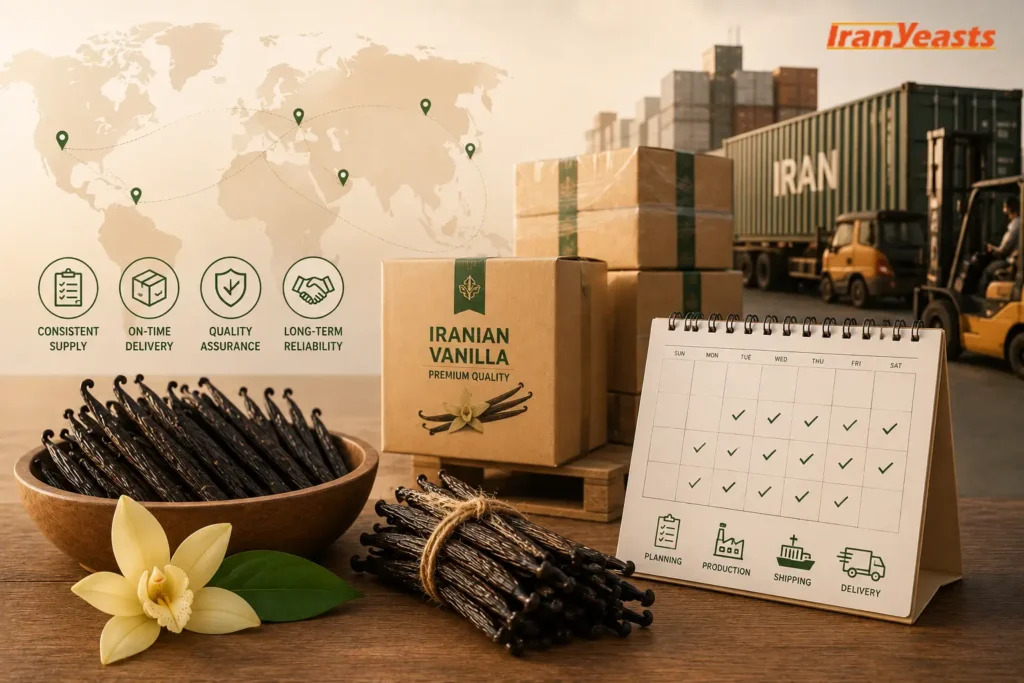
Benefit 3 : Transit Time Advantage for Gulf, Middle Eastern, and Central Asian Buyers
For buyers in the Gulf states, Iraq, Afghanistan, Pakistan, and Central Asian markets, this benefit is often the most commercially decisive one, even though it rarely appears on a traditional cost comparison.
Transit time from supply origin to destination port directly affects three procurement variables: safety stock requirements (more transit time requires more buffer inventory), product shelf life consumed during transit (longer transit reduces the usable shelf life available at destination), and landed cost (longer freight routes cost more and expose cargo to more handling risk).
Sea freight from Bandar Abbas, Iran’s primary export port, to Gulf ports runs 3 to 5 days. Land freight from Iran to Iraq, Afghanistan, and Pakistan runs 5 to 10 days. Compare this to the 15 to 25 days of sea transit from Chinese ports to Gulf destinations, or the 10 to 15 days from Turkish ports.
For a distributor in Dubai or Baghdad ordering 5 tons of vanillin powder, the difference between a 4-day replenishment lead time and a 20-day one is the difference between carrying two weeks of safety stock and carrying six weeks. That carrying cost difference is real cash tied up in inventory, not a theoretical procurement metric.
When buying Iranian vanilla in bulk, buyers in these specific markets access not just a lower per-unit cost but a logistics structure that reduces working capital requirements and improves the freshness of product arriving at destination.
Benefit 4 : Halal Certification Included as Standard on Every Shipment
For distributors supplying the GCC, Iraq, Afghanistan, Pakistan, Southeast Asia, or any Muslim-majority market, Halal certification is not optional : it is a baseline prerequisite for selling into the channel at all.
Sourcing from a supplier whose Halal certification is current, properly issued by a recognized body, and documented at the batch level eliminates a category of compliance risk that creates expensive delays when it goes wrong. A shipment that arrives without valid Halal documentation faces customs holds, rejection, or the cost of return freight.
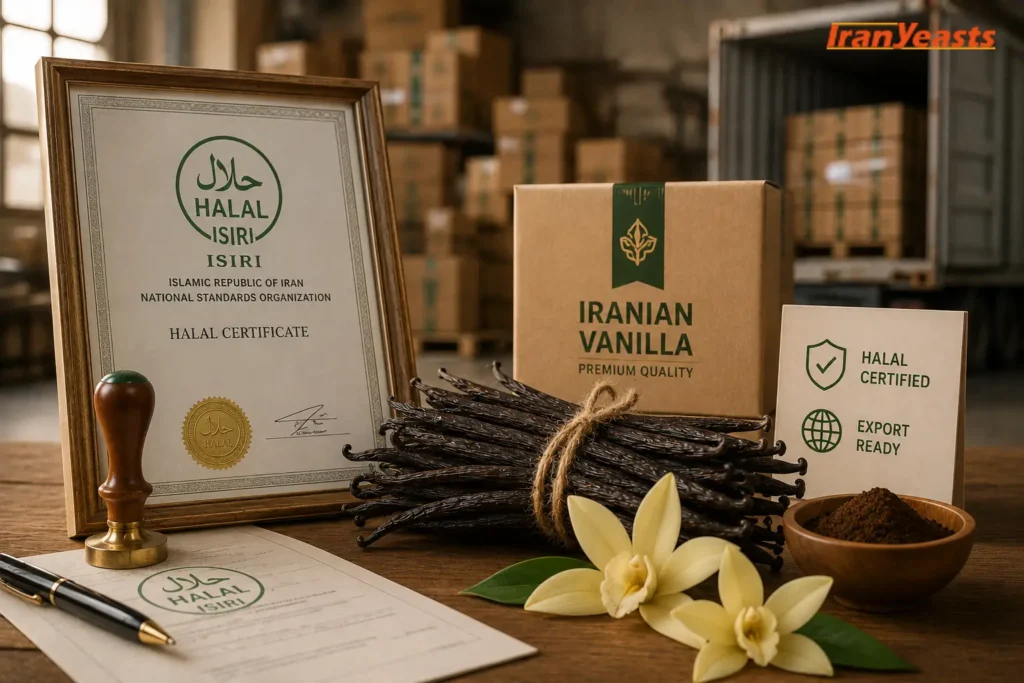
IranYeasts’ Halal certification is issued by ISIRI, Iran’s National Standards Organization, recognized by the Codex Alimentarius Commission as Iran’s competent food safety authority. This certification is accepted without supplementary documentation across all Gulf Cooperation Council markets, Iraq, Pakistan, Afghanistan, and Central Asian markets where IranYeasts currently operates.
When buying in bulk, the Halal certificate is issued per production batch, included in the standard export documentation package, and provided before shipment confirmation. There is no additional cost and no separate application process for the buyer. For a detailed breakdown of how Iranian Halal certification works and which markets accept it, see our post on Halal-certified yeast export from Iran, which covers the same ISIRI certification framework applied to both our yeast and vanilla product lines.
Benefit 5 : Private Label Capability From an Accessible Minimum Order
One of the most commercially valuable benefits for distributors building long-term regional brand equity is the ability to source Iranian vanilla in bulk under their own brand name rather than reselling a supplier’s existing brand.
IranYeasts offers private label vanillin production from a 500 kilogram minimum order across multiple retail and industrial packaging formats, including consumer sachets (10g to 100g), tin formats, and industrial bags (1kg to 25kg). The private label production capability covers custom logo printing, multilingual packaging (Arabic, English, French, Persian), and brand-specific packaging design for buyers entering new retail markets.
For a distributor in Iraq, the UAE, or Saudi Arabia, selling vanillin powder under a locally recognized brand they own rather than an imported brand they resell is a fundamentally different business model. Brand equity accumulates with every sale. Pricing flexibility improves as the brand becomes established. Customer loyalty shifts from the product to the distributor’s brand identity.
Customization capabilities, including tailored formulations and packaging, are a key advantage of sourcing vanillin from specialized producers rather than general trading intermediaries.
When this capability is available from a 500kg minimum at a direct producer price rather than through a premium-charging intermediary, it is accessible to mid-sized distributors at an earlier stage of their growth, not just to established FMCG brands with large procurement budgets.
Benefit 6 : Extended Shelf Life in Vacuum-Sealed Bulk Formats
Vanillin powder is chemically stable under correct storage conditions, and vacuum-sealed packaging extends that stability to its practical maximum : which is a real procurement advantage for buyers managing long distribution chains or uncertain storage environments.
In vacuum-sealed bulk formats (industrial bags from 1kg to 25kg), Iranian food-grade vanillin maintains its purity, aroma, and flavoring performance for 24 to 36 months under recommended storage conditions: cool, dry, sealed, and away from direct sunlight and extreme heat.
This shelf life window is long enough to support a full procurement and distribution cycle for most buyers, including:
Buyers who import in large volumes once or twice per year to benefit from bulk pricing and then distribute over several months without quality degradation. Distributors in markets with irregular freight schedules who need products that remain viable through variable transit and warehousing conditions. Food manufacturers who hold buffer stock against supply disruption and need assurance that buffer inventory will not have degraded when it is eventually used.
The shelf life advantage is directly linked to packaging format selection. Open bulk bags carry 12 to 18 months, while vacuum-sealed formats carry the full 24 to 36 months. Buyers who want maximum shelf life should specify vacuum-sealed packaging explicitly at the inquiry stage rather than accepting the default format.
Benefit 7 : Full Export Documentation as Standard, Not on Request
This benefit is operational rather than financial, but it consistently makes the difference between a smooth first import and a frustrating one.
Every IranYeasts vanillin export shipment includes the following documentation as a standard part of the transaction:
Certificate of Analysis (COA) for the specific production batch, including vanillin purity result, moisture content, microbial testing results, and appearance confirmation. Halal Certificate (ISIRI, current validity). HACCP Compliance Certificate. Certificate of Origin (issued by the relevant Iranian trade authority, required for customs clearance in most destination markets). Commercial Invoice and Packing List. Bill of Lading (sea freight) or CMR (land freight).
This documentation package is prepared in parallel with production so it is ready at the point of loading, not assembled in response to a post-shipment request. For buyers whose procurement processes or destination customs clearance depend on specific documentation being present on arrival, this standard approach eliminates the back-and-forth that commonly delays clearance when working with less organized suppliers.
For buyers who need additional documentation for specific regulated markets, requirements discussed at the inquiry stage are incorporated into the preparation timeline so they do not cause post-shipment delays.
Benefit 8 : Direct Producer Relationship Without Intermediary Markup
Most vanillin available in Middle Eastern and Central Asian markets arrives through trading intermediaries rather than directly from producers. The intermediary adds a margin to the producer price, provides no additional technical knowledge about the product, and creates an extra communication layer when specification questions or quality issues arise.
Buying Iranian vanilla in bulk directly from IranYeasts eliminates this layer. The price reflects production cost and export margin, not an additional trading margin. Technical questions about vanillin specification, batch testing methodology, or Halal certification scope receive direct, expert answers from the team that produces the product rather than a sales intermediary who relays the question.
When a quality question arises after delivery, the direct producer relationship means the resolution process involves the party with actual authority over the production process and the actual test data, not an intermediary who is also receiving the answer second-hand. The 100 percent money-back guarantee on documented quality claims is a commitment from the producer, not a promise from a trader whose own ability to honor it depends on what the producer agrees to do.
A supplier’s ability to respond quickly and clearly reflects their professionalism and organizational maturity, and diversified supply channels that reduce sourcing risks while maintaining competitive pricing are a key advantage of direct producer relationships.
Who Benefits Most From Buying Iranian Vanilla in Bulk
The benefits above are not equally applicable to every buyer profile. The clearest beneficiaries are:
Regional food distributors in the Gulf, Iraq, Central Asia, and South Asia who supply commercial bakeries, confectionery manufacturers, and ice cream producers. The transit advantage, Halal certification depth, and private label capability combine to create a supplier relationship that is difficult for competitors to replicate through Chinese or Turkish channels.
Commercial food manufacturers using vanillin as a direct production input, who benefit most from the per-unit cost reduction at volume and the supply predictability that comes with bulk inventory.
FMCG and retail brand owners building or expanding a private label vanilla product line, who need a producer capable of custom packaging from an accessible minimum order with full Halal documentation included.
Distributors currently reselling a third-party brand who want to evaluate whether the private label transition makes sense for their market and business scale.
Final Thoughts
The benefits of buying Iranian vanilla in bulk are not theoretical. They are quantifiable per-unit cost reductions, measurable transit time advantages, verifiable certification standards, and operational documentation reliability that shows up in every shipment. For buyers in the Middle East, Central Asia, and South Asia in particular, the combination of these eight factors produces a supply relationship that is genuinely difficult to match from any other single origin.
The right starting point is a specification-level inquiry, a sample to test in your own facility, and a formal pro-forma quote. From there, the numbers make the case more clearly than any marketing material can.
References
- Mordor Intelligence. (2026, January 15). Vanillin market size, share and forecast 2025–2031. Mordor Intelligence Research.
- Alibaba.com. (2025, December 1). Vanillin food grade supplier guide: Sourcing from top manufacturers. Alibaba Food and Beverage Intelligence.
- Niran Bio. (2026, April 10). Vanillin supplier: Bulk supply for food, beverage and industrial applications. Niran Bio Ingredients.
Frequently Asked Questions
Find answers to common questions about Iranian instant dry yeast, including certifications, bulk orders, private labeling, export logistics, and delivery worldwide
What is the minimum order quantity for buying Iranian vanilla in bulk?
The minimum order quantity for bulk Iranian food-grade vanillin from IranYeasts is 500 kilograms. This minimum applies to both standard branded product and private label orders. Volume discount tiers apply progressively above this threshold.
How much cheaper is bulk vanillin compared to small-batch purchases?
Orders above 1,000 kilograms typically reduce per-kilogram costs by 30 to 50 percent compared to small-batch purchases. The exact reduction depends on the specific packaging format, purity grade, and total order volume. A formal pro-forma invoice with your specification will confirm the precise price for your volume.
What purity level does bulk Iranian vanillin come in?
IranYeasts supplies food-grade vanillin at 98 to 99 percent vanillin content, verified by batch testing and documented in the Certificate of Analysis provided with every shipment. Both grades are suitable for commercial food manufacturing applications including bakery, confectionery, ice cream, and beverage production.
Is Halal certification included with bulk orders?
Yes. Halal certification (issued by ISIRI, Iran’s National Standards Organization) is included as standard documentation with every bulk shipment. There is no separate certification fee or application process for the buyer. The certificate is batch-specific and provided before shipment confirmation.
What shelf life can I expect from bulk Iranian vanillin?
In vacuum-sealed bulk bags, Iranian food-grade vanillin maintains full purity and flavoring performance for 24 to 36 months under standard storage conditions (cool, dry, sealed, away from direct sunlight). For buyers who want maximum shelf life, specify vacuum-sealed packaging format at the inquiry stage.
Can I get vanillin under my own brand name?
Yes. Private label production is available from a 500 kilogram minimum order across multiple packaging formats including consumer sachets, tins, and industrial bags. Custom packaging design, logo printing, and multilingual labeling (Arabic, English, French, Persian) are all available as part of the private label service.
How does buying Iranian vanilla compare to sourcing from China for Gulf market buyers?
For buyers in the Gulf, Iraq, and Central Asian markets, the most significant difference is transit time. Iranian vanillin reaches Gulf ports in 3 to 5 days by sea, compared to 15 to 25 days from Chinese ports. This reduces safety stock requirements, improves shelf life available at destination, and lowers total landed cost even when FOB prices are comparable.
What documentation comes with a bulk Iranian vanilla shipment?
Every shipment includes as standard: Certificate of Analysis (batch-specific), Halal Certificate (ISIRI), HACCP Compliance Certificate, Certificate of Origin, Commercial Invoice, Packing List, and Bill of Lading or CMR. All documents are prepared before the shipment is released, not assembled on request after departure.