

A distributor in Central Asia once switched to a Chinese yeast supplier purely on price, then spent the next two months explaining to retail customers why shelves sat empty while a delayed shipment cleared customs.
Price is usually the first thing buyers compare when weighing yeast suppliers, but it rarely tells the full story. Production scale, shipping distance, minimum order flexibility, and certification depth all shape the real cost and risk of a supplier relationship, and these factors play out very differently depending on whether a shipment is coming from Iran or China. Buyers who compare only the quoted price per ton often discover the rest of the picture after a contract is already signed.
This article compares Iranian and Chinese yeast suppliers across the factors that actually affect a bulk buyer’s operations, from lead time to minimum order size to the certification paperwork each market expects.
Looking to Import Iranian Instant Dry Yeast at Wholesale Scale?
Get expert guidance on product selection, packaging, export documentation, pricing, and international shipping directly from our export team.
Iranian Yeast vs Chinese Yeast: Where the Real Differences Show Up
The comparison between Iranian yeast and Chinese yeast comes down to a tradeoff between scale and proximity. Chinese producers operate at an industrial scale few other countries can match, while Iranian suppliers compete on faster delivery to the Middle East, Central Asia, and South Asia, along with lower minimum order thresholds for buyers who are not yet ordering at container-load volumes.
Neither position is automatically better. The right choice depends on where a buyer is shipping to, how large their orders typically run, and how much weight they place on delivery speed versus unit price.
Scale and Market Position: A Very Different Starting Point
China’s yeast industry operates at a scale that is genuinely difficult to compare against most other exporting countries. Angel Yeast, China’s largest producer, alone holds an estimated 15 percent of the global yeast market and exports to more than 150 countries, backed by production capacity in the hundreds of thousands of tons annually.
What This Scale Means in Practice
That scale translates into deep production capacity and established global logistics networks, which matters for buyers placing very large, standardized orders with limited need for customization. Iranian producers operate at a smaller but more specialized scale, often built around flexibility rather than sheer volume. A closer look at how Iran’s export capacity and product range have developed is available in Iran Instant Dry Yeast: Why It’s Becoming a Top Choice for Bulk Importers Worldwide.
Shipping Time to the Middle East and Central Asia
Geography is where the comparison shifts most clearly in Iran’s favor for buyers in neighboring regions. Sea freight from Chinese ports to the Persian Gulf typically takes between 15 and 30 days depending on the destination port and shipping line, before customs clearance is even factored in.
Iranian exporters, by contrast, can reach markets like Afghanistan, Iraq, and Pakistan via direct land routes in a fraction of that time, alongside standard sea shipments from Bandar Abbas to other regional ports. For buyers where inventory turnover and shelf-life management matter, this difference in transit time can outweigh a modest gap in unit price.
Minimum Order Quantities and Private Label Access
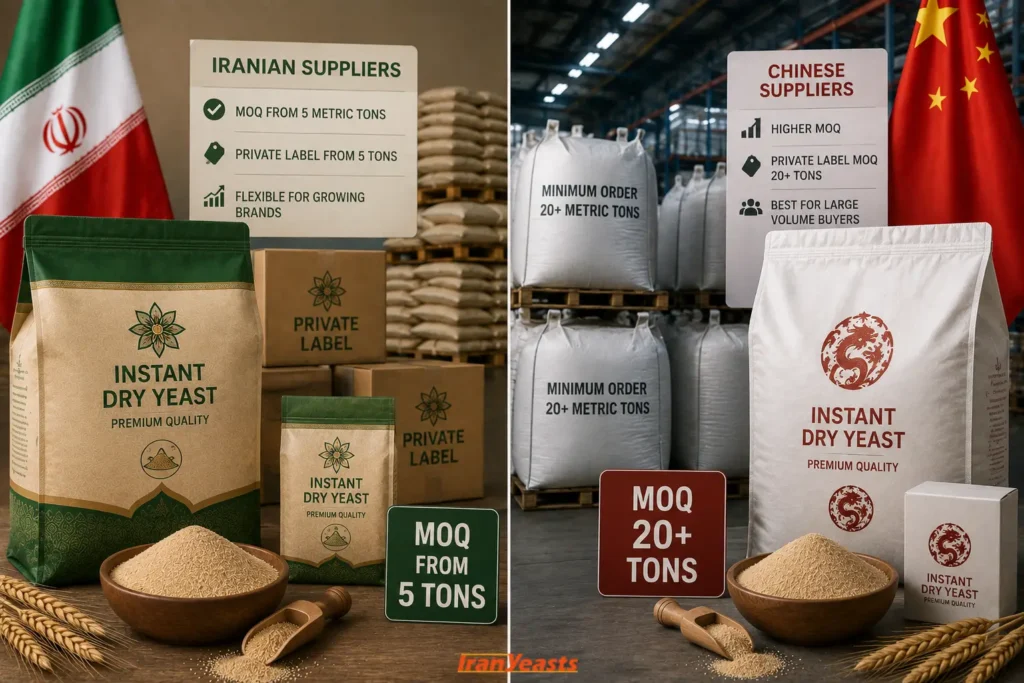
This is often the deciding factor for mid-sized distributors and smaller retail brands. The typical minimum order requirements differ substantially between the two markets:
- Standard bulk orders from Iranian suppliers commonly start around 5 metric tons, making the entry point accessible to distributors who are not yet ordering full container loads.
- Private label production in Iran is generally available from that same 5-ton threshold, allowing smaller brands to launch their own packaging without committing to industrial-scale volumes upfront.
- Large Chinese producers, built around massive production runs, more commonly set private label and custom packaging minimums well above what a smaller distributor can commit to in a first order.
For a buyer specifically evaluating private label options, the practical steps involved in setting one up are covered in Private Label Yeast Manufacturing: How Distributors and Food Brands Build Their Own Yeast Business.
Certification and Halal Documentation
Both countries export yeast that carries recognized quality certifications, but the specific documentation buyers should expect differs by market. Iranian yeast exporters typically hold Halal certification issued through Iran’s national standards body, alongside HACCP and Iran National Standard (ISIRI) certification, all verifiable at the batch level through a Certificate of Analysis.
For buyers shipping into Muslim-majority markets specifically, this Iran-origin halal documentation can simplify import approval in ways that a general international halal certificate from a different exporting country sometimes does not. What this certification actually covers, and what to request from a supplier before finalizing an order, is detailed in Halal-Certified Yeast Export from Iran: Standards, Certifications, and What to Ask Your Supplier.
Where Chinese Yeast Has the Genuine Advantage
A fair comparison has to acknowledge where Chinese suppliers lead. Chinese producers typically offer:
- Wider product range across baker’s yeast, brewer’s yeast, and nutritional yeast categories under a single supplier relationship.
- Established brand recognition in markets where Chinese yeast has been present for decades, reducing buyer hesitation during first-time sourcing.
- Deep production redundancy, meaning large orders are less likely to be constrained by a single facility’s capacity limits.
Buyers running very large, standardized procurement programs across multiple product categories often find this breadth genuinely useful in ways that smaller, more specialized suppliers cannot match.
Which Buyers Typically Choose Each Option
In practice, the choice tends to split along a few consistent lines rather than coming down to price alone:
- Buyers prioritizing fast replenishment cycles and shorter shelf-life exposure, especially in neighboring regions, tend to favor Iranian suppliers.
- Buyers running smaller or first-time private label launches often find Iran’s lower order thresholds more accessible.
- Buyers placing very large, multi-category orders with less sensitivity to lead time often default to established Chinese suppliers.
- Buyers targeting Muslim-majority markets where Iran-specific halal documentation simplifies customs clearance frequently weigh that factor heavily.
Whichever direction a buyer leans, the underlying supplier evaluation process should look similar. A structured checklist for that evaluation is available in How to Evaluate a Bulk Yeast Supplier: An 8-Point Checklist for Importers and Distributors.
Final Thoughts
Choosing between Iranian and Chinese yeast is rarely a question of one market being universally better than the other. It is a question of which tradeoffs matter most for a specific buyer’s operations, whether that is shipping distance, order flexibility, or the certification paperwork a destination market actually requires at customs.
Buyers who compare suppliers on lead time and documentation quality alongside price tend to make sourcing decisions that hold up past the first shipment. The buyers who compare on price alone are usually the ones who end up doing that comparison again a few months later.
References
- Angel Yeast Co., Ltd. (2026). About Angel Yeast: Global market position and production capacity. Angel Yeast Co., Ltd.
- Volza. (2026). China yeast exports data and trade statistics. Volza FZE.
- Sea Freight Go. (2026). China to UAE shipping time and freight rates. Sea Freight Go.
- iContainers. (2025, December 12). Shipping from China to Saudi Arabia: Transit times and costs. iContainers.
- Mordor Intelligence. (2026). Bakers yeast market size, forecast, share analysis 2026-2031. Mordor Intelligence Pvt. Ltd.
Frequently Asked Questions
Find answers to common questions about Iranian instant dry yeast, including certifications, bulk orders, private labeling, export logistics, and delivery worldwide
Is Iranian yeast cheaper than Chinese yeast?
Pricing varies by order volume, packaging format, and current shipping costs rather than following a fixed rule. Iranian FOB pricing typically ranges from 1,500 to 2,600 US dollars per ton, and buyers should request current quotes from both markets rather than relying on general price assumptions.
How much faster is delivery from Iran compared to China for Middle Eastern buyers?
Iranian exporters can reach neighboring markets like Afghanistan, Iraq, and Pakistan via land routes in days rather than weeks, while sea freight from China to Gulf ports typically takes 15 to 30 days before customs clearance.
Which country offers lower minimum order quantities for private label yeast?
Iranian suppliers commonly offer private label production from around 5 metric tons, which is generally more accessible to smaller distributors than the higher volume thresholds typical of large-scale Chinese producers.
Does Chinese yeast carry halal certification?
Some Chinese exporters do offer halal-certified yeast, but buyers shipping into Muslim-majority markets should confirm which certifying body issued it, since Iran-origin halal certification is sometimes more directly recognized in neighboring import markets.
Why would a buyer choose a smaller Iranian supplier over a large Chinese producer?
Buyers often prioritize faster regional delivery, lower order thresholds for private label launches, and more direct communication with a supplier, especially when ordering below full container-load volumes.
Is Chinese yeast better quality than Iranian yeast?
Quality depends on the specific supplier and its certifications rather than the country of origin alone. Buyers should request Fermentation Power data, microbial test results, and a batch-specific Certificate of Analysis from any supplier regardless of where it is based.