

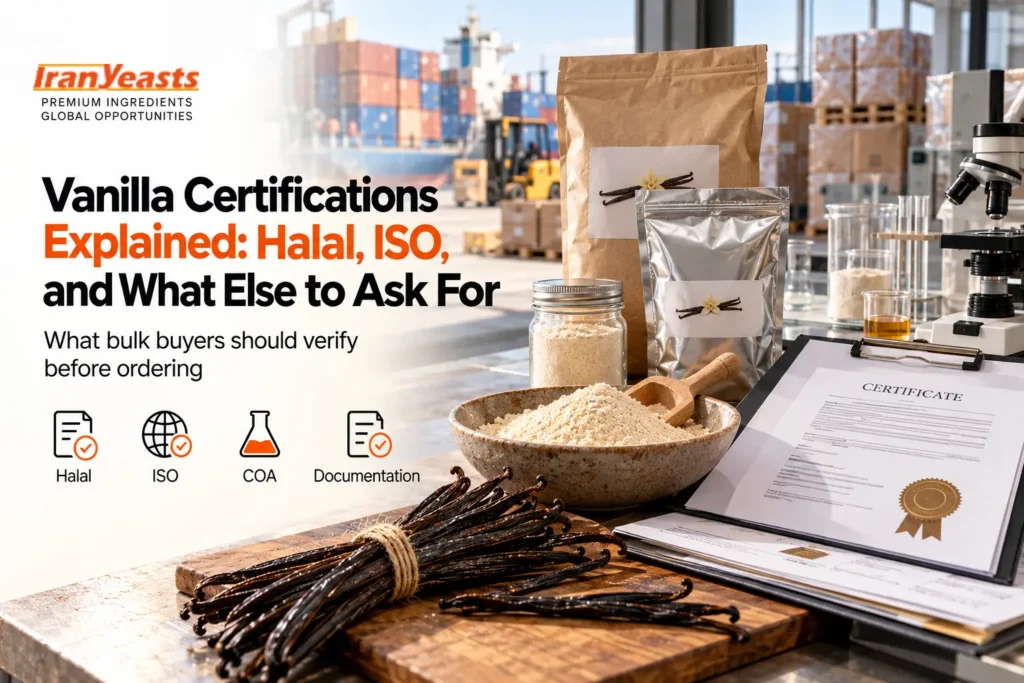
A certificate on a supplier’s website tells you very little until you know what it covers, who issued it, and whether your destination market accepts it. Many buyers collect logos and never check the scope, which is how a halal certificate valid in one country ends up rejected at another border.
Vanilla adds its own questions. Vanillin is a flavor compound, so some certifications that matter for beans, such as organic or fair trade, may not apply at all.
This guide explains which certifications matter for vanilla, what each one proves, and how to verify them before you place an order.
Looking to Import Iranian Premium Vanilla at Wholesale Scale?
Get expert guidance on product selection, packaging, certification documents, export paperwork, pricing, and international shipping directly from our export team.
Vanilla Certifications for Iranian Vanilla: What Buyers Should Ask For
Iranian vanilla is industrially produced vanillin, so the certifications that matter most are the ones that prove how it is made and handled: halal status, a food safety management system, and batch-level documentation. A full look at the product line is on the Iranian vanilla hub page. The table below shows what each certification proves and who tends to ask for it.
| Certification | What It Proves | Who Usually Asks For It |
|---|---|---|
| Halal | Ingredients and process meet halal rules, verified by a certifying body | Buyers in Muslim-majority and halal-conscious markets |
| HACCP | A hazard analysis and control plan exists | Almost all food buyers, as a minimum |
| ISO 22000 | A documented food safety management system, audited by a third party | Manufacturers and importers who vet suppliers formally |
| FSSC 22000, BRCGS, SQF, IFS | A GFSI-recognized scheme, accepted by major retailers | Retail chains and large food manufacturers |
| Kosher | Ingredients and process meet kosher rules | Buyers supplying kosher-sensitive customers |
None of these replaces a batch-specific certificate of analysis. Certificates describe the facility and the system, while the COA describes the product in your drum.
Halal Certification: Why the Issuing Body Matters
Halal is the certification most often requested for vanilla bound for the Middle East, Central Asia, and South and Southeast Asia. The detail buyers miss is that a halal certificate is only as useful as the market’s willingness to accept its issuer. Reviews of import requirements note that Malaysia’s JAKIM accepts certificates only from foreign bodies it has recognized, while the UAE and Saudi Arabia publish lists of accepted certifiers. For a deeper look at the standards involved, see halal certified Iranian vanilla.
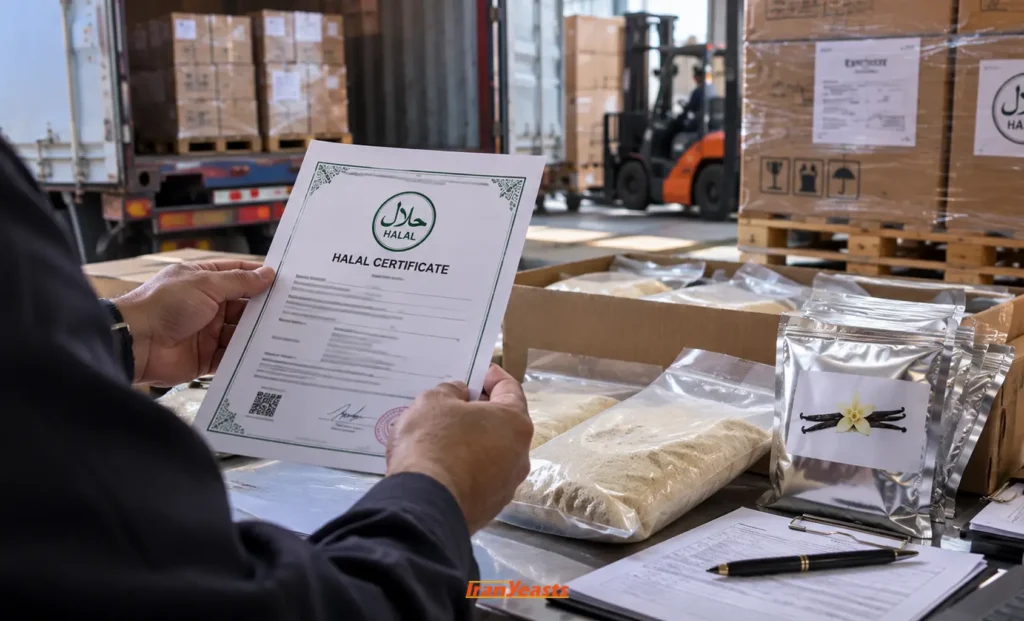
What to Check on a Halal Certificate
- Issuing body: The certificate should name the certifying body, and that body should be accepted in your destination country.
- Scope: It should cover the specific product and the plant that makes it, not just the company name.
- Validity dates: Confirm the certificate is current, since halal certificates are renewed on a cycle.
- Carriers and processing aids: Ask whether carriers, solvents, and processing aids used with the vanillin are covered by the same certificate.
Why Halal Is Not Interchangeable
Halal standards differ by country and religious authority, so a product certified in one market is not automatically accepted in another. Certificate recognition is a destination-market question, and the safest time to ask it is before the order, not at customs.
Food Safety Certifications: HACCP, ISO 22000, and GFSI Schemes
These labels are often used as if they mean the same thing. They do not. HACCP is a method for finding and controlling hazards. ISO 22000 is a certifiable management system built around that method. GFSI-recognized schemes sit above both. Food safety guidance for suppliers makes the point that a supplier having a HACCP plan is a lower bar than holding current GFSI-recognized certification, and the two should not be treated as equivalent. This is also relevant to Iranian vanilla for food manufacturers, who often write these requirements into supplier approval.
The Assurance Ladder, From Lowest to Highest
- HACCP plan: The supplier has a written hazard analysis and control plan, but may not be independently audited.
- ISO 22000 certificate: A third-party certification body has audited the supplier’s food safety management system.
- FSSC 22000: ISO 22000 combined with additional prerequisite programs, benchmarked by GFSI.
- BRCGS, SQF, or IFS: Other GFSI-recognized schemes, often required by retailers and large manufacturers.
A Point Buyers Often Miss
ISO 22000 on its own is not recognized by GFSI as a benchmarked scheme, though it forms the core of FSSC 22000, which is. GFSI also does not issue certificates itself. Buyers should ask for certification to a named scheme, not to “GFSI” in general.
Other Certifications and Statements Worth Requesting
Beyond halal and food safety, a few other documents are routinely requested depending on the buyer’s customers and market.
- Kosher: Commonly requested by manufacturers supplying kosher-sensitive customers. Ask for the certifying agency and the product listing.
- Allergen statement: Written confirmation of allergen status and cross-contact controls at the plant.
- GMO statement: A statement on genetically modified content where a destination market or customer requires it.
- SDS and specification sheet: A safety data sheet and product specification sheet for handling and formulation.
- Organic and fair trade: Organic and fair trade programs are designed for vanilla beans. They generally do not apply to industrially produced vanillin, so be cautious of a supplier claiming them for a vanillin product.
How to Verify a Certificate Before You Rely on It
A certificate you cannot verify is just a picture. These steps take a few minutes and catch most problems. They also pair naturally with the export paperwork explained in how to export vanilla from Iran.
- Check the names: Match the company name and plant address on the certificate to the supplier you are actually buying from.
- Read the scope: Confirm the certificate covers the product and the site that will fill your order.
- Check validity: Look at the issue and expiry dates, and ask for the renewal if it is close.
- Verify with the issuer: Contact the certification body or check its public register to confirm the certificate number.
- Confirm market acceptance: Confirm the issuing body is accepted in your destination market, especially for halal.
Putting It Together Before Your First Order
For a first order, ask for the halal certificate, the food safety certificate, a specification sheet, and a batch-specific COA, and compare them against your market’s requirements. Once the paperwork checks out, wholesale vanilla is a practical starting point for browsing formats and requesting samples.
Conclusion
The certifications worth asking for are halal, a food safety system certificate, and batch-level documents. What matters is the detail behind each logo: the issuing body, the scope, the dates, and whether your destination market accepts them.
A few minutes of verification before the first order is far cheaper than a shipment held at customs. Ask early, check the register, and keep copies on file.
References
- Jade Premium. (2026, February 24). Halal certification requirements: The buyer's checklist international importers can't afford to miss. https://jadepremium.com/2026/02/24/halal-certification-requirements-the-buyers-checklist-international-importers-cant-afford-to-miss/
- BTSA. (n.d.). What halal certification means for your food production. https://www.btsa.com/en/halal-certification-food-industry/
- CASRAI. (n.d.). GFSI certification: Meaning, recognized schemes, and how to get it. https://casrai.org/guides/gfsi-certification
- BTSA. (n.d.). Food industry certificates: ISO 22000, FSSC, BRC and IFS. https://www.btsa.com/en/main-food-certificates/
- International Organization for Standardization. (2018). Food safety management systems: Requirements for any organization in the food chain (ISO 22000:2018). https://www.iso.org/standard/65464.html
Frequently Asked Questions
Find answers to common questions about vanilla certifications, including halal, HACCP, ISO 22000, GFSI schemes, organic claims, and how to verify a supplier’s certificate.
Which certifications matter most for vanilla?
Halal for halal-conscious markets, a food safety certification such as ISO 22000 or a GFSI-recognized scheme, and a batch-specific certificate of analysis for every shipment.
Is a halal certificate valid in every country?
No. Halal standards and accepted certifiers differ by country, so a certificate accepted in one market may be rejected in another unless that market recognizes the issuing body.
What is the difference between HACCP and ISO 22000?
HACCP is a method for identifying and controlling food safety hazards. ISO 22000 is a certifiable management system built around that method and audited by a third party.
Is ISO 22000 the same as GFSI certification?
No. ISO 22000 on its own is not GFSI-recognized, though it is the core of FSSC 22000, which is. GFSI benchmarks schemes and does not issue certificates itself.
Does vanillin need organic or fair trade certification?
Generally no. Those programs are designed for vanilla beans, so they typically do not apply to industrially produced vanillin.
How do I verify a supplier's certificate?
Match the company and plant details, read the scope and dates, and confirm the certificate number with the issuing body or its public register.
Is a certificate the same as a certificate of analysis?
No. A certificate describes the facility or system, while a certificate of analysis reports test results for a specific batch, and buyers should ask for both.