

Vanilla does not price like most food ingredients. One country’s harvest drives most of the swings the global natural vanilla market feels, and buyers who ignore that calendar can end up paying peak prices for a purchase they could have made months earlier.
The pattern repeats every year: hand pollination, a mid-year harvest, months of curing, then a wave of exports once the new crop is ready. Each stage moves price in a different way.
This guide walks through that calendar, when natural vanilla prices tend to firm up or soften, how the market has changed since 2023, and why industrial vanillin does not follow the same pattern.
Looking to Import Iranian Premium Vanilla at Wholesale Scale?
Get expert guidance on product selection, packaging, certification documents, export paperwork, pricing, and international shipping directly from our export team.
Vanilla Price Seasonality and Where Iranian Vanilla Fits
Almost all seasonal pricing pressure in the vanilla market traces back to natural, bean-derived vanilla, and above all to Madagascar, the world’s largest producer. Iranian vanilla is industrially produced vanillin, manufactured to order rather than harvested once a year, which puts it in a fundamentally different pricing position. Understanding the bean calendar is still useful for any vanilla buyer, because it explains why the flavour market as a whole moves the way it does.
Quick insight
- Madagascar grows about 42 percent of the world’s vanilla and supplies roughly three quarters of US vanilla bean imports.
- Its harvest runs mid-year, curing ends in late fall, and bulk exports usually start around March or April.
- The US$250 per kilogram export price floor was removed in May 2023, and prices have been falling since.
- Industrial vanillin is made to order, so it does not follow the bean calendar.
The Madagascar Vanilla Calendar: Why Vanilla Has a Season
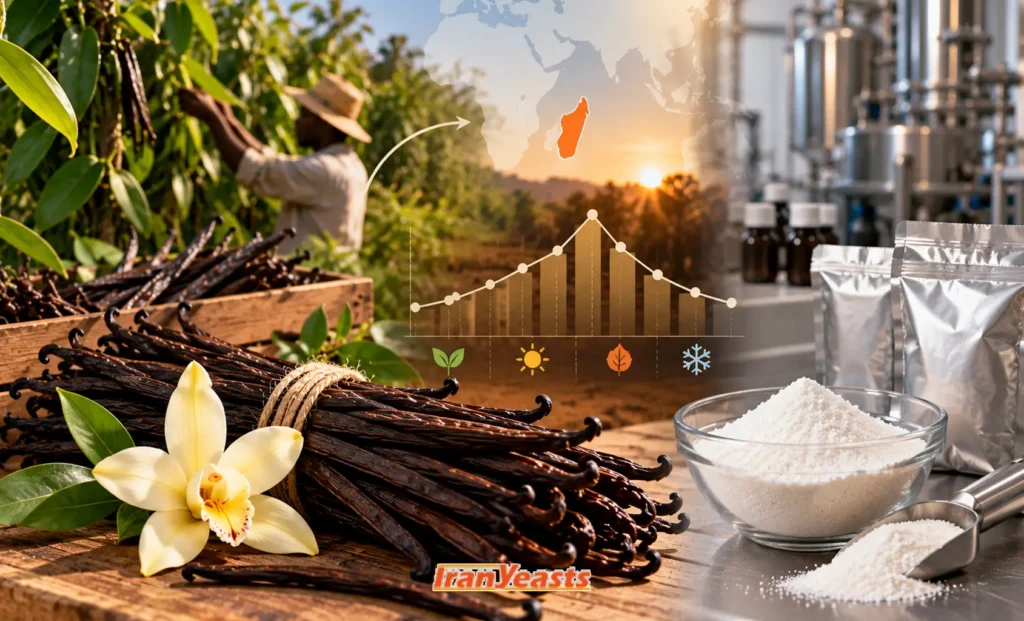
Natural vanilla’s price cycle follows directly from how slowly the crop is produced. An analysis in Choices magazine, citing FAO data, puts Madagascar at about 42 percent of world vanilla production and notes that the island averages two cyclones a year.
| Stage | Typical Timing | What Happens |
|---|---|---|
| Flowering and pollination | Roughly October to January | Each flower is hand-pollinated on the single day it opens |
| Pod development | The following months | Green pods grow on the vine with no vanilla flavour yet |
| Green harvest | Mid-year, mainly June to August | Pods are hand-picked once mature, on dates set by the authorities |
| Curing | Through to late fall | Killing, sweating, drying, and conditioning develop flavour and aroma |
| Bulk exports | From around March to April | Cured beans ship to international buyers in volume |
From flower to export-ready bean, the cycle takes well over a year, and farmers get only one harvest. That single annual window is why vanilla behaves like a seasonal commodity rather than a steady, year-round supply. It also shows up in trade data: US imports of whole vanilla beans are concentrated between January and July and are lowest from about October to February.
How the Vanilla Calendar Moves Prices
Each stage of the cycle creates its own kind of price pressure.
Cyclone Season: Weather Risk Drives Speculation
Madagascar’s cyclone season runs from roughly December to April, overlapping pollination and early pod development. A severe storm can destroy a large share of the standing crop, and even the risk of damage, before any loss is confirmed, can move prices. The two biggest price spikes of the past 25 years both followed severe weather in Madagascar.
Harvest: Early Picking and Quality Risk
Theft is a persistent problem in Madagascar’s growing regions, and it pushes some farmers to pick pods before they are fully mature. Early-picked beans carry less flavour and lower quality, which can tighten the supply of top-grade vanilla even in a year with normal harvest volume.
Curing: A Quiet Period
While the crop cures, no new vanilla reaches the market, so prices tend to hold on whatever supply and sentiment existed going in. This is also the stretch, from late in the year into early the next, when import volumes are at their lowest and buyers who run short have the least choice.
Export Season: Supply Arrives and Prices Find a Level
Once bulk exports start, usually around March or April, the size and quality of the new crop become clear and buyers compete for it. In a tight year, prices firm up quickly. In a large crop year, the arrival of new supply tends to pull prices down.
How Vanilla Pricing Has Changed Since 2023
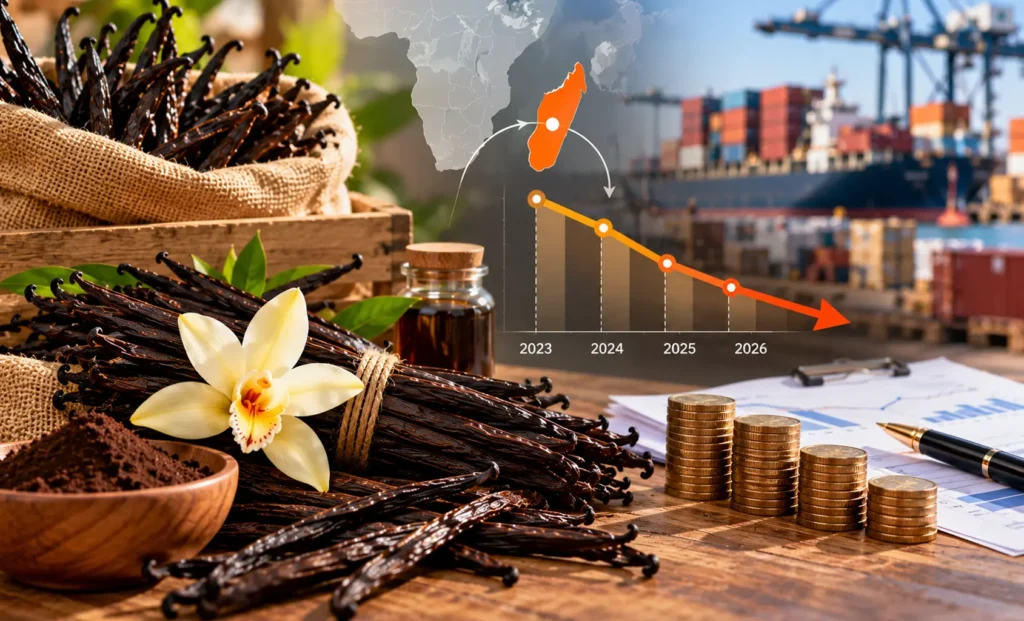
For several years Madagascar enforced a minimum export price of US$250 per kilogram on natural vanilla. According to Pacific Trade Invest, the government removed that floor in May 2023, setting off a deflationary trend that has continued since. Madagascar’s vanilla export revenue reportedly fell 64 percent in early 2024 even as shipments nearly doubled, and other producing countries expanded their market share as prices dropped.
For buyers, this means the old assumption of a guaranteed price floor no longer holds. Seasonal timing still matters, but it now sits on top of a market that has been adjusting downward. The wider demand picture is covered in the global vanilla demand forecast for 2026.
When Should Natural Vanilla Buyers Lock In Rates?
For buyers who need bean-derived vanilla, timing a purchase against the calendar can make a real difference:
- Negotiate once the new crop is known: The weeks after bulk exports begin, when crop size and quality are confirmed, are often the most negotiable, especially in a large crop year.
- Consider forward contracts carefully: A forward agreement can lock in a rate before a weather-driven spike, but it also locks you out of any fall in prices after a big harvest.
- Watch cyclone news from December to April: Storm reports are often the first signal that prices are about to move, well before damage is confirmed.
- Build stock before the low-import months: Carrying enough bean-derived stock into October to February avoids buying when supply is thinnest.
Quick tip
Ask your supplier for the crop year on every lot of natural vanilla. Beans from a strong crop year and beans held over from a weak one can be priced very differently, even in the same month.
Why Industrial Vanillin Does Not Follow the Same Calendar
Industrially produced vanillin is not tied to a single annual harvest, a cyclone season, or one country’s export policy. That is a large part of why Iranian vanilla is emerging in the global market: buyers tired of Madagascar’s swings have a practical alternative for products that do not need a natural flavour claim. How the two pricing structures compare is set out in the vanilla price comparison between Iran and other origins.
That does not mean vanillin prices never move. Input costs, energy prices, freight, and currency shifts still apply, as covered in factors affecting Iranian vanilla export price. What it does mean is that vanillin pricing is not exposed to the single-point-of-failure risk of a once-a-year harvest in one country.
A Practical Vanilla Buying Calendar
Buyers sourcing a mix of bean-derived and industrial vanilla can use the natural vanilla calendar as a planning reference:
| Months | What to Watch | Buying Action |
|---|---|---|
| December to April | Cyclone season and crop condition | Track storm news and early crop reports |
| March to May | Start of bulk exports and new crop quality | Negotiate bean-derived contracts once supply is confirmed |
| June to August | Harvest volume for the next crop | Plan next year's volumes and forward options |
| September to February | Curing period and low import volumes | Hold enough stock to avoid buying at the thinnest point |
| Any time of year | Your own production schedule | Plan vanillin purchases independently of the bean cycle |
Building Price Stability Into Your Vanilla Sourcing
For buyers who want less exposure to seasonal swings, shifting part of a formulation to industrial vanillin is one of the most direct options, as long as the label does not require a natural claim. How to buy Iranian vanilla in bulk covers packaging formats and supplier checks, and wholesale vanilla is a good place to compare current formats.
Irany Yeasts supplies Iranian vanillin in bulk on your own production schedule, and the export team can quote volumes, pack formats, and delivery terms for your market.
Conclusion
Natural vanilla prices follow Madagascar’s single annual crop, from pollination and cyclone risk through harvest and curing to the arrival of bulk exports in spring. Since the export floor was removed in 2023, that seasonal pattern has played out in a market that has been trending down. Buyers who track the calendar can time purchases far better than those who treat every quote as equally priced.
Industrial vanillin sidesteps that calendar entirely, which is why it is increasingly part of a diversified sourcing strategy for products that do not need a natural claim.
References
- Choices Magazine. (2025). Sourcing vanilla closer to home: Market potential for US production. https://www.choicesmagazine.org/choices-magazine/submitted-articles/sourcing-vanilla-closer-to-home-market-potential-for-us-production
- Pacific Trade Invest. (2025). Industry story: The floor and ceiling of vanilla pricing. https://pacifictradeinvest.com/stories/focus/industry-story-the-floor-and-ceiling-of-vanilla-pricing/
- Verité. (n.d.). Vanilla. https://verite.org/initiative/africa/commodities/vanilla/
Frequently Asked Questions
Find answers to common questions about vanilla price seasonality, the Madagascar harvest calendar, and when to lock in vanilla rates.
Why does vanilla have a pricing season?
Natural vanilla depends largely on Madagascar’s single annual harvest, which follows a fixed cycle of pollination, harvest, curing, and export. That once-a-year supply window creates the market’s seasonal price pattern.
When does Madagascar vanilla reach export markets?
Harvest usually happens mid-year, curing runs into late fall, and bulk exports typically start around March or April. US import data shows most whole vanilla bean imports arrive between January and July.
When is the best time to negotiate a natural vanilla contract?
Often in the weeks after bulk exports begin, once the crop’s size and quality are confirmed. In a large crop year, new supply tends to soften prices, while a weak crop can push them up quickly.
Does cyclone season affect vanilla prices even without crop damage?
Yes. Madagascar’s cyclone season runs from about December to April, and markets often react to the risk of damage before any loss is confirmed.
Does Madagascar still have a minimum vanilla export price?
No. The US$250 per kilogram minimum export price was removed in May 2023, which started a deflationary trend in vanilla prices that has continued since.
Does industrial vanillin have the same price seasonality as natural vanilla?
No. Vanillin is manufactured rather than harvested, so it is not tied to an annual crop, a cyclone season, or one country’s export policy. Its price still responds to input costs, energy, freight, and currency.
Should I switch entirely to vanillin to avoid seasonal price swings?
Only if your product does not need a natural flavour claim. Where that claim is required, bean-derived vanilla remains necessary despite its seasonal pricing.