

A food manufacturer in Dubai once received a shipment of vanillin from a new supplier, only to have it rejected at customs because the halal paperwork did not match what had been promised during negotiation.
For buyers importing flavoring ingredients into markets across the Middle East and North Africa, halal certification is not a formality. It determines whether a product can legally clear customs, whether retailers will stock it, and whether a brand keeps the trust of its own customers. Many importers only discover gaps in a supplier’s paperwork after a shipment has already left port.
This article explains what halal certification actually verifies for Iranian vanilla, which body issues it, and the specific documents a buyer should request before signing a purchase agreement.
Looking to Import Iranian Instant Dry Yeast at Wholesale Scale?
Get expert guidance on product selection, packaging, export documentation, pricing, and international shipping directly from our export team.
What Halal Certified Iranian Vanilla Actually Verifies for Buyers
Halal certified Iranian vanilla is food-grade vanillin powder produced in a facility and process certified against Iran’s halal food standard, confirming that raw materials, processing aids, and production lines are free of prohibited substances and separated from any non-halal handling at every stage.
For a synthetic flavoring compound like vanillin, this scope matters more than buyers often assume. The certification does not stop at the finished powder, it extends back through the entire production chain. In practice, a halal audit for vanillin typically checks:
- The raw materials and reagents used in the guaiacol-glyoxylic acid synthesis route
- Solvents and processing aids applied at each stage of refinement
- Whether production equipment is shared with, or fully separated from, any non-halal processing lines
- Storage and handling conditions that could introduce cross-contamination before packaging
Why This Extends Beyond the Finished Product
A batch of vanillin can look identical on paper and still fail an audit if the equipment upstream was shared with a non-certified process. This is why halal status is granted to a facility and process, not simply stamped onto a product specification sheet. A full walkthrough of how Iranian vanillin is actually produced, including the purity levels and appearance buyers should expect from a 98 to 99 percent food-grade batch, is covered in this overview of Iranian vanilla production.
The Certification Body Behind Iran's Halal Standard for Vanillin
Halal certification for food products manufactured in Iran is issued through the Institute of Standards and Industrial Research of Iran, now operating as the Iran National Standards Organization. The body was established in 1960 and joined the International Organization for Standardization the same year, giving it a long operating history in food and industrial standards rather than being a certification scheme created solely for export purposes.
ISIRI 12000: What the Standard Actually Covers
The specific halal standard applied to food products, including flavoring ingredients such as vanillin, is known as ISIRI 12000. It sets out requirements across the entire food supply chain, from sourcing and processing through to storage and distribution, rather than covering the finished product alone. Buyers should ask a supplier for the certificate number and issuing date, since a legitimate ISIRI halal certificate can be verified against the issuing body rather than taken on trust from a scanned copy.
The Certifications That Typically Accompany Halal Status
Halal certification on its own answers one question: is the product free of prohibited substances and cross-contamination. It does not answer separate questions about hygiene management, quality consistency, or manufacturing practice, which is why serious suppliers pair it with additional certifications rather than presenting halal status as a standalone guarantee.
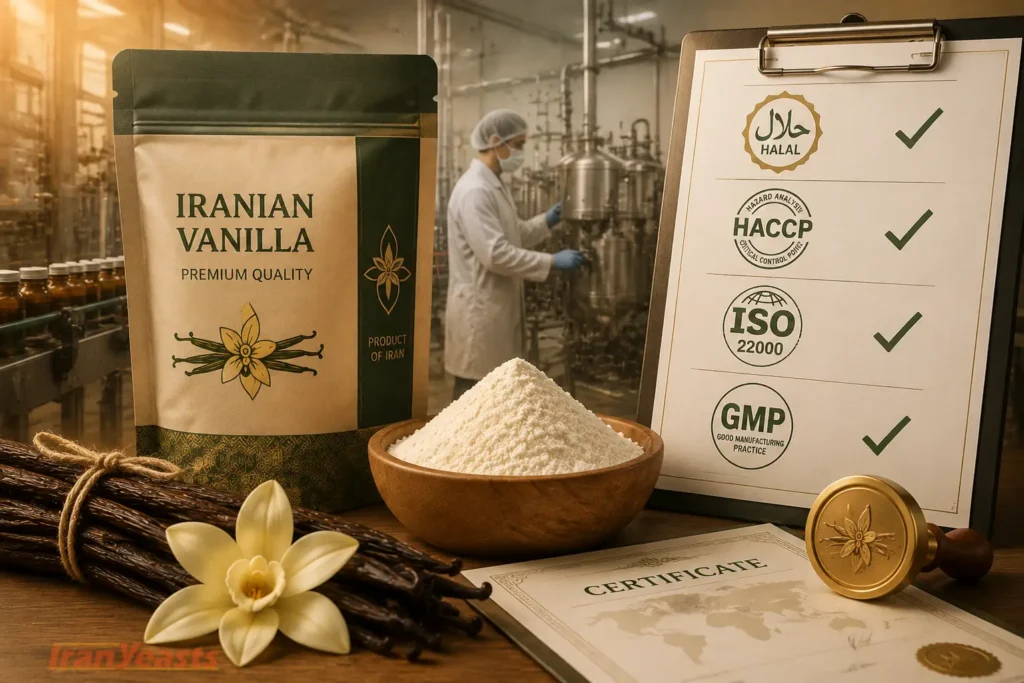
- HACCP confirms that critical control points in the production process are identified and actively monitored to prevent contamination.
- ISO 22000 covers the broader food safety management system around the facility, not just individual production steps.
- GMP confirms that manufacturing practices meet consistency and hygiene requirements independent of the specific product being made.
A supplier offering halal certified Iranian vanilla without any of these three should prompt a buyer to ask why.
Documents to Request Before Placing a Bulk Order
Before confirming a purchase order, a buyer should request a specific set of documents alongside the halal certificate itself. Together, these form the minimum paper trail that most import authorities and downstream retailers expect to see:
- Certificate of Analysis (COA) for the exact batch being shipped, not a generic or template result.
- Technical Data Sheet (TDS) describing the product specification, including purity and appearance.
- Safety Data Sheet (SDS) covering handling and storage requirements.
Why a Batch-Specific COA Matters More Than Buyers Expect
A generic or reused Certificate of Analysis is one of the clearest warning signs of a weak supplier relationship. The document should reference the actual lot number of the shipment, not a template result copied across multiple deliveries. The documentation requirements around exporting from Iran, including how customs and shipping paperwork interact with these quality documents, are detailed further in this guide on how to export vanilla from Iran.
Which Export Markets Treat Halal Certification as Non-Negotiable
Not every market applies the same level of scrutiny to halal paperwork, but several of the markets currently prioritized for Iranian vanilla exports do:
- Iraq, the UAE, Qatar, and Oman all have import frameworks where halal certification is either mandatory or strongly expected for food and flavoring ingredients.
- Afghanistan’s retail market operates on the same underlying expectation, even where enforcement is less centralized.
For a buyer sourcing into any of these markets, halal certification is less a competitive advantage and more a baseline requirement to clear customs without delay. A closer look at where current demand for Iranian vanilla is concentrated, and how that demand is expected to shift, is available in this breakdown of the top markets for Iranian vanilla exports.
Halal Certification and Private Label Production
Buyers producing under their own brand sometimes assume that private label runs fall outside a supplier’s standard certification, since the packaging and branding are custom. In practice, halal certification applies to the production process and facility, not to the label printed on the box, so a private label order manufactured on the same certified line carries the same halal status as any other batch.
This matters for smaller buyers in particular, since private label vanilla production is available from relatively modest order volumes rather than requiring the scale that private label agreements often demand for other ingredients. The broader cost and quality advantages of consolidating a private label order into a single bulk shipment are covered in more detail in this look at the benefits of buying Iranian vanilla in bulk.
Beyond the Certificate, What Builds Long-Term Buyer Confidence
A halal certificate answers a compliance question, but it rarely explains why a specific buyer chose one supplier over another for a repeat order. That decision usually comes down to consistency between shipments, responsiveness when documentation is requested, and whether the supplier treats certification as an ongoing commitment rather than a one-time audit. Some of the reasoning behind why importers continue choosing Iranian vanilla as a source, beyond price alone, is explored further in this piece on why importers choose Iranian vanilla.
Final Thoughts
Halal certification for Iranian vanilla is not a single checkbox, and treating it that way is usually where import problems begin. The certificate itself is the starting point for a conversation with a supplier, not the end of one, and the buyers who avoid customs delays are typically the ones who ask for the full documentation set before the shipment leaves port rather than after it arrives.
If a supplier hesitates to provide a batch-specific Certificate of Analysis, the underlying HACCP or ISO 22000 certificates, or a verifiable halal certificate number, that hesitation is itself useful information. A supplier confident in its own compliance record will usually have these documents ready before being asked twice.
References
- Institute of Standards and Industrial Research of Iran. (2023, November 21). Global trends in halal food standards: A review. Foods (MDPI)
- Food and Agriculture Organization of the United Nations. (n.d.). Codex Alimentarius: Iran country profile. FAO-WHO Codex Alimentarius.
- Mordor Intelligence. (2026). Vanillin market size, share and growth analysis report. Mordor Intelligence Pvt. Ltd.
- American Halal Foundation. (2024, November 20). Required export certifications and documents for U.S. manufacturers. Halal Foundation.
- Jade Premium. (2026, February 26). Halal certification for imported foods: Buyer checklist. Jade Premium.
Frequently Asked Questions
Find answers to common questions about Iranian instant dry yeast, including certifications, bulk orders, private labeling, export logistics, and delivery worldwide
What does halal certification for vanillin actually verify?
It verifies that the raw materials, processing aids, and manufacturing line used to produce the vanillin are free of prohibited substances and are kept separate from any non-halal processing at every stage, not just in the finished product.
Which body certifies Iranian vanillin as halal?
The Iran National Standards Organization, formerly the Institute of Standards and Industrial Research of Iran, issues halal certification for food products under the ISIRI 12000 standard.
Is a halal certificate enough on its own, or should buyers request more documents?
A halal certificate alone does not cover hygiene management or quality consistency. Buyers should also request HACCP, ISO 22000, and GMP documentation, along with a batch-specific Certificate of Analysis, before confirming an order.
Does halal certification apply to private label production as well?
Yes. Halal certification applies to the production facility and process rather than the packaging or branding, so private label runs manufactured on a certified line carry the same halal status as any other batch.
What is the minimum order quantity for halal certified Iranian vanilla?
Bulk export orders are available from 500 kilograms, and private label production with custom packaging is also available starting from this same volume.
Which export markets require halal certification most strictly?
Iraq, the UAE, Qatar, and Oman currently apply the strictest expectations for halal documentation on food and flavoring imports, with Afghanistan following similar underlying market expectations.
How can an importer verify that a halal certificate is authentic?
A legitimate certificate includes a certificate number and issuing date that can be checked against the issuing body directly, rather than relying solely on a scanned copy provided by the supplier.