

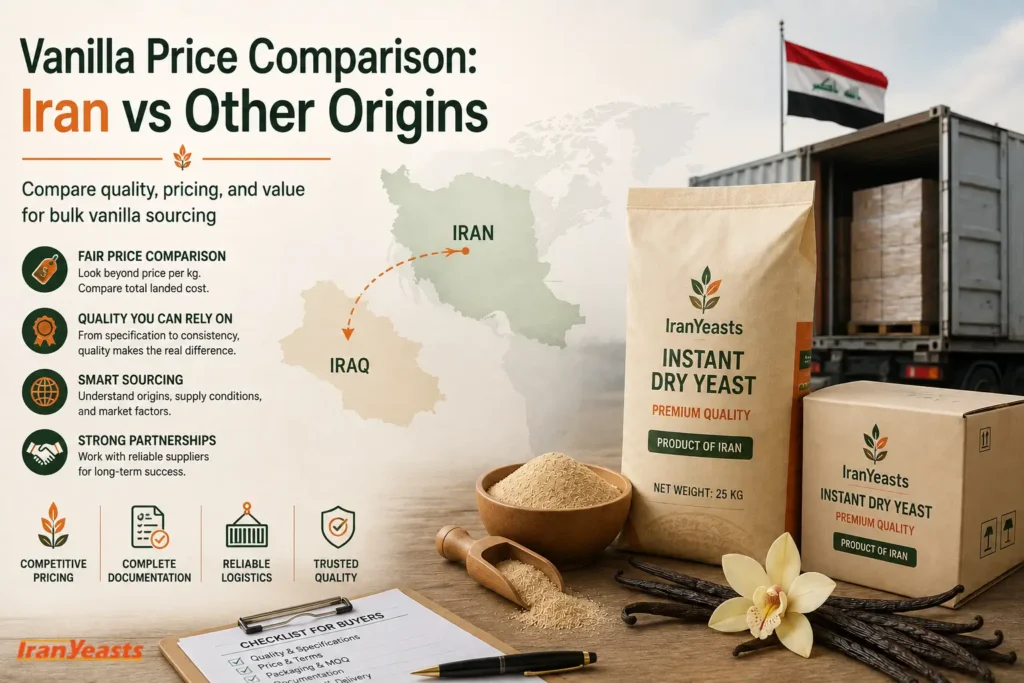
Vanilla price quotes can differ by a factor of ten or more depending on origin, grade, and whether the product is natural bean extract or synthetic vanillin. Buyers who compare quotes without context often end up comparing products that are not actually equivalent.
Iran’s position in this market is different from the classic bean-growing origins. Instead of harvested pods, Iranian vanilla suppliers produce vanillin and vanilla flavoring at industrial scale, which puts pricing on a completely different curve than Madagascar or Indonesia.
This guide of Irany Yeast Company breaks down what drives price in each category, where Iran sits relative to other sources, and how to compare quotes on a fair, apples-to-apples basis.
Looking to Import Iranianvanilla at Wholesale Scale?
Get expert guidance on product selection, packaging, export documentation, pricing, and international shipping directly from our export team.
Vanilla Price Comparison: How Iran Stacks Up Against Other Origins
The vanilla market is really three separate markets wearing one name: natural cured beans, natural vanillin extracted from those beans, and synthetic vanillin produced industrially. Prices across these three categories do not move together, and comparing a quote from one category against another without adjusting for it is the most common pricing mistake bulk buyers make.
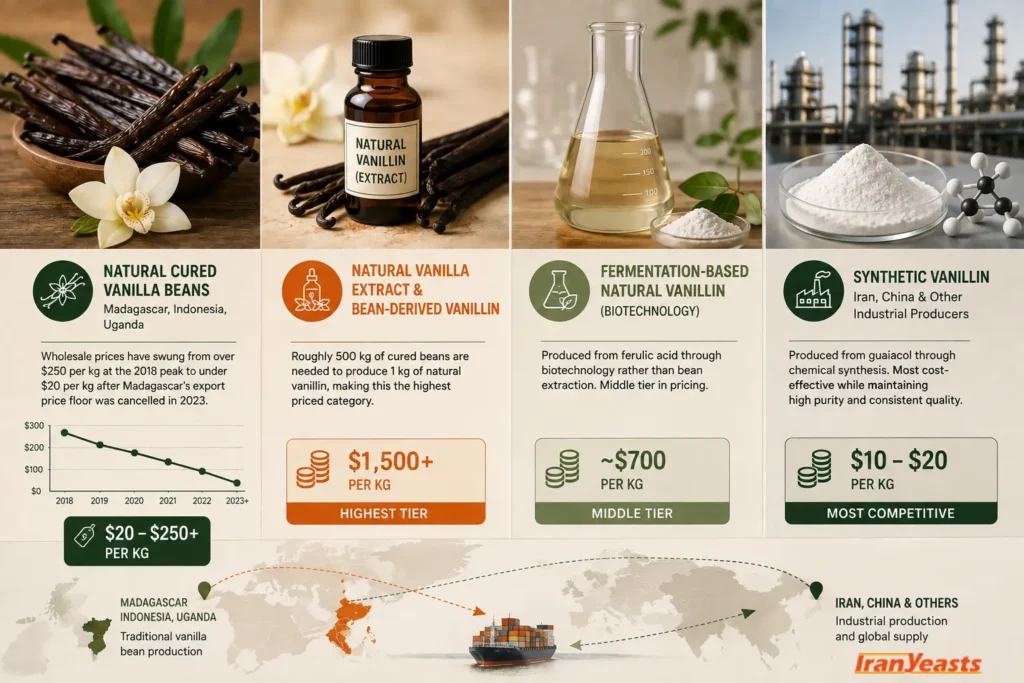
- Natural cured vanilla beans (Madagascar, Indonesia, Uganda): Wholesale vanilla prices have swung from over $250 per kilogram at the 2018 peak to under $20 per kilogram after Madagascar’s export price floor was cancelled in 2023, and pricing remains highly grade- and season-dependent.
- Natural vanilla extract and bean-derived vanillin: Because roughly 500 kilograms of cured beans are needed to produce a single kilogram of natural vanillin, this category commands the highest price of the three, often exceeding $1,500 per kilogram.
- Fermentation-based natural vanillin: Produced from ferulic acid through biotechnology rather than bean extraction, this sits in a middle tier, typically around $700 per kilogram, and is often used to label products as naturally derived at a lower cost than bean extraction.
- Synthetic vanillin (Iran, China, and other industrial producers): Produced from guaiacol through chemical synthesis, this category is priced closer to $10 to $20 per kilogram, a fraction of any natural category, while still delivering the core vanillin flavor compound at high purity.
Why Natural Vanilla Bean Prices Swing So Much
Bean-origin vanilla behaves less like a stable commodity and more like a speculative crop. Supply is concentrated in a small number of countries, harvests are seasonal and weather-dependent, and government export policy in the dominant origin can move global prices within weeks. This volatility is one reason the global vanilla demand forecast for 2026 matters as much to buyers as current spot prices: demand pressure on a thin, weather-exposed supply base is what turns a normal season into a price spike.
Madagascar's Outsized Influence
Madagascar alone accounts for the majority of global vanilla bean supply, so any disruption there, whether a cyclone, a policy change, or a shift in farmer behavior, has an outsized effect on world pricing. A 2023 government decision to cancel a mandatory minimum export price caused wholesale rates to fall from roughly $250 per kilogram to under $20 per kilogram within months, illustrating how quickly bean-origin pricing can move.
Grade Spread Within the Same Harvest
Grade A and Grade B beans from the same harvest can differ in price by 100 percent or more. A quote without a specified grade, moisture content, and length range is not a comparable quote, regardless of which origin it comes from.
Synthetic Vanillin Pricing: Iran vs China vs Global Producers
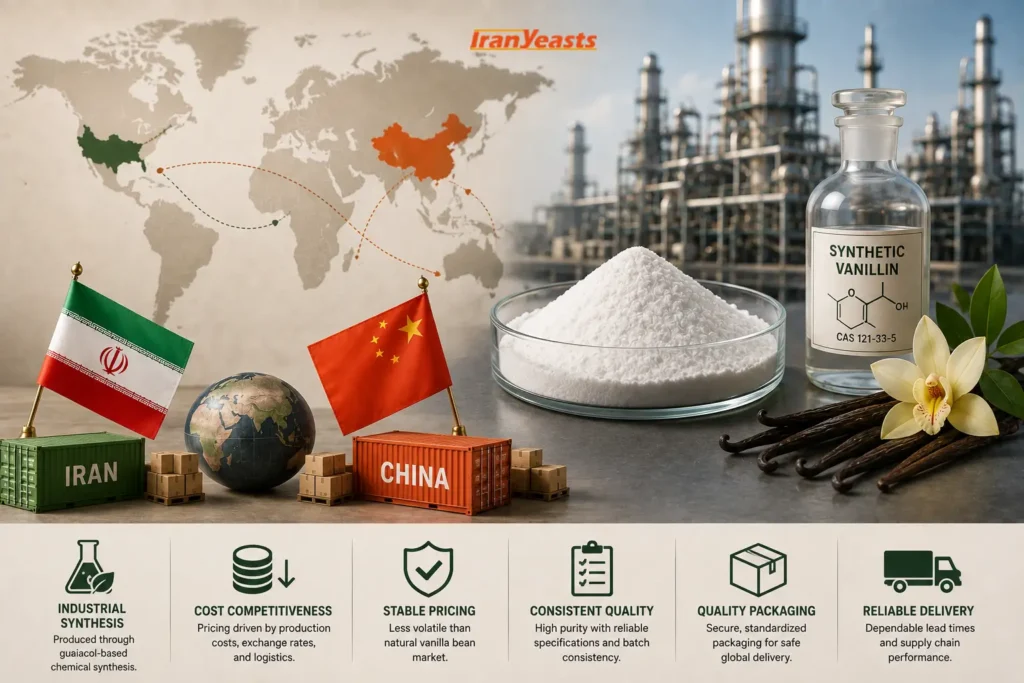
Synthetic, guaiacol-based vanillin is the workhorse of the global flavor industry, accounting for the large majority of total vanillin volume consumed worldwide. Pricing in this category is far more stable than bean-origin vanilla because it depends on industrial chemical inputs rather than a single weather-exposed harvest. Iranian producers compete in this space primarily on production cost, currency exchange rates, and export logistics rather than on raw material scarcity, which is a large part of what shapes the factors affecting Iranian vanilla export price for buyers evaluating quotes.
China remains the largest global producer of synthetic vanillin by volume, and Chinese pricing often serves as the informal benchmark buyers compare other quotes against. Iranian vanillin typically competes on similar cost fundamentals, with the main differentiators between suppliers coming down to purity consistency, documentation, packaging quality, and reliability of delivery schedules rather than large swings in raw material price.
Comparing Total Cost, Not Just Price per Kilogram
A lower quoted price per kilogram does not automatically mean a lower total cost. Freight terms, minimum order quantities, payment currency, and rejection risk from inconsistent quality all affect what a shipment actually costs once it reaches your warehouse. This is especially relevant when weighing the benefits of buying vanilla in bulk, since a larger order amplifies both the savings from a good quote and the damage from a bad one.
Freight and Incoterms: A cheap unit price with an unfavorable Incoterm can end up costing more once destination handling, duties, and insurance are added in.
Currency exposure: Quotes priced in a volatile currency carry hidden risk that a stable-currency quote at a slightly higher headline price may not.
Rejection and rework risk: A shipment that fails quality control on arrival costs far more than the difference between a cheap and a mid-priced quote, once delays and replacement sourcing are factored in.
Documentation quality: Suppliers who provide clear certificates of analysis and consistent batch data reduce the hidden cost of verifying quality yourself on every shipment.
When Natural Vanilla Makes Sense vs When Vanillin Does
Neither category is universally the right choice. The decision usually comes down to labeling requirements, target price point, and how much flavor intensity a formulation needs. A direct quality comparison between Iranian vanilla and Madagascar vanilla often surprises first-time buyers, since the right choice depends more on end-use than on which origin sounds more premium on paper.
Products marketed with a natural or clean-label claim generally require bean-derived or fermentation-based vanillin despite the higher cost, since regulatory labeling rules in most markets restrict what can be called natural. Products where cost efficiency and consistent flavor intensity matter more than a natural claim, such as many mass-market bakery, beverage, and confectionery applications, are well served by synthetic vanillin at a fraction of the price.
Conclusion
Vanilla pricing only makes sense once you separate it into its real categories: natural beans, natural extract or fermentation-based vanillin, and synthetic vanillin. Each moves on a different set of drivers, and comparing a quote from one category against another without adjusting for that is where most sourcing mistakes start. It is also part of why importers choose Iranian vanilla for cost-sensitive, high-volume applications: stable industrial pricing without the seasonal swings that define the bean-origin market.
The buyers who get the best long-term value are rarely the ones chasing the single lowest quote. They are the ones who understand what category they are actually buying, what drives its price, and how to weigh a quote against total landed cost.
References
- United States International Trade Commission. (2020). Alright stop, collaborate and listen: Vanillin not vanilla [Working paper].
- Chiocchio, I., et al. (2024). From waste to value: Recent insights into producing vanillin from lignin. Molecules, 29(2), 442.
- VanillaRoots. (2026). Vanilla bean price history 2010-2026: The full chart with context.
- ExportReady Africa. (2026, April 14). Vanilla price per kg Madagascar: Market rates, volatility and price drivers.
- Mordor Intelligence. (2026). Vanillin market size, share and 2031 growth analysis report.
Frequently Asked Questions
Find answers to common questions about Iranian instant dry yeast, including certifications, bulk orders, private labeling, export logistics, and delivery worldwide
Why is synthetic vanillin so much cheaper than natural vanilla?
Synthetic vanillin is produced from guaiacol through industrial chemical synthesis, while natural vanillin requires roughly 500 kilograms of cured beans per kilogram of extract, which is why natural options can cost more than 50 times as much.
How does Iranian vanillin pricing compare to Chinese vanillin?
Both compete on similar industrial cost fundamentals rather than raw material scarcity, so pricing is generally close between the two, with differentiation coming from purity consistency, documentation, and delivery reliability.
Why did Madagascar vanilla bean prices crash after 2023?
Madagascar cancelled its government-mandated minimum export price in April 2023, which caused wholesale rates to fall sharply from around $250 per kilogram to under $20 per kilogram for lower grades within months.
Is natural or synthetic vanillin better for food manufacturing?
Neither is universally better. Natural options suit products with a clean-label claim, while synthetic vanillin offers consistent flavor intensity at a much lower cost for applications where a natural claim is not required.
What causes such a wide price range within the same vanilla grade?
Moisture content, bean length, curing quality, and harvest timing all affect grade classification, and even beans within the same nominal grade can vary significantly in price based on these factors.
Does a lower price per kilogram always mean lower total cost?
No. Freight terms, currency risk, minimum order quantities, and the cost of rejected or reworked shipments can outweigh a lower headline unit price.
How stable is synthetic vanillin pricing compared to natural vanilla?
Synthetic vanillin pricing is considerably more stable because it depends on industrial chemical inputs rather than a single weather-exposed seasonal harvest concentrated in a few countries.