

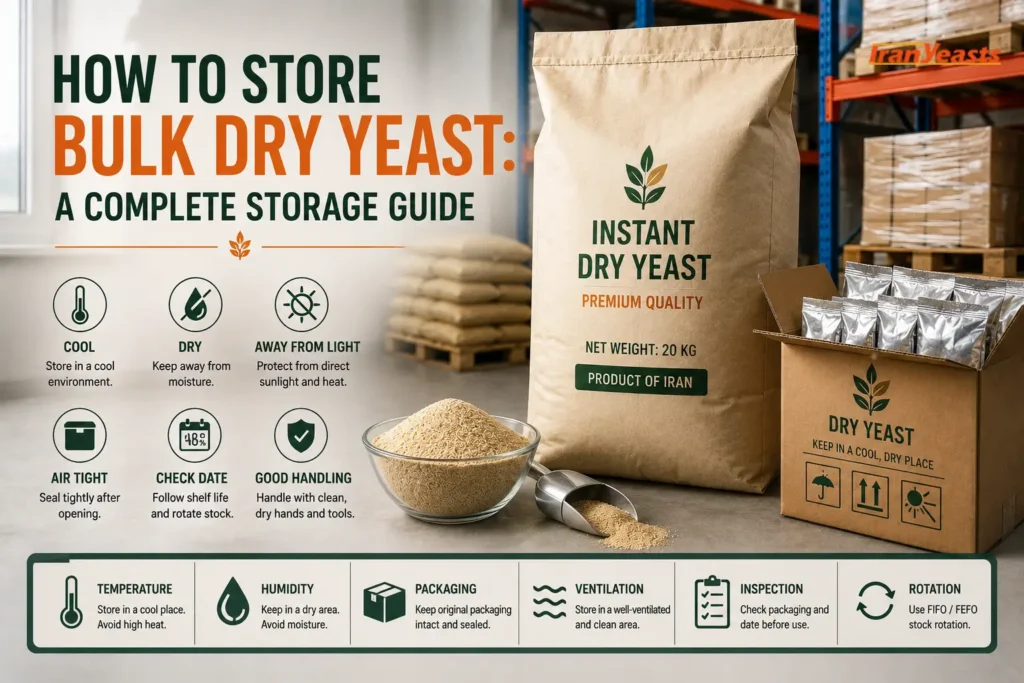
Yeast is a living organism, even in its dry, dormant form. Store it wrong and it does not just lose potency slowly, it can stop performing altogether by the time it reaches a bakery’s mixing line.
Bulk quantities raise the stakes further. A pallet of 25-kilogram bags sitting in a hot warehouse or a humid port for a few extra weeks can lose fermentation power in ways a small retail packet never would, simply because of how much surface area and total volume are exposed to the same conditions.
This guide of Irany Yeast Compnay covers what distributors and importers need to know about storing bulk dry yeast correctly, from the warehouse floor to the inside of a shipping container.
Looking to Import Iranian Instant Dry Yeast at Wholesale Scale?
Get expert guidance on product selection, packaging, export documentation, pricing, and international shipping directly from our export team.
How to Store Bulk Dry Yeast: Core Requirements
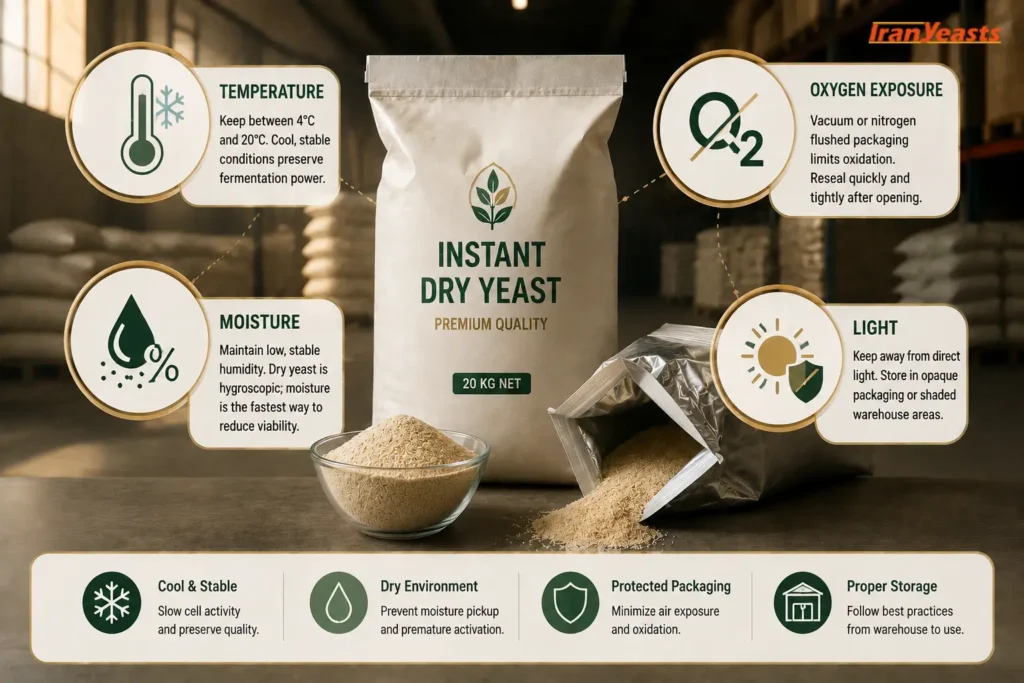
Dry yeast cells are dormant, not dead, and four conditions determine how long they stay that way: temperature, moisture, oxygen exposure, and light. A peer-reviewed study on active dry yeast products found that viability declines sharply once water activity in the product rises above roughly 0.40, which is exactly what happens when packaging fails to keep moisture out during storage or transit.
Temperature: Keep bulk yeast between 4°C and 20°C where possible. Cool, stable conditions slow cell activity to a minimum; heat above 25°C accelerates the loss of fermentation power even inside sealed packaging.
Moisture: Relative humidity in the storage area should stay low and stable. Dry yeast is hygroscopic, and moisture pickup is the single fastest way to trigger premature cell activation and die-off.
Oxygen exposure: Vacuum-sealed or nitrogen-flushed packaging removes the oxygen that drives oxidation. Once a bulk bag is opened, exposure begins immediately, so resealing quickly and tightly matters.
Light: Store bulk bags away from direct light in an opaque outer packaging or a shaded warehouse zone. Light exposure is a secondary factor next to temperature and moisture, but it compounds their effect over time.
Instant Dry Yeast vs. Active Dry Yeast: Storage Differences
Not all dry yeast behaves the same way once it leaves the factory, and buyers who assume otherwise sometimes store one type using rules meant for the other. The differences in cell structure between the two forms affect not just how they are used in baking but also how forgiving they are of storage conditions, a distinction covered in detail when comparing active dry yeast vs. instant dry yeast for export.
Instant dry yeast has smaller cells and a lower moisture content at production, which gives it a longer typical shelf life and slightly more tolerance for ambient storage. Active dry yeast has larger, more porous cells and is generally more sensitive to heat and moisture swings, making stable cool storage more important throughout its shelf life rather than only during the final leg of transport.
Packaging That Protects Bulk Yeast During Export
Packaging is the first line of defense, and for bulk export volumes it has to perform for months, not days. Multi-layer bags with a metallized or foil barrier layer, vacuum-sealed or nitrogen-flushed at the point of packing, are the standard for any yeast shipment expected to survive ocean freight and warehouse dwell time. Buyers new to sourcing should understand this stage as part of the broader process covered in how to import yeast from Iran, since packaging quality is one of the first things worth confirming with any supplier before placing an order.
Bulk bags in the 10 to 25 kilogram range should carry an inner moisture barrier layer independent of the outer bag, so that a damaged or punctured outer layer does not immediately expose the product. Once a bulk bag is opened at a distribution point, the remaining yeast should be resealed tightly or transferred into a smaller airtight container rather than left folded or clipped shut.
Container Shipping and Warehouse Storage for Bulk Yeast
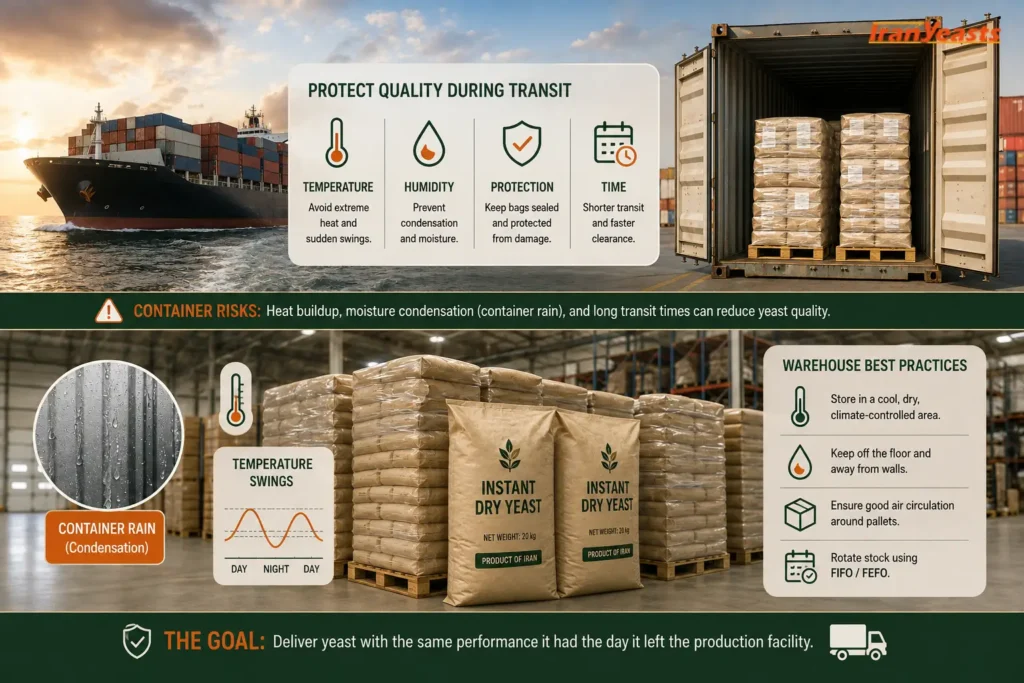
A shipment that leaves the production facility correctly packaged can still lose quality during weeks at sea or sitting in an uncooled bonded warehouse after customs clearance. Temperature swings inside a shipping container, sometimes called container rain when condensation forms on cooling overnight, can degrade yeast quality even when the outer packaging looks intact on arrival. Underestimating this risk is one of the hidden costs behind any bulk dry yeast price quote, since a shipment that arrives underperforming often costs more in reduced baking performance than the difference between a cheap and a properly packaged order.
Where possible, request that bulk yeast ship in temperature-controlled containers on longer routes or during summer months, and confirm with your freight forwarder whether the destination bonded warehouse offers climate control before goods arrive. A few weeks in an uncooled facility in a hot climate can undo weeks of careful packaging.
Shelf Life, Viability Testing, and Signs of Degraded Yeast
Manufacturer shelf life figures assume correct storage the entire time, and bulk packaging often carries a shorter stated shelf life than small retail packets because of the larger surface-to-volume ratio involved. This is one more reason how to evaluate a bulk yeast supplier matters as much as evaluating the product itself, since a supplier’s packaging discipline determines whether the stated shelf life holds up in practice.
On arrival, check that packaging is intact, dry, and free of any bulging or discoloration, which can signal moisture intrusion or early fermentation activity inside the bag. When in doubt, proof a small sample in warm water with a pinch of sugar; vigorous foaming within ten minutes confirms the yeast is still active, while a weak or absent reaction signals reduced potency that should be factored into dosage or flagged with the supplier.
Working With a Supplier That Packages for the Long Haul
Storage discipline at a distributor’s warehouse can only protect what arrives in good condition to begin with. This is a core part of what has made Iran instant dry yeast a top choice for bulk importers worldwide: consistent multi-layer packaging built for long transit times, paired with batch documentation that lets distributors verify what they are receiving before it goes into storage.
Conclusion
Bulk dry yeast storage comes down to controlling four variables end to end: temperature, moisture, oxygen, and light, from the moment it leaves the production facility until it reaches a bakery’s mixing line. Packaging quality is what determines whether that control holds up over weeks of transit and warehouse dwell time, not luck.
Getting storage right protects performance as much as it protects cost. A properly stored shipment bakes exactly as promised, while a poorly stored one quietly underperforms in ways that are far more expensive to trace back than the packaging that would have prevented it.
References
- Lesaffre Yeast Corporation. (2025, October 30). Red Star active dry yeast: Product specifications and storage guidelines.
- Rasmussen, S. K., et al. (2010). Viable cell yield from active dry yeast products and effects of storage temperature and diluent on yeast cell viability. Journal of Dairy Science.
- Justlong in Food. (2025, July 28). Storage of dry yeast: Temperature, humidity, and shelf life guidelines.
- Fres-co System USA. (2022, June 8). Flexible packaging for yeast to maintain, improve its value.
- Food Republic. (2024, October 21). How to store a block of yeast, both active dry and instant.
Frequently Asked Questions
Find answers to common questions about Iranian instant dry yeast, including certifications, bulk orders, private labeling, export logistics, and delivery worldwide
What is the ideal storage temperature for bulk dry yeast?
Between 4°C and 20°C, in a cool, stable environment. Refrigeration is not required for unopened packaging, but stable cool conditions preserve fermentation power far longer than warm storage.
How long does bulk dry yeast last compared to small retail packets?
Bulk packaging often carries a shorter stated shelf life than small packets, commonly around 18 months versus 2 years, because of the larger surface-to-volume ratio and slightly higher moisture exposure risk in large bags.
Can bulk dry yeast be frozen for long-term storage?
Freezing is not generally recommended for bulk instant or active dry yeast intended for near-term commercial use, since temperature cycling during freezing and thawing can damage cell membranes and reduce activity.
How can I test if stored yeast is still active?
Proof a small sample in warm water with a pinch of sugar. Vigorous foaming within about ten minutes indicates the yeast is still active; a weak or absent reaction signals reduced potency.
Does instant dry yeast store differently than active dry yeast?
Yes. Instant dry yeast generally tolerates ambient storage slightly better due to its lower moisture content at production, while active dry yeast is more sensitive to heat and humidity swings throughout its shelf life.
What packaging is best for bulk yeast shipped by container?
Multi-layer bags with a metallized or foil moisture barrier, vacuum-sealed or nitrogen-flushed at the point of packing, are standard for bulk export shipments expected to survive weeks of ocean freight.
Why does opened bulk yeast lose potency faster than unopened yeast?
Once opened, the vacuum or nitrogen-flushed seal is broken, exposing the yeast to ambient oxygen and moisture. Resealing tightly or transferring to an airtight container slows this exposure but does not eliminate it.