

Africa’s yeast market rarely comes up in sourcing conversations the way the Middle East or South Asia does, but the numbers are hard to ignore. The continent consumed about 1.6 million tons of bakers’ and active yeast in 2024, and the market was worth roughly 4 billion dollars.
Most of that yeast is produced locally, but a group of countries still relies heavily on imports, and limited cold-chain infrastructure makes shelf-stable dry yeast a better fit than fresh yeast in many of them. That is where the opportunity sits.
This guide looks at the size of the yeast market in Africa, which countries buy the most, why dry yeast fits, and what importers and distributors should plan for.
Looking to Import Iranian Yeast at Wholesale Scale?
Get expert guidance on yeast type, packaging format, export documentation, pricing, and international shipping directly from our export team.
The Yeast Market in Africa: Where Iranian Yeast Could Fit
Africa is not yet a core market for Iranian yeast the way Afghanistan, Iraq, or Pakistan are, which is exactly why it is worth examining now. Iranian instant dry yeast matches what many African markets need: a shelf-stable product that ships and stores without refrigeration and suits commercial bakeries scaling up production.
How Big Is the Yeast Market in Africa?
The scale is larger than most sourcing teams assume. According to IndexBox market data, these were the headline figures for bakers’ and active yeast in Africa:
| Metric | Figure | Year |
|---|---|---|
| Consumption | About 1.6 million tons, up 3.2% | 2024 |
| Market value | About $4 billion, up 7.3% | 2024 |
| Local production | About 1.5 million tons | 2024 |
| Imports | About 127,000 tons, worth about $322 million | 2024 |
| Average import price | About $2,540 per ton, a flat trend | 2024 |
| Forecast | 1.9 million tons and $5.3 billion | By 2035 |
The forecast implies steady rather than explosive growth, about 1.7 percent a year in volume and 2.7 percent in value. Figures differ between research firms, and Africa is sometimes reported together with the Middle East, so treat these as directional and confirm current data before building a business case. For context on the wider picture, see the global instant dry yeast market in 2026.
Which African Countries Buy the Most Yeast?
The largest consumers and the largest importers are not the same countries, and that difference matters for anyone selling into the region.
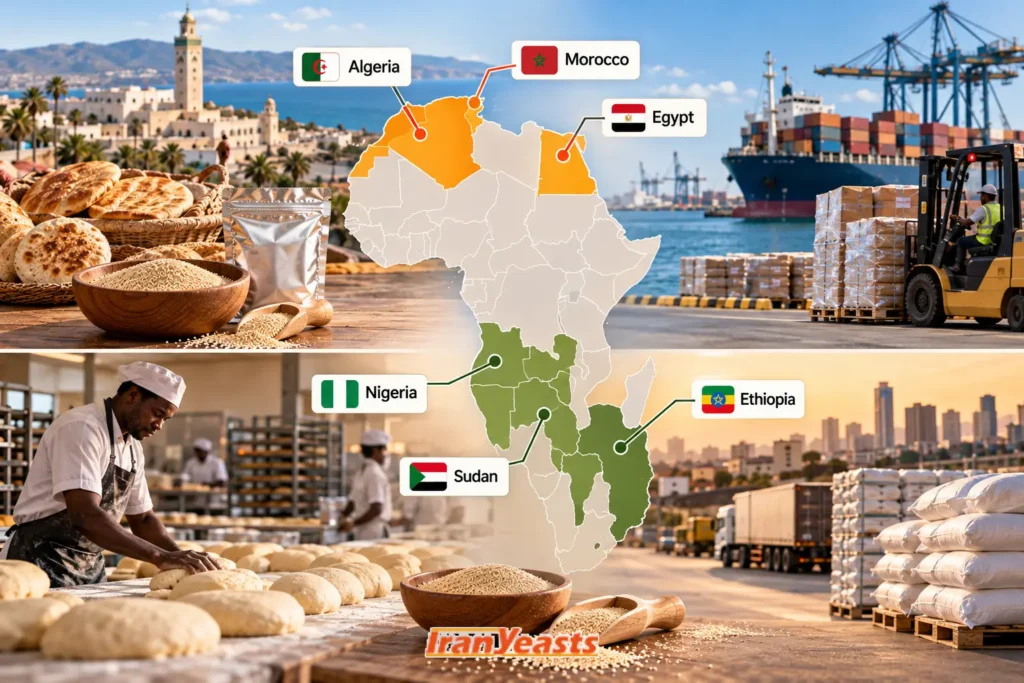
- Largest consumers: Nigeria (about 217,000 tons), Ethiopia (124,000 tons), and Egypt (114,000 tons) together accounted for 29 percent of African consumption in 2024.
- Largest importers by volume: Algeria and Sudan, at about 18,000 tons each, made up roughly 28 percent of imports, followed by Nigeria, Ethiopia, and Morocco.
- Largest importers by value: Algeria ($47 million), Sudan ($46 million), and Morocco ($21 million) held a combined 36 percent share.
- Main regional exporter: Egypt shipped about 29,000 tons, 64 percent of Africa’s yeast exports, which makes it the main regional competitor.
In practice, the most accessible openings are markets that already import in volume, such as Algeria, Sudan, and Morocco, rather than large consumers that are mostly supplied by local production.
Why Yeast Demand in Africa Keeps Growing
A handful of structural trends are lifting demand across the continent, not just in one or two countries:
- Urbanization: More people living in cities means more reliance on commercially baked bread rather than home baking.
- Population growth: Africa has some of the fastest-growing populations in the world, which steadily adds to bread consumption.
- Bakery modernization: A gradual shift toward commercial bakery products and larger production lines adds demand for consistent, easy-to-dose yeast.
Where the Opportunity Is Strongest
North Africa
Bread is a dietary staple across North Africa, and Algeria and Morocco are among the continent’s largest yeast importers. Halal expectations, bread-centred diets, and trade practices are close to those of Middle Eastern markets, which makes the region a logical first step for suppliers already serving the Gulf and Iraq. Egypt is different: it is a large producer and the region’s main exporter, so it is a competitor more than a target.
Sub-Saharan Africa
Nigeria and Ethiopia are the largest consumers on the continent, and Sudan is one of its biggest importers. Infrastructure, payment logistics, and import procedures are generally less developed than in North Africa, so local partners and careful planning matter more here.
The Supply Gap: Why Dry Yeast Fits African Markets
Fresh yeast needs refrigeration from the factory to the bakery, and Mordor Intelligence notes that limited cold-chain infrastructure restricts fresh yeast distribution across the Middle East and Africa. Instant dry yeast avoids that problem because it ships and stores at ambient temperature and holds its activity for a long time when packed correctly. In hot, humid climates the pack format matters too, which is why vacuum and nitrogen-flushed yeast packaging is worth comparing before a first order.
What Importers and Distributors Should Plan For
Entering a new African market works best with the same groundwork used for any new region:
- Halal certification: North and West Africa have large Muslim populations where halal documentation is commonly expected, as in Middle Eastern markets.
- Local distribution partners: A distributor who already knows import procedures and has bakery relationships is usually faster than direct entry.
- Country-by-country terms: Payment norms and logistics vary widely, so set terms and shipping plans market by market, not continent-wide.
- Trial orders first: A smaller first shipment through a distributor who already serves the market reduces risk in unfamiliar territory.
Suppliers that already document halal-certified yeast export from Iran for Middle Eastern buyers can usually extend the same paperwork to North and West African markets with similar requirements.
Sourcing Iranian Yeast for African Markets
A practical first step is to compare bulk dry yeast prices from Iran with Africa’s average import price of about $2,540 per ton, then factor in freight to your port. That comparison shows quickly whether a specific market makes sense.
Irany Yeasts supplies Iranian dry yeast in bulk to importers and distributors, and the export team can advise on pack formats and documents for your destination. Distributors who want to build their own brand in a new market can also look at private label yeast packaging.
Conclusion
Africa’s yeast market is large, worth about 4 billion dollars in 2024, and still growing steadily. Most yeast is produced on the continent, but importers such as Algeria, Sudan, and Morocco, together with limited cold-chain infrastructure, create a real opening for shelf-stable dry yeast.
The markets most worth starting with combine existing import demand, workable logistics, and a local partner who already understands the terrain, rather than the biggest headline number on a market report.
References
- IndexBox. (2026). Africa's bakers' and active yeast market to reach 1.9M tons and $5.3B by 2035. https://www.indexbox.io/blog/active-yeast-africa-market-overview-2024-2/
- Mordor Intelligence. (2026). Baker's yeast market size, forecast, share analysis 2026 to 2031. https://www.mordorintelligence.com/industry-reports/bakers-yeast-market
- IndexBox. (2026). World bread baking yeast market analysis, forecast, size, trends and insights. https://www.indexbox.io/store/world-bread-baking-yeast-market-analysis-forecast-size-trends-and-insights/
Frequently Asked Questions
Find answers to common questions about the yeast market in Africa, the largest importing countries, and why dry yeast suits the region.
How big is the yeast market in Africa?
Africa consumed about 1.6 million tons of bakers’ and active yeast in 2024, and the market was worth roughly 4 billion dollars. IndexBox forecasts 1.9 million tons and 5.3 billion dollars by 2035.
Which African countries import the most yeast?
Algeria and Sudan were the largest importers in 2024 at about 18,000 tons each, followed by Nigeria, Ethiopia, and Morocco. By value, Algeria, Sudan, and Morocco led.
Which African countries consume the most yeast?
Nigeria, Ethiopia, and Egypt were the largest consumers in 2024, together accounting for about 29 percent of African consumption.
Does Africa import most of its yeast?
No. Africa produced about 1.5 million tons in 2024 and imported about 127,000 tons, but several countries, especially Algeria, Sudan, and Morocco, rely heavily on imports.
Why is dry yeast better suited to Africa than fresh yeast?
Fresh yeast needs refrigeration throughout the supply chain, which many African markets lack. Instant dry yeast ships and stores at ambient temperature, avoiding that constraint.
What is the average yeast import price in Africa?
Africa’s average import price for bakers’ and active yeast was about 2,540 dollars per ton in 2024, almost unchanged from the year before.
Is halal certification important for exporting yeast to Africa?
In North and West Africa, large Muslim populations make halal documentation commonly expected, similar to Middle Eastern markets.