

Dry yeast looks stable in its package, but it is still a living organism, and the package is the only thing standing between it and oxygen, moisture, and heat. Two bags of the same yeast can arrive in the same warehouse and perform very differently three months later, purely because of how they were sealed.
Vacuum, nitrogen-flushed, and standard sealed packaging all claim to protect the product, yet they do it differently and cost differently. Buyers comparing quotes often treat them as the same thing.
This guide explains how each format works, where it fits, and what to ask a supplier before you order.
Looking to Import Iranian Yeast at Wholesale Scale?
Get expert guidance on yeast type, packaging format, export documentation, pricing, and international shipping directly from our export team.
Yeast Packaging Types for Iranian Yeast: Three Formats at a Glance
Every format below is a different answer to the same problem: keeping oxygen and moisture away from dormant yeast cells. The right answer for Iranian yeast depends on pack size, transit time, and how long the product will sit before use, a question that matters most for the bulk instant dry yeast covered in why Iranian instant dry yeast is a top choice for bulk importers. The table gives a quick side-by-side view before the detail.
| Format | How It Protects | Typical Shelf Life | Best Suited For |
|---|---|---|---|
| Vacuum | Removes air from the pack before sealing | 1.5 to 2 years | Bulk packs, long transit, long storage |
| Nitrogen-flushed | Replaces air with inert nitrogen, then seals | About 1 to 2 years | Small sachets and retail packs |
| Standard sealed | Sealed pack with no oxygen removal | 6 months to 1 year | Short supply chains, fast turnover |
Major brands follow the same split. Red Star, for example, vacuum-packs its industrial 2 lb yeast and nitrogen-flushes its small packets and jars. Shelf-life figures depend on the film, the storage temperature, and the supplier, so treat them as typical ranges, not guarantees.
Why Packaging Matters for Dry Yeast
Dry yeast is dormant, not inert. Three things shorten its life even inside an unopened pack, and every packaging format is really a strategy for controlling them.
- Oxygen: Yeast makers state that dry yeast loses leavening power faster when exposed to air, even inside a sealed pack.
- Moisture: Dry yeast is hygroscopic, so moisture that gets in activates cells early and shortens usable life.
- Heat: Heat speeds every degradation process, which is why packaging and storage temperature work together.
One yeast packaging patent notes that active dry yeast can be preserved for at least two years at ambient temperature, 20 to 25 degrees Celsius, if it is protected against moisture and, preferably, against oxygen and light. Good packaging is how that protection is delivered.
Vacuum Packaging: The Standard for Bulk Yeast
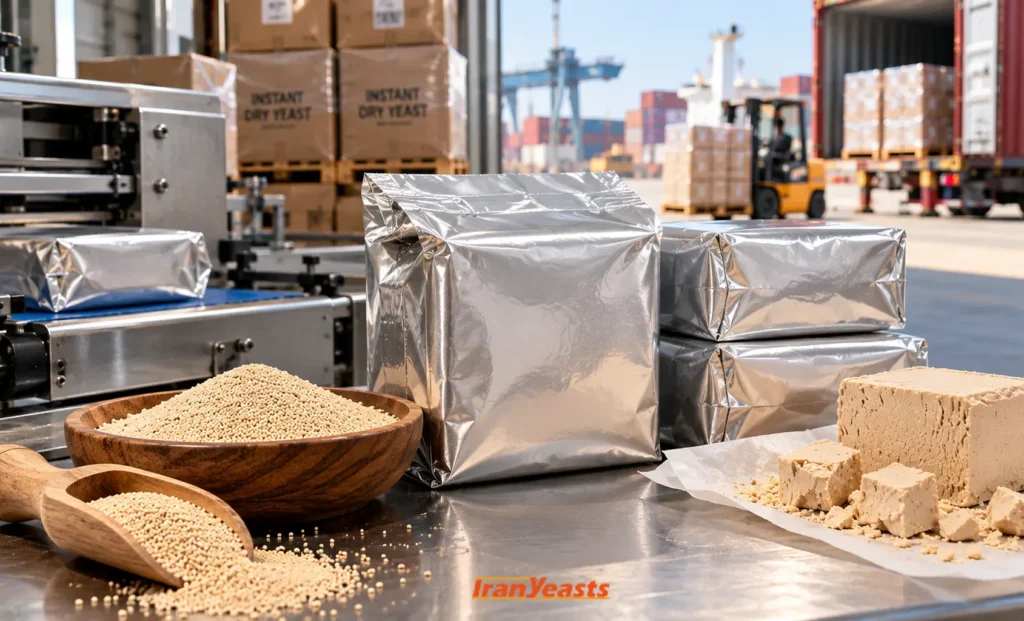
In vacuum packaging, air is drawn out of a multi-layer pack before it is sealed, leaving the yeast in a very low-oxygen environment. Instant dry yeast is commonly sold this way, and industry patent literature describes instant active dry yeast with a dry matter of at least 94 percent packed under vacuum in a pack that must be impermeable to oxygen and humidity. The finished pack usually turns firm and brick-like. Red Star’s industrial 2 lb yeast, for example, is vacuum-packed and hard like a brick before opening, which is a quick visual sign the seal is intact.
Applications
- Bulk instant dry yeast for bakeries and distributors.
- Export shipments with long sea or land transit.
- Private label programs built around a durable, premium-looking pack.
Benefits
- Shelf life: The longest typical shelf life of the three formats, 1.5 to 2 years in IranYeasts’ export specifications.
- Easy integrity check: A firm, sealed pack is easy to inspect on arrival, since a loose or puffy pack suggests a leak.
- Strong barrier: Multi-layer films resist moisture well, which suits humid ports and warehouses.
Limitations
- Higher packaging cost: Vacuum lines and laminated films cost more than basic sealing.
- Protection ends at opening: Once opened, the vacuum is gone and the yeast needs resealing or refrigeration.
- Handling: The hard brick shape needs breaking up before portioning in some uses.
IranYeasts builds its private label packaging service around this format, and the private label yeast manufacturing guide explains how the process works from design approval to shipment.
Nitrogen-Flushed Packaging: Protection in a Softer Pack
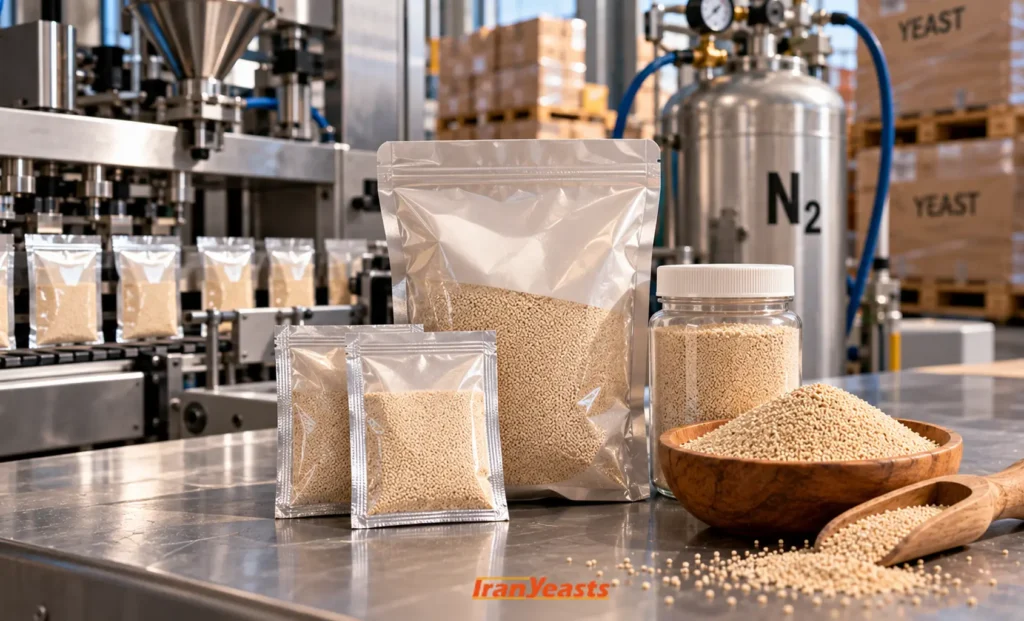
Nitrogen flushing pushes oxygen out of the pack with nitrogen gas just before sealing. Nitrogen is inert, so the yeast sits in an atmosphere with very little oxygen even though the pack is not under vacuum.
How low the oxygen goes matters. A bakery-packaging patent describes residual oxygen below about 5 percent as acceptable, with under 2 percent, under 1 percent, and ideally under 0.5 percent as progressively better. The gas does the work, but only if the film is a genuine oxygen barrier.
Applications
- Small sachets and retail packs, where vacuum is costly relative to the product inside.
- Jars and pouches that need to stay soft and free-flowing.
- Consumer-facing brands where a pillow-style pack suits the shelf.
Benefits
- Free-flowing product: Granules stay loose rather than forming a hard brick, so portioning is easy.
- Proven in the market: Red Star, a major yeast brand, nitrogen-flushes its dry yeast packets and states a best-by date two years from packaging.
- Practical for small formats: Lower equipment demands than a vacuum line for very small packs.
Limitations
- Harder to inspect: A nitrogen-flushed pack looks full and puffy even with a pinhole leak, so integrity is harder to judge by eye.
- Quality varies: Residual oxygen varies by line quality, so the result depends on the supplier’s process.
- No vacuum indicator: Red Star notes its nitrogen-flushed jars are not vacuum sealed, so there may be no pop on opening and no vacuum signal to check.
For a deeper look at how the product inside differs, see active dry yeast vs. instant dry yeast for export, since cell structure affects how well each type tolerates its packaging.
Standard Sealed Packaging: Simple, but Shorter-Lived
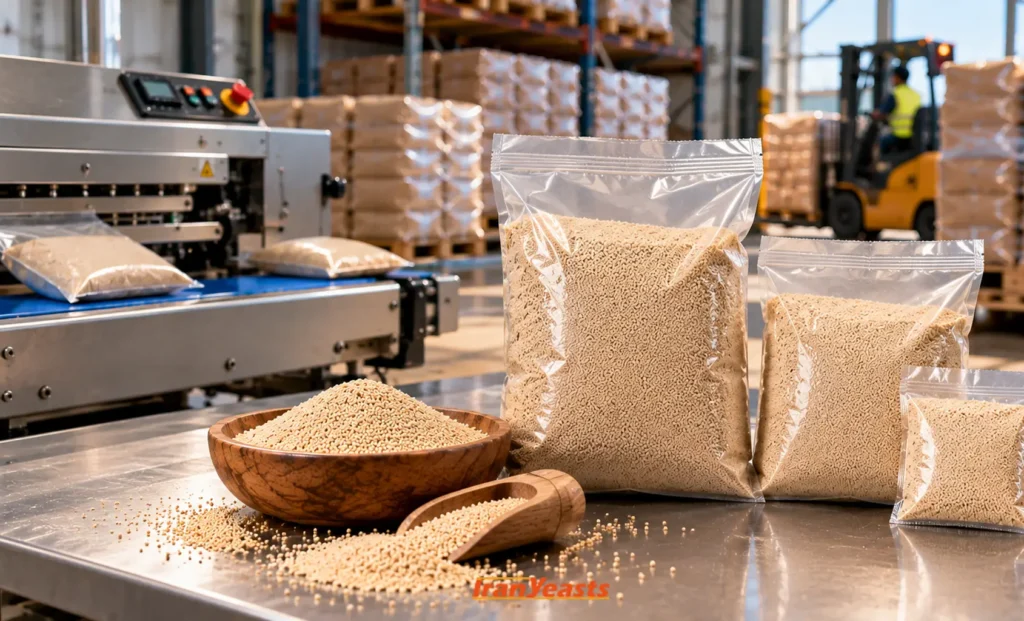
A standard sealed pack is a bag or pouch closed with heat but without removing the air inside. It keeps dust and loose moisture out, but the oxygen trapped at filling stays in contact with the yeast. This format is covered here so buyers can recognize it when comparing quotes from different suppliers.
Applications
- Fast-turnover supply chains where stock is used within a few months.
- Short domestic or regional routes with cool, dry storage.
- Cost-sensitive orders where the buyer accepts a shorter shelf life.
Benefits
- Lowest cost: The simplest and cheapest sealing method.
- Easy to produce: Needs no vacuum or gas equipment.
- Widely available: Familiar to buyers and easy to restock quickly.
Limitations
- Shorter life: Typical shelf life is 6 months to 1 year, well below vacuum.
- Weaker barrier: Trapped air and thinner films leave yeast more exposed to heat and humidity in transit.
- Less forgiving: Storage conditions matter far more, so cool, dry warehousing becomes essential.
Because packaging format changes the cost of a shipment, it is worth reading it alongside bulk dry yeast pricing from Iran, where pack type is one of the factors behind the final quote.
How to Choose the Right Packaging Format
Work through these steps in order and the right format usually becomes clear.
- Start with the route: Long transit or humid ports point toward vacuum. Short, cool routes leave more room for other formats.
- Estimate storage time: If stock may sit for more than six months, choose vacuum. If it turns over fast, a cheaper format can work.
- Match the pack size: Bulk packs of 500g and above usually suit vacuum. Small sachets often suit nitrogen flushing.
- Think about handling and presentation: A hard vacuum brick and a soft nitrogen pack present differently on the shelf and in the bakery.
- Weigh the full cost: Compare landed cost per kilogram of usable yeast, not the packaging price alone, since spoilage costs more than a better seal.
What to Ask Your Supplier Before You Order
A few direct questions reveal how seriously a supplier treats packaging. They also fit into the wider checklist in how to evaluate a bulk yeast supplier.
- What film structure is used, and does it include an aluminum or other oxygen-barrier layer?
- For nitrogen-flushed packs, what residual oxygen level does the line achieve?
- Is the shelf life counted from the packaging date, and what storage conditions does it assume?
- How are packs checked for leaks before shipment?
- Can I receive a sample in the exact format I plan to order?
Request a Yeast Sample in Your Preferred Packaging
Test vacuum or nitrogen-flushed packs before you commit to a full order, or talk to our export team on WhatsApp.
Conclusion
Vacuum, nitrogen-flushed, and standard sealed packaging protect dry yeast in different ways. Vacuum gives the longest life for bulk and export, nitrogen flushing suits small soft packs, and standard sealing works only where stock moves quickly.
Matching the format to your route, storage time, and pack size protects both the yeast and your margin. Ask for the film structure, the shelf-life basis, and a sample before you commit.
References
- Lesaffre Yeast Corporation. (n.d.). Red Star active dry yeast 2-pound package. Red Star Yeast. https://redstaryeast.com/product/active-dry-yeast-2-pound-package/
- Lesaffre Yeast Corporation. (n.d.). Red Star all-natural active dry yeast. Red Star Yeast. https://redstaryeast.com/product/all-natural-active-dry-yeast-strip/
- Lesaffre Yeast Corporation. (n.d.). Red Star active dry yeast 4-ounce jar. Red Star Yeast. https://redstaryeast.com/red-star-products/red-star-active-dry-yeast/
- Packaged powder composition for bakery (U.S. Patent No. 9,408,399). (n.d.). U.S. Patent and Trademark Office. https://patents.google.com/patent/US9408399B2/en
- Yeast packaging (U.S. Patent Application Publication No. 2006/0193948 A1). (n.d.). U.S. Patent and Trademark Office. https://patents.google.com/patent/US20060193948A1/en
Frequently Asked Questions
Find answers to common questions about yeast packaging types, including vacuum, nitrogen-flushed, and standard sealed packs, shelf life, inspection, and private label options.
Which yeast packaging type lasts longest?
Vacuum packaging typically lasts longest, with IranYeasts’ export specifications listing 1.5 to 2 years for vacuum packs compared with 6 months to 1 year for standard sealed bags.
Is nitrogen-flushed yeast as good as vacuum-packed yeast?
It can be, when the line keeps residual oxygen very low and the film is a true oxygen barrier. Yeast packaging patents describe both vacuum sealing and a dry nitrogen atmosphere as established ways to protect dry yeast.
Why is vacuum-packed yeast hard like a brick?
Removing the air lets the film press tightly against the granules. A firm pack is a good sign, because a soft or puffy vacuum pack suggests the seal has failed.
What does nitrogen flushing actually do?
It replaces most of the oxygen in the pack with nitrogen before sealing, so the yeast sits in an inert atmosphere that slows oxidation.
Does packaging type affect fermentation power?
Indirectly. Better packaging preserves live cells longer, so the yeast keeps more of its original gassing ability by the time you use it.
How long does dry yeast last after the pack is opened?
Much less than unopened. Red Star advises using an opened packet within about four weeks and an opened jar within four months, stored refrigerated or frozen.
Which format is best for private label yeast?
Vacuum is the usual choice for private label, since it gives the longest shelf life and a durable pack that carries custom printing well.