

A vanillin shipment can leave the factory in perfect condition and still arrive clumped, discolored, or weaker than specified. The product did not change in the drum. The journey changed it, through humidity, heat, and weeks of sitting in a steel box.
Vanillin is sensitive to moisture, air, and light, and every export route exposes it to some mix of the three. The risk is not the same on a short sea leg to a neighboring market as it is on a long voyage to North America.
This guide explains what actually damages vanilla in transit, how risk changes by route, and what importers can do about it.
Looking to Import Iranian Premium Vanilla at Wholesale Scale?
Get expert guidance on product selection, packaging, certification documents, export paperwork, pricing, and international shipping directly from our export team.
How Climate and Shipping Affect Iranian Vanilla Quality in Transit
Iranian vanilla is industrially produced vanillin, a crystalline compound that is stable when kept cool, dry, and protected from light, and less stable when it is not. Safety data sheets describe it as sensitive to light and moisture, and the OECD’s chemical assessment notes that vanillin oxidizes slowly in air, more readily in moist air, and is affected by light. That is why packaging and route choice matter for the whole Iranian vanilla range. The table below links each transit risk to its cause and its main defense.
| Risk | What Causes It | What It Does | Main Defense |
|---|---|---|---|
| Moisture and condensation | Warm humid air cooling inside the container | Clumping, caking, mold risk in damaged packs | Moisture-barrier packaging, sealed liners |
| Heat | Hot ports, sun-exposed stacks, long dwell | Speeds oxidation and caking | Shaded storage, good packaging, shorter dwell |
| Light | Translucent packs or open storage | Color and aroma loss over time | Opaque packaging |
| Air exposure | Poor seals, punctured packs | Slow oxidation to vanillic acid | Tight seals, intact liners |
The Four Transit Risks Behind Most Quality Problems
Most export damage traces back to a short list of causes. Knowing them helps importers ask better questions before a shipment leaves.
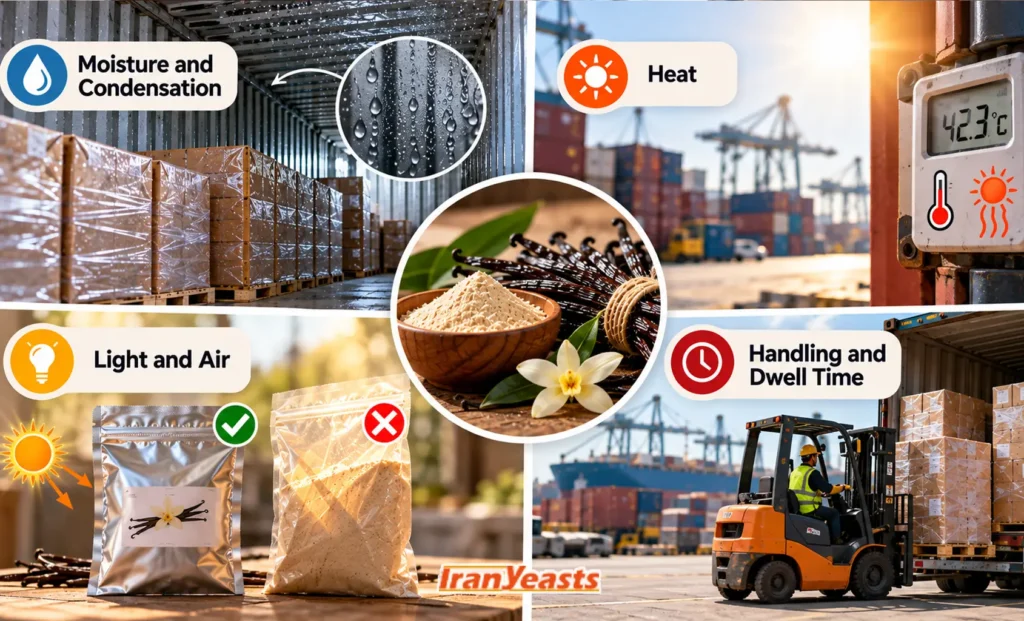
Moisture and Condensation
This is the most common cause of arrival problems. When warm, humid air inside a container meets a cooler surface, water condenses and can drip onto cargo, a problem shipping specialists describe as cargo sweat and container rain, a major cause of moisture damage in transit. Desiccants help, but they are no substitute for a pack that keeps moisture out in the first place.
Heat
Vanillin melts at about 81 degrees Celsius, so it will not melt in a normal shipment. Heat still speeds oxidation and, combined with humidity, can encourage clumping. Cargo stacked in the sun at a hot port, or left waiting for days before loading, takes more heat than the voyage itself.
Light and Air
- Light: Translucent packaging lets light reach the product during port and yard storage.
- Air: A pinhole or poor seal gives oxygen a slow, steady path to the powder.
- Fix: Opaque, tightly sealed packaging addresses both at once.
Handling and Dwell Time
Every transfer between truck, port, vessel, and warehouse is a chance for a pack to be punctured or left in the heat. The longer cargo waits at a port, the more of the risks above it absorbs.
Route by Route: What Changes
No two export routes put the same stress on a shipment. The full export process is covered in how to export vanilla from Iran, and the sections below focus on how the route changes the risk.
Short Sea Routes to the Middle East
Shorter transit means fewer days of exposure, which lowers the odds of condensation damage. The remaining risk is heat and humidity at loading and discharge ports along the Gulf, so shaded storage and quick turnaround at the port matter most.
Long Sea Routes to Europe and Canada
Weeks at sea mean more temperature swings, and more chances for condensation as the container moves between climate zones. This is where barrier packaging and sealed liners earn their cost, and where a damaged outer pack is most likely to become a damaged product.
Overland Routes to Afghanistan, Pakistan, and Central Asia
Road transport brings dust, rough handling, and wide day and night temperature swings. Strong outer cartons and sealed inner packs matter more here than on sea freight, since packs are loaded and unloaded more often.
Packaging: The First Line of Defense
Since no route is risk-free, packaging does most of the protecting. Rigid, fully sealed formats give the strongest barrier, which is why wholesale tin vanilla packaging suits long routes and extended storage. Whatever the format, the goal is the same: keep moisture, air, and light out from loading to opening.
- Moisture-barrier films or rigid containers with a sealed closure.
- Opaque material to block light during port and yard storage.
- Sturdy outer cartons or drums that survive repeated handling.
- Desiccants as backup where the route is humid, not as the main defense.
A Practical Checklist for Importers
Packaging and route choices also affect cost, which is one of the themes in factors affecting Iranian vanilla export price. Use these steps to protect quality at each stage.
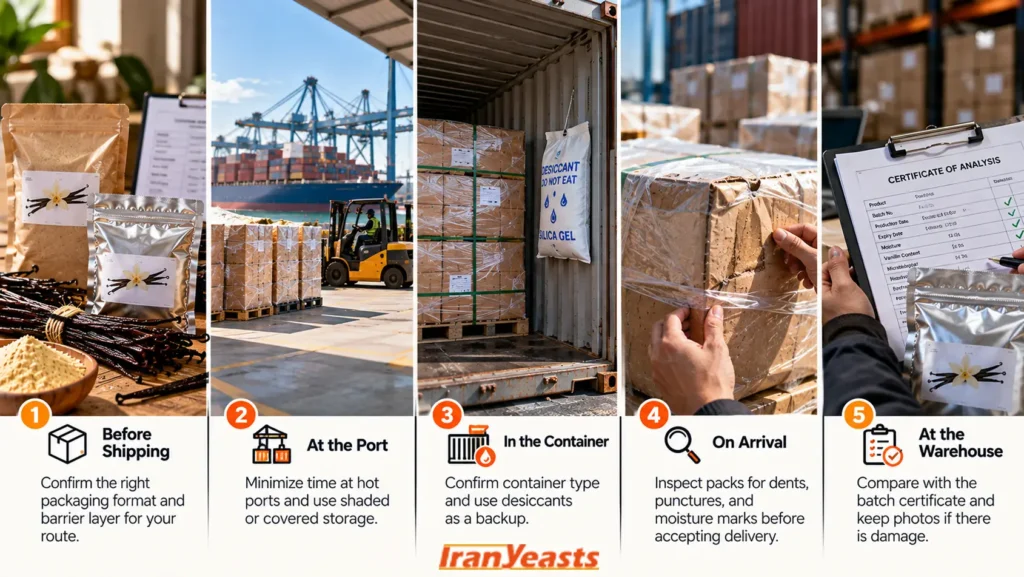
- Before shipping: Ask the supplier what packaging format and barrier layer protect the shipment on your specific route.
- At the port: Plan loading to minimize time at hot ports, and ask for shaded or covered storage while cargo waits.
- In the container: Confirm the container type and whether desiccants will be used as a backup.
- On arrival: Inspect packs for dents, punctures, and moisture marks before accepting delivery.
- At the warehouse: Compare the batch certificate of analysis with the condition of the goods, and keep photos if there is damage.
What to Check When the Shipment Arrives
A quick inspection on arrival catches most transit damage. A good starting point is browsing wholesale vanilla formats to see which packaging suits your route before you order.
- Dents, punctures, or torn outer cartons.
- Water marks or damp patches on the packaging.
- Clumped, hardened, or discolored product when a sample pack is opened.
- An unusual or weaker aroma compared with your reference sample.
- Any mismatch between batch numbers on the pack and the paperwork.
Conclusion
Vanilla quality in export is decided by moisture, heat, light, and air, and by how long and how rough the route is. Short routes lower the exposure, while long sea routes and handling-heavy overland routes raise it.
Strong packaging, shaded port handling, and a careful inspection on arrival protect most of the quality. Ask your supplier what protects your shipment on your route before you order.
References
- Organisation for Economic Co-operation and Development. (n.d.). Vanillin: SIDS initial assessment profile. https://hpvchemicals.oecd.org/ui/handler.axd?id=2928e1f3-70af-4d2c-80a8-3c1205d0daa3
- Arviem. (n.d.). Moisture and condensation as a challenge for cargo in transit. https://arviem.com/condensation-and-moisture-as-a-challenge-for-cargo-in-transit/
- Conex West. (n.d.). Shipping container sweating: What causes it and how to stop it. https://www.conexwest.com/blog/shipping-container-sweating-what-causes-how-stop
- Cole-Parmer. (n.d.). Material safety data sheet: Vanillin (ACC# 24863) [PDF]. https://pim-resources.coleparmer.com/sds/24863.pdf
- Multisorb Technologies. (2025, July 30). How desiccants for food shipping protect your food's quality. https://www.multisorb.com/blog/desiccants-in-food-shipping/
Frequently Asked Questions
Find answers to common questions about how climate, shipping routes, packaging, and arrival checks affect vanilla quality during export.
What is the biggest threat to vanilla quality during shipping?
Moisture, usually from condensation inside the container, since vanillin is sensitive to moisture and moist air speeds oxidation.
Will heat melt vanillin during export?
Not in a normal shipment. Vanillin melts at about 81 degrees Celsius, but heat can still speed oxidation and, together with humidity, encourage clumping.
Why does vanilla sometimes arrive clumped?
Clumping usually comes from moisture getting into the pack, either through condensation in the container or a damaged or poorly sealed package.
Are desiccants enough to protect vanilla in a container?
They help, but they are a backup. The main defense is a pack that keeps moisture, air, and light out from loading to opening.
Which route is riskiest for vanilla quality?
Long sea routes carry the most exposure to temperature swings and condensation, while overland routes add handling and dust risks. The right packaging matters most on longer routes.
Does light affect vanillin?
Yes. Vanillin is described as light sensitive, so opaque packaging helps protect color and aroma, especially during port and yard storage.
What should I inspect when a vanilla shipment arrives?
Check for dents, punctures, water marks, clumped or discolored product, and any weaker aroma, and compare batch numbers on the packs with the paperwork.