

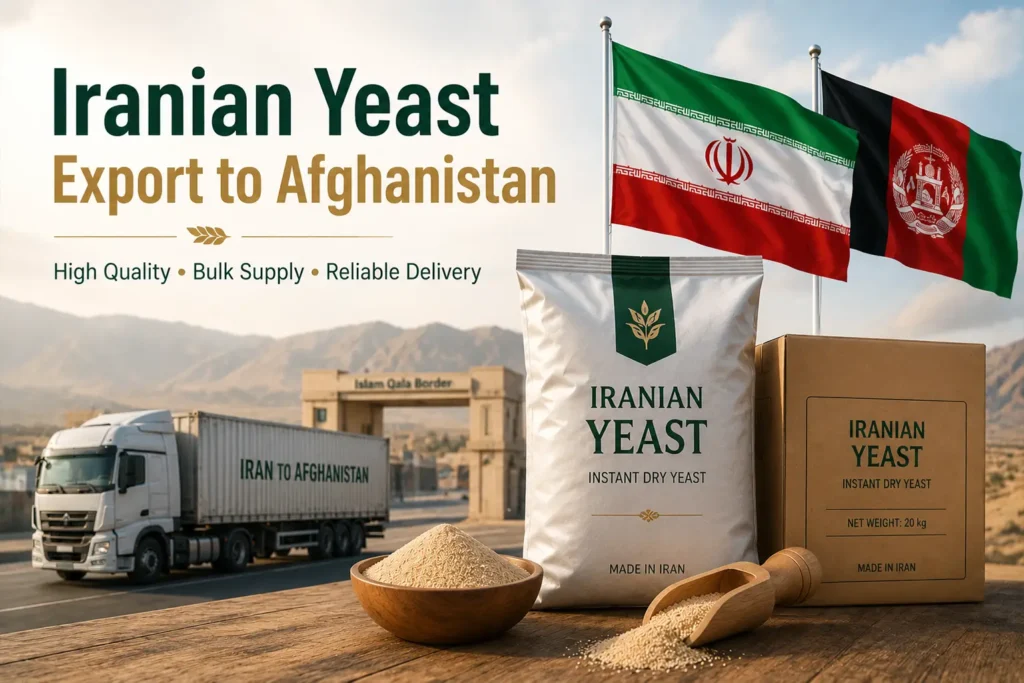
Afghanistan is one of the largest and most consistent markets for Iranian food exports, and yeast is a staple part of that trade. Naan and other flatbreads are eaten daily across the country, which keeps demand for reliable dry yeast steady year-round rather than tied to a single season.
Getting product across the border is only part of the job. Distributors also need to think through documentation, packaging suited to a hot and dusty climate, and how currency and payment terms work on a route that can shift with local conditions.
This guide walks through what distributors and wholesalers need to know about exporting and importing yeast between Iran and Afghanistan.
Looking to Import Iranian Instant Dry Yeast at Wholesale Scale?
Get expert guidance on product selection, packaging, export documentation, pricing, and international shipping directly from our export team.
Why Iranian Yeast Dominates the Afghan Import Market
Iran shares a long land border with Afghanistan and has built the logistics infrastructure to move food staples across it reliably, which gives Iranian suppliers a structural advantage over sea-freight competitors on price and delivery time. This proximity is a large part of why Iranian instant dry yeast has become a top choice for bulk importers worldwide, and Afghanistan in particular, where road transport keeps freight costs low compared to yeast shipped in from more distant origins.
Afghanistan’s bread culture also plays a role. Naan is baked fresh daily in households and bakeries across the country, creating steady, high-volume demand for instant dry yeast that holds up in ambient storage conditions without refrigeration, which matches well with what Iranian producers are set up to supply at scale.
Border Crossings and Logistics Between Iran and Afghanistan
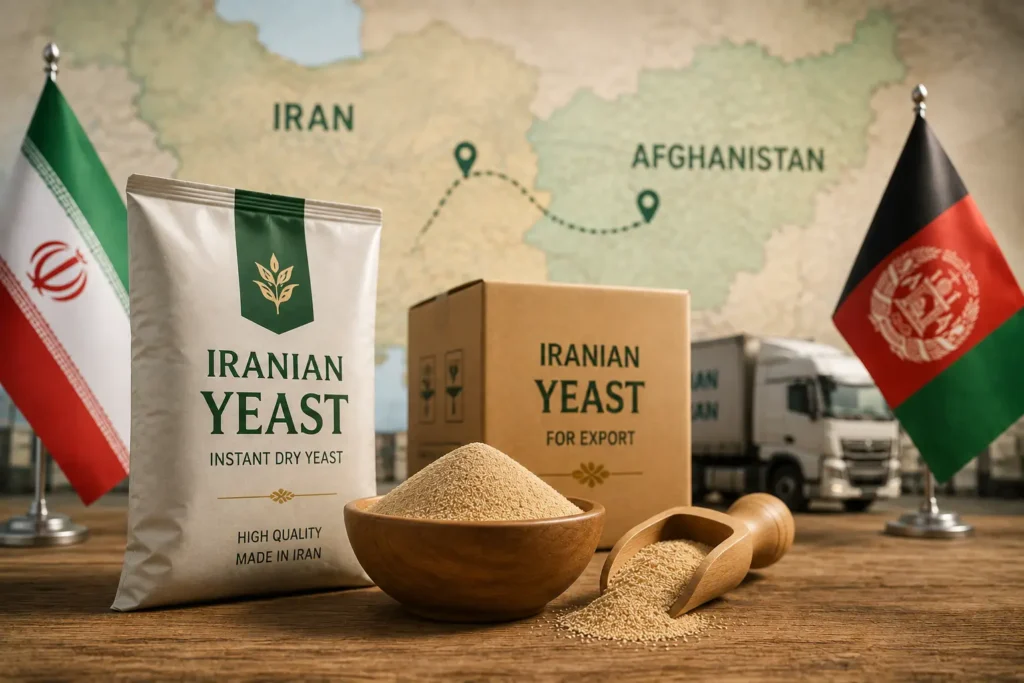
Three official border crossings connect Iran and Afghanistan: Dogharoun-Islam Qala in Razavi Khorasan province, Mahirud in South Khorasan province, and Milak-Zaranj in Sistan and Baluchestan province. Dogharoun-Islam Qala handles the large majority of Iran’s exports to Afghanistan and is generally the most reliable route for commercial cargo, with trade volume through the crossing reaching roughly $3 billion a year and around a thousand trucks crossing daily under normal conditions.
Customs clearance at these crossings typically requires a commercial invoice, waybill or bill of lading, certificate of origin, packing list, and any relevant health or import documentation for food products, a process outlined in more detail in logistics assessments of the Islam Qala crossing. Processing times vary with border traffic and can extend during periods of regional disruption, so distributors should build a buffer into delivery timelines rather than quoting customers based on best-case transit time alone.
Packaging Yeast for Afghanistan's Climate and Supply Chain
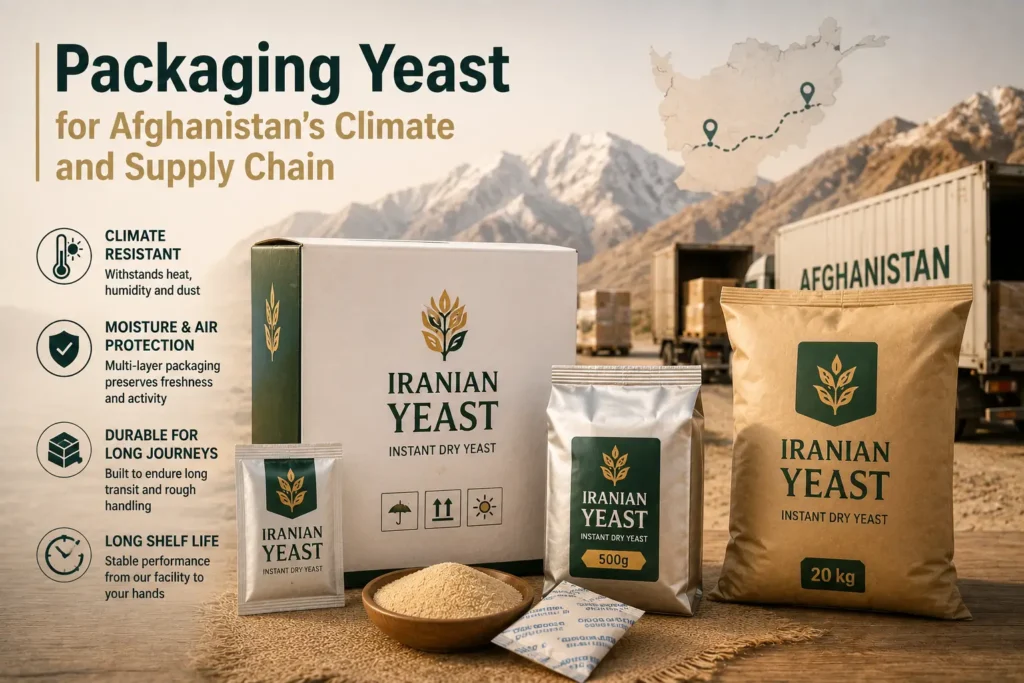
Afghanistan’s climate runs hot and dry through much of the year, with dust exposure a real factor during road transport and at open-air distribution points. Packaging built for this environment needs a strong moisture and oxygen barrier that holds up to rougher handling than a container shipped by sea, which is one of the practical differences covered when comparing active dry yeast vs. instant dry yeast for export for overland routes specifically.
Instant dry yeast in vacuum-sealed, multi-layer bags generally travels better on this route than active dry yeast, since it tolerates ambient temperature swings more consistently and does not require refrigeration at any point between the production facility and the final bakery.
Certification and Documentation for the Afghan Market
Halal status matters throughout Afghanistan’s food supply chain, and yeast is no exception even though it does not contain animal-derived ingredients in most formulations. Buyers and regulators increasingly expect documented certification rather than a verbal assurance, a shift covered in detail in halal-certified yeast export from Iran, which walks through what standards and paperwork to ask a supplier for before placing an order.
Distributors should also confirm that batch documentation, including production date and any relevant lab testing, travels with the shipment. This becomes especially important if goods are held at the border for an extended period, since it gives both sides a clear reference point for the product’s condition at the time of dispatch.
Pricing and Payment Considerations for the Afghanistan Route
Land freight over the Dogharoun-Islam Qala route generally keeps landed costs lower than sea-freight alternatives, but currency exchange and payment timing still deserve attention. Understanding the general structure of bulk dry yeast pricing from Iran helps distributors separate a genuinely competitive quote from one that looks cheap on paper but carries hidden costs in payment terms or delivery reliability.
Getting Started: A Simple Process for New Distributors
For distributors sourcing yeast from Iran for the first time, the process is more structured than it might first appear, from initial supplier vetting through to first shipment. A step-by-step walkthrough of how to import yeast from Iran covers the full sequence in more detail, including what documentation to prepare before the first order ships.
Conclusion
Exporting yeast to Afghanistan comes down to a short list of fundamentals: choosing the right border route, preparing complete documentation in advance, packaging for a hot and dusty overland journey, and confirming halal certification is in order before goods ship.
Distributors who treat these as routine steps rather than afterthoughts tend to see fewer delays and fewer disputes at the point of delivery, which matters more on a route where relationships and reliability carry as much weight as price.
References
- Ariana News. (2024, July 18). Islam Qala-Dogharoun border trade volume climbs to $3 billion a year: Iran.
- Digital Logistics Capacity Assessments. (n.d.). 2.3.5 Afghanistan land border crossing of Islam Qala (Iran). Logistics Cluster.
- AtlasPress News Agency. (2025, October 20). 60% of Iran's exports to Afghanistan pass through Dogharoun border crossing.
- DID Press Agency. (2026, July 24). Iran says 60% of exports to Afghanistan pass through Dogharoun border.
- Border Crossing Hub. (2025, September 4). Dogharoun & Islam Qala border crossing.
Frequently Asked Questions
Find answers to common questions about Iranian instant dry yeast, including certifications, bulk orders, private labeling, export logistics, and delivery worldwide
Which border crossing is best for exporting yeast from Iran to Afghanistan?
Dogharoun-Islam Qala in Razavi Khorasan province handles the majority of Iran’s exports to Afghanistan and is generally the most consistent route for commercial food cargo.
What documents are needed to export yeast from Iran to Afghanistan?
Standard requirements include a commercial invoice, waybill or bill of lading, certificate of origin, and packing list, along with any applicable health or food safety documentation for the shipment.
Is halal certification required for yeast exported to Afghanistan?
It is not always a strict legal requirement, but documented halal certification is increasingly expected by buyers and helps avoid questions at the point of sale or distribution.
Does instant dry yeast travel better than active dry yeast on overland routes?
Generally yes. Instant dry yeast tolerates ambient temperature swings more consistently and does not require refrigeration, which suits the road transport conditions common on this route.
How long does customs clearance typically take at the Iran-Afghanistan border?
Clearance times vary with border traffic and can extend during periods of regional disruption, so distributors should build buffer time into delivery schedules rather than relying on best-case transit estimates.
Why is Afghanistan a stable long-term market for yeast imports?
Naan and other flatbreads are a daily staple across Afghanistan, which creates consistent, non-seasonal demand for dry yeast rather than demand tied to a single baking season.
What packaging works best for yeast shipped overland to Afghanistan?
Vacuum-sealed, multi-layer bags with a strong moisture and oxygen barrier hold up best against the heat, dust, and rougher handling typical of overland distribution in Afghanistan.