

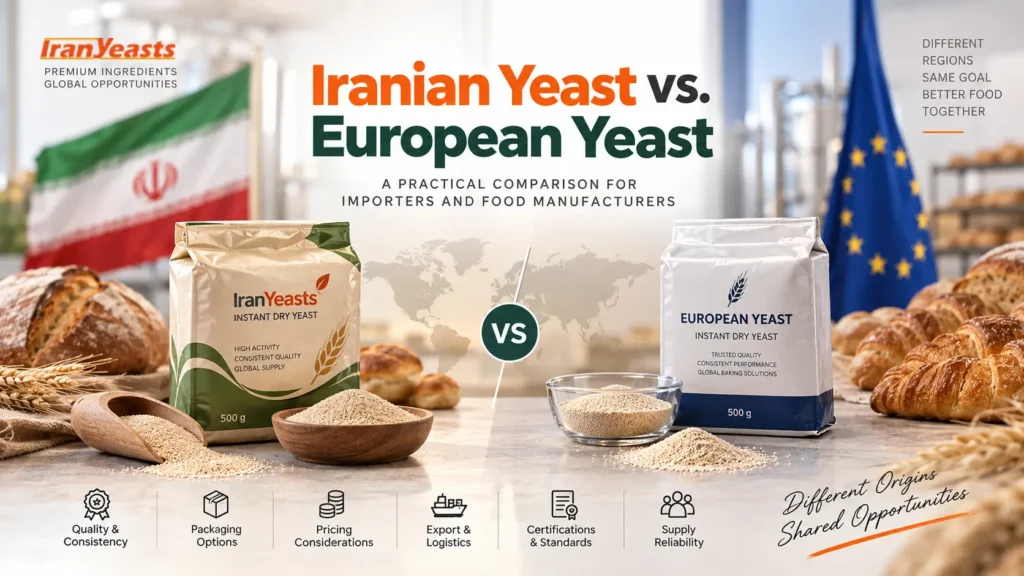
Comparing Iranian yeast to European yeast is not really a contest between equals. One side includes Lesaffre, a single French company that supplies roughly a fifth of the world’s yeast and operates in over a hundred countries. The other is a smaller, export-focused industry built around regional strengths rather than global scale.
That gap does not settle the question for buyers on its own. Scale answers some sourcing questions, but not the ones about freight cost to a specific region, minimum order flexibility, or how quickly a supplier can turn around a private label request.
This guide of Irany Yeast compares the two industries on scale, pricing, and logistics, and looks at where each origin actually has the advantage.
Looking to Import Iranian Instant Dry Yeast at Wholesale Scale?
Get expert guidance on product selection, packaging, export documentation, pricing, and international shipping directly from our export team.
Iranian Yeast vs. European Yeast: How the Two Industries Compare
The two industries sit at very different points on the scale spectrum, which shapes almost every other part of the comparison. The table below summarizes the core differences.
| Factor | European Yeast Industry | Iranian Yeast Industry |
|---|---|---|
| Industry structure |
A few global giants (Lesaffre, AB Mauri, Lallemand) |
Multiple export-focused domestic producers |
| Global market position | Lesaffre alone holds roughly one-fifth of the world market | Established regional exporter, not a top global producer by volume |
| Geographic reach | Operations in 100+ countries | Export to 9+ countries, concentrated regionally |
| Typical strength | Scale, R&D, specialty strains, global brand recognition | Price, regional freight advantage, order flexibility |
| Best-positioned buyer regions | Global, especially where brand recognition matters | Middle East, Central Asia, and nearby export corridors |
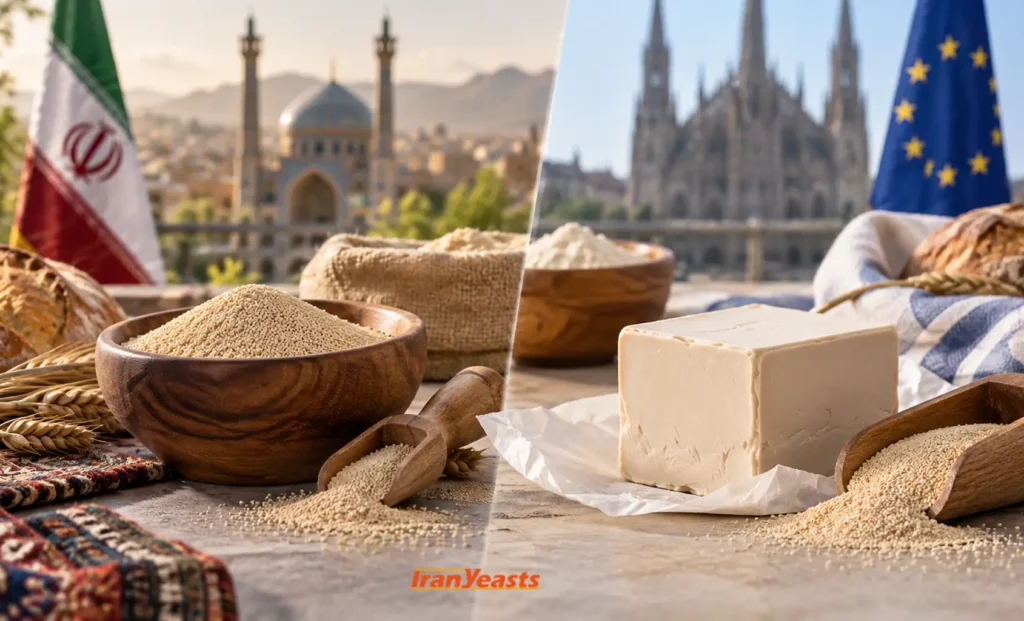
Europe's Yeast Industry: Scale Led by a Handful of Global Giants
Unlike many origins where yeast production is fragmented across dozens of small domestic players, Europe’s industry is dominated by a small number of companies operating at genuinely global scale.
Lesaffre's Global Footprint
Lesaffre, founded in France in 1853, is the world’s largest yeast producer. The company employs roughly 11,000 people of 96 nationalities and operates in 185 countries, with production facilities spread across multiple continents rather than concentrated in one region. That footprint gives Lesaffre logistics and distribution options that a single-country exporter cannot easily replicate.
Other Major European Producers
Lesaffre is not alone at the top. Together with AB Mauri and Angel Yeast, the three largest global producers account for roughly 64.6 percent of the instant dry yeast market by some industry estimates, and European specialty yeast producers such as Lallemand and Ohly add further depth in categories like yeast extract and nutritional yeast that go beyond basic baker’s yeast.
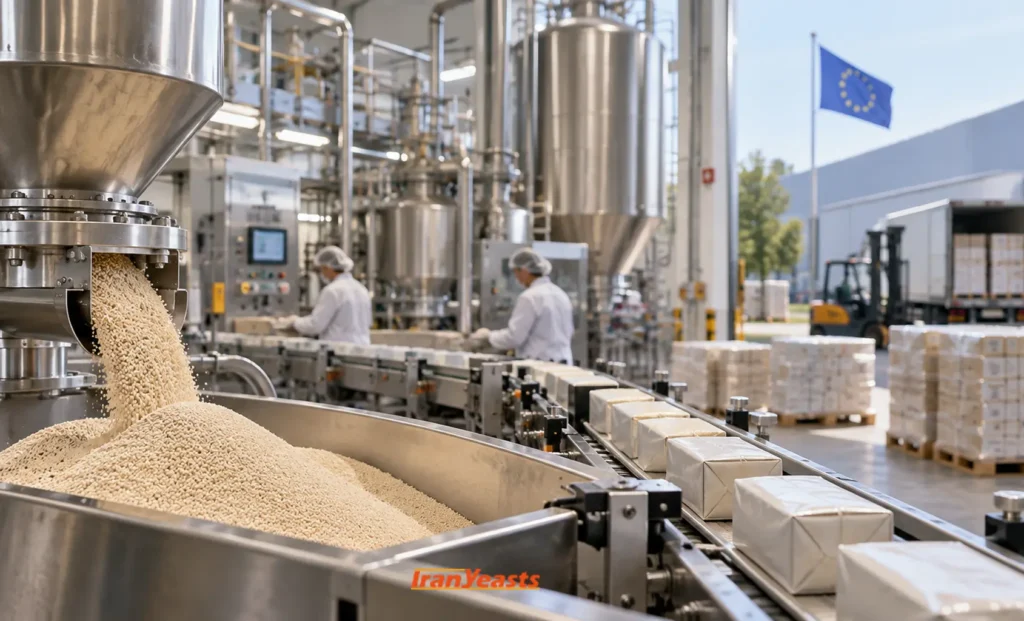
Iran's Yeast Industry: Smaller Scale, Regional Focus
Iran’s yeast industry looks fundamentally different in structure. Rather than one or two dominant companies operating globally, the market includes multiple domestic brands, such as Fariman and Razavi, each competing for export volume within a narrower geographic footprint centered on the Middle East, Afghanistan, Pakistan, and Central Asia. This export-first orientation is a large part of why Iranian instant dry yeast has become a top choice for bulk importers worldwide within that regional footprint, even without competing head-on with European producers for global volume.
This regional concentration is a deliberate strength rather than a limitation for buyers in those corridors. Shorter freight distances, established land and sea routes, and export documentation built around halal-conscious markets all give Iranian suppliers an edge for buyers whose primary need is regional reliability rather than global brand recognition.
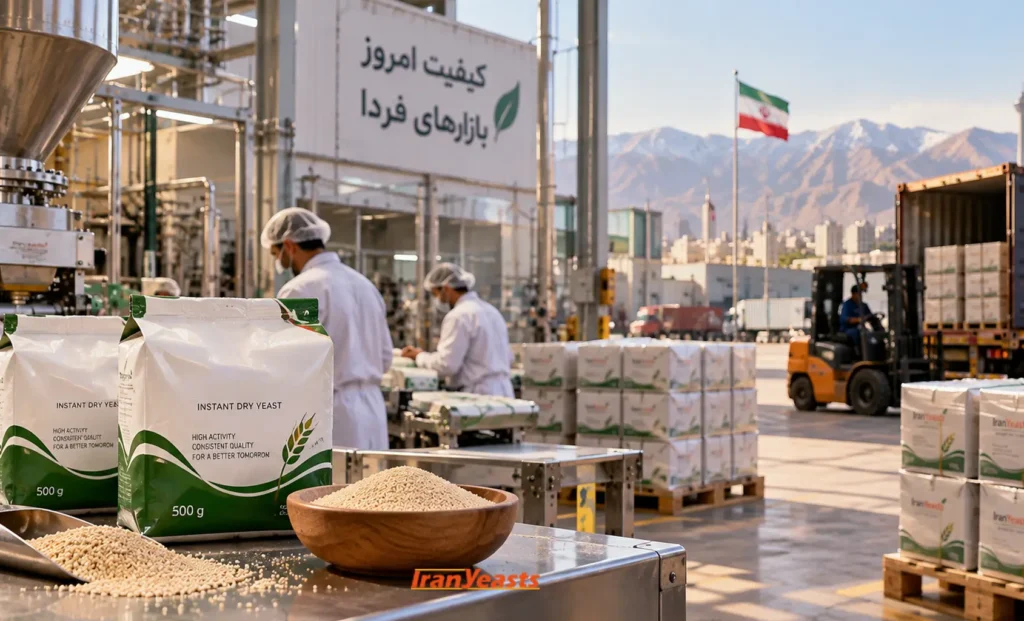
Comparing Price and Value
Price comparisons between European and Iranian yeast are complicated by the fact that European producers serve a much wider range of product tiers, from commodity baker’s yeast to specialty strains and yeast-derived ingredients priced well above basic bulk yeast. For straightforward bulk instant dry yeast, current bulk dry yeast pricing from Iran is generally positioned to be competitive against European bulk offerings, particularly once European freight costs to Middle Eastern and Central Asian destinations are factored into a landed cost comparison rather than comparing factory-gate prices alone.
Where Each Origin Actually Wins
Europe wins on: Global brand recognition, breadth of specialty and technical yeast products, R&D-backed strain development, and logistics infrastructure built for worldwide distribution rather than one region.
Iran wins on: Freight cost and transit time to Middle Eastern and Central Asian buyers, flexibility on smaller or first-time order volumes, and typically lower minimum commitments for private label arrangements.
Documented halal-certified yeast export from Iran is also built into standard export practice for most Iranian suppliers, which matters for buyers who need that paperwork readily available rather than arranged on request.
Which Should Buyers Choose?
For buyers in Europe, North America, or markets where a globally recognized yeast brand matters to end customers, a European producer’s scale and product breadth is hard to match. For buyers in the Middle East, Afghanistan, Pakistan, or Central Asia, particularly those working with smaller order volumes or building a private label yeast brand, Iranian suppliers generally offer a more accessible entry point on both price and minimum order size. A structured look at how to evaluate a bulk yeast supplier applies to either origin and is worth running through regardless of which one a buyer is leaning toward.
Conclusion
Iranian and European yeast are not really competing for the same buyer in most cases. European producers, led by Lesaffre, operate at a global scale built around brand recognition, specialty products, and worldwide distribution. Iran’s industry is smaller but structured around regional strengths that matter more to a specific set of buyers than raw scale does.
For buyers in Europe or markets where global brand recognition drives purchasing decisions, a European producer is the natural fit. For buyers closer to Iran’s export corridors, particularly those prioritizing price, flexibility, and private label access, Iranian yeast is generally the more practical choice.
References
- Fortune Business Insights. (2026). Baker's yeast market size, share and industry analysis.
- Future Market Insights. (2026). Instant dry yeast market outlook (2025 to 2035).
- Global Growth Insights. (2026). Specialty yeast market size, growth and forecast.
- Lesaffre. (n.d.). About us.
- Mordor Intelligence. (2026). Yeast market size, share and 2031 growth analysis report.
Frequently Asked Questions
Find answers to common questions about Iranian instant dry yeast, including certifications, bulk orders, private labeling, export logistics, and delivery worldwide
Is Lesaffre really the largest yeast producer in the world?
Yes. Lesaffre is widely recognized as the world’s largest yeast producer, employing roughly 11,000 people across 185 countries, with a global market share estimated at around one-fifth of world yeast supply.
Is Iranian yeast lower quality than European yeast?
Not inherently. Quality depends on the specific producer and certification rather than origin alone. The main structural difference is scale and product breadth, not a fixed quality gap.
Why would a buyer choose Iranian yeast over a global brand like Lesaffre?
Common reasons include lower freight cost and transit time for Middle Eastern and Central Asian buyers, more flexible minimum order quantities, and more accessible private label arrangements for smaller distributors.
Do European yeast producers offer private label options?
Some do, but minimum order requirements at large global producers are often higher than what smaller regional exporters require, which can make private label programs more accessible through an origin like Iran for smaller buyers.
Which European companies compete with Lesaffre in yeast production?
AB Mauri and Lallemand are among the other major producers with significant European operations, alongside specialty players like Ohly in yeast extract and related categories.
Is Iranian yeast cheaper than European yeast?
Generally competitive for standard bulk instant dry yeast, particularly once European freight costs to Middle Eastern and Central Asian destinations are included in the comparison rather than looking at factory-gate pricing alone.
Does Iran export yeast to Europe?
Iranian yeast exporters are primarily positioned around Middle Eastern, Central Asian, and South Asian markets rather than competing directly for European domestic demand, where local and regional producers dominate.