

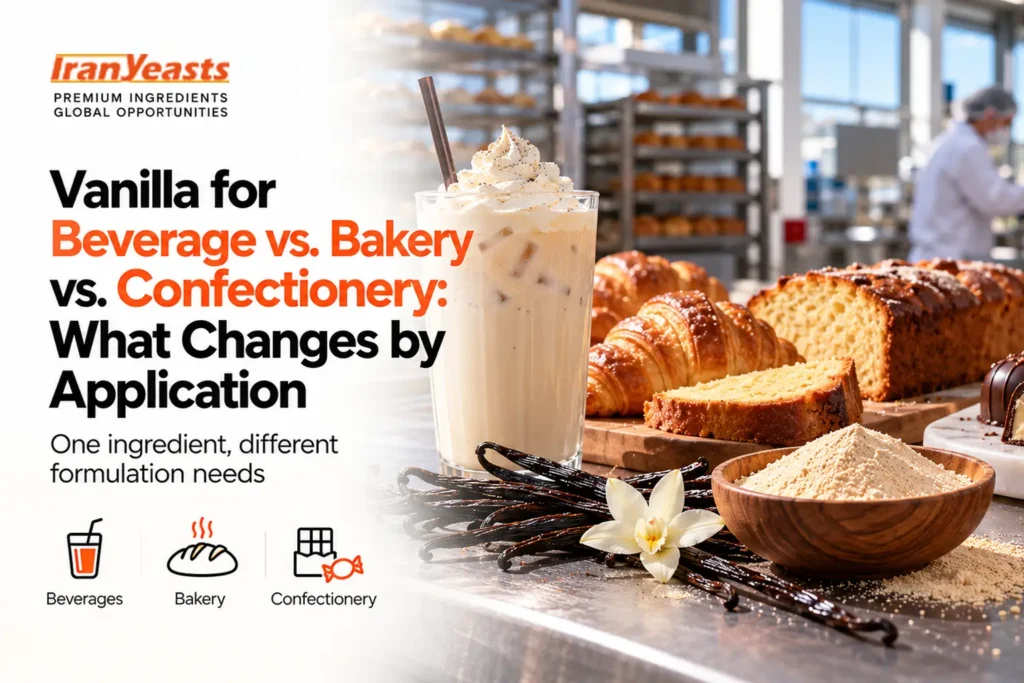
Vanilla is not one flavor behaving the same way everywhere. A vanillin dose that tastes right in a cold drink can nearly vanish in a hot oven, and a form that dissolves well in water may disperse poorly in chocolate.
Manufacturers who treat vanilla as a single ingredient usually find out the hard way, through reformulations and inconsistent batches. The differences come down to three things: heat, solvent, and how much flavor the product needs to carry.
This guide compares beverages, bakery, and confectionery, using published use-level data, so you can match form and dose to the application.
Looking to Import Iranian Premium Vanilla at Wholesale Scale?
Get expert guidance on product selection, packaging, certification documents, export paperwork, pricing, and international shipping directly from our export team.
Vanilla Flavoring by Application: How Iranian Vanilla Performs Across Three Categories
Iranian vanilla is industrially produced vanillin, which makes it a precise, repeatable flavor tool, but each application stresses it differently. The table below summarizes what each category asks of a vanillin ingredient, using weighted mean use levels reported by the flavor industry and summarized by the OECD.
| Application | Main Stress on Vanillin | Reported Use Level (usual / maximum, ppm) | Key Watch-Out |
|---|---|---|---|
| Beverages | Dissolving evenly, staying stable in liquid | About 30 to 39 usual, 47 to 97 maximum | Poor dissolution and uneven flavor |
| Bakery | Oven heat and flavor loss | About 75 usual, 106 maximum | Flavor lost to heat |
| Confectionery | Cooking temperature and fat | Soft candy about 247 / 408, hard candy about 26 / 193 | Wide range, large losses in hot cooking |
These figures are reference points from older industry data, not recipes. Your formulation, flavor intensity, and process will set the real dose.
What Vanillin Does Under Heat, Water, and Fat
Three physical properties explain most of the differences between applications.
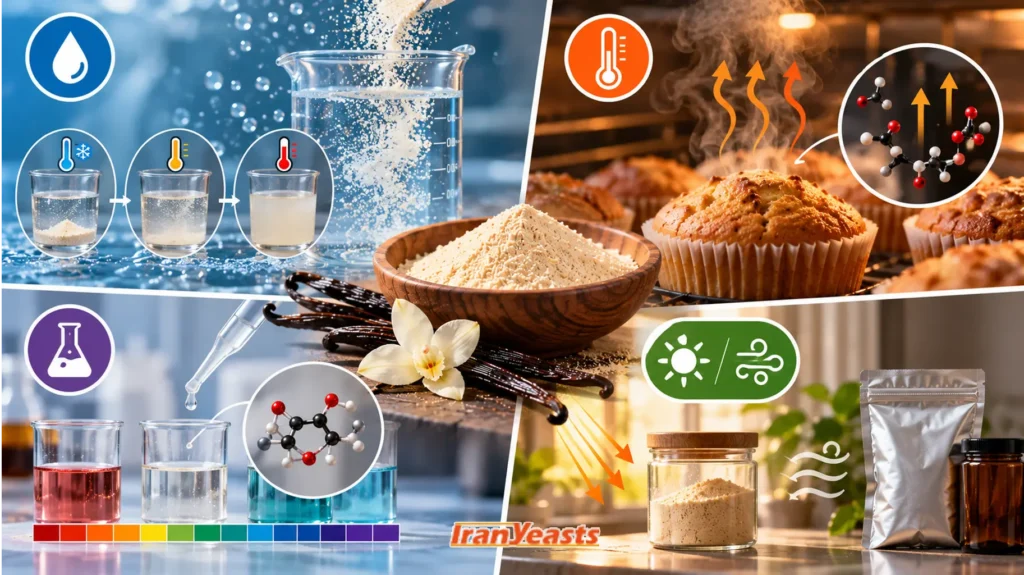
According to the OECD’s assessment, vanillin dissolves in water at about 10 grams per liter at 25 degrees Celsius, rising to around 50 grams per liter at 75 to 80 degrees, and it is freely soluble in ethanol and soluble in oils. Its vapor pressure also climbs steeply with temperature, from about 0.002 hPa at 25 degrees to roughly 9.7 hPa at 140 degrees, which is why heat can drive vanillin out of a product.
- Solubility: Vanillin dissolves better in warm water or alcohol than in cold water, which matters for liquid products.
- Volatility: The hotter and longer the process, the more flavor can be lost, which matters for baking and candy cooking.
- pH: Vanillin is weakly acidic and reacts with strong bases, so very alkaline formulas need testing.
- Light and air: Light and moist air slowly degrade vanillin, so storage conditions and packaging still matter.
Vanilla in Beverages
In drinks, vanilla has to dissolve fully and stay stable through filling and shelf life. Manufacturers working in this space can find broader guidance in Iranian vanilla for food manufacturers.
Typical Beverage Applications
- Ready-to-drink coffee, tea, and dairy beverages.
- Flavored milks, shakes, and plant-based drinks.
- Syrups and concentrates used in cafes and bars.
What Works Well in Beverages
- Pre-dissolved vanillin: Vanillin pre-dissolved in warm water or alcohol disperses evenly through the batch.
- Dosing control: Vanillin is precise, so flavor stays consistent from batch to batch.
- Low dose: Reported use levels in beverages are low, so a small amount goes a long way.
Beverage Watch-Outs
- Dissolution: Undissolved crystals leave uneven flavor or specks, so dissolve fully before adding.
- Processing losses: Heat treatment steps can reduce flavor, so test after the full process.
- Light: Light exposure during shelf life can dull aroma over time.
Vanilla in Bakery
Baking exposes flavor to oven heat, which drives off volatile aromatics. That is why America’s Test Kitchen’s blind tastings found that vanillin-heavy imitation vanilla can hold its flavor in baked goods better than pure extract, while pure extract’s delicate notes fade. Large bakeries buying at volume can look at bulk premium vanilla.
Typical Bakery Applications
- Cakes, cookies, and pastries.
- Batters, doughs, and filled products.
- Dry mixes, where vanillin can be blended into the flour or sugar.
What Works Well in Bakery
- Dry blending: Vanillin in powder form blends into dry ingredients before mixing.
- Heat tolerance: Its concentration helps flavor survive baking better than delicate extracts.
- Predictable dosing: Reported bakery use levels are moderate, around 75 ppm usual and 106 ppm maximum.
Bakery Watch-Outs
- Bake loss: Oven temperature and bake time drive flavor loss, so tune dose to the process.
- Where it goes in: Whether vanillin goes into a dry mix, a fat, or a batter can change how evenly it disperses.
- Product format: Different product formats lose flavor at different rates, so test each one.
Vanilla in Confectionery
Confectionery covers the widest range, from chocolate to chewy candy to hard candy cooked at high temperature. Use levels vary just as widely, and cooking steps decide how much flavor survives.
Typical Confectionery Applications
- Chocolate and compound coatings.
- Soft candies, caramels, and chewy confections.
- Hard candy and lollipops, cooked at high temperature.
What Works Well in Confectionery
- Fat solubility: Vanillin dissolves in fats and oils, so it mixes into chocolate and fat-based fillings.
- Strong flavor capacity: Soft candy can carry high levels of vanillin, reported near 247 ppm usual and 408 ppm maximum.
- Late addition: Adding vanillin after the hottest cooking step protects flavor.
Confectionery Watch-Outs
- Cooking losses: Hard candy shows a very wide range, from about 26 ppm usual to 193 ppm maximum, which reflects heavy variation in cooking loss.
- Different medium: Chocolate and fat systems behave differently from water-based ones, so do not copy a beverage dose.
- Perceived intensity: Flavor balance with sugar and cocoa changes how strong vanilla tastes.
How to Choose the Right Form for Your Application
Work through these questions in order. For a side-by-side look at the formats themselves, see vanilla extract vs. vanilla powder vs. vanillin. If your label needs a natural-flavor claim, synthetic vanillin will not qualify, a trade-off explored in Iranian vanilla vs. Madagascar vanilla.
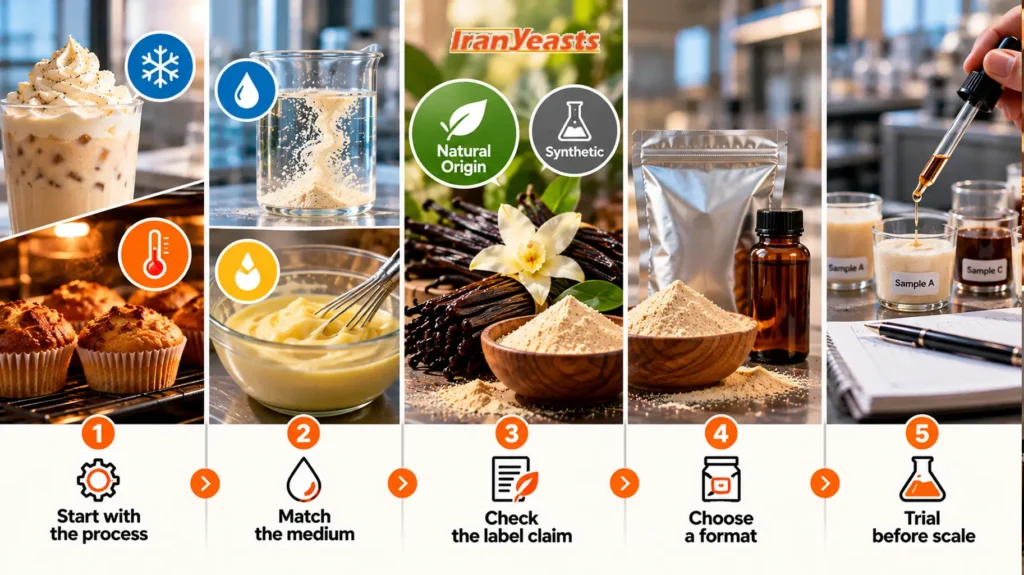
- Start with the process: Cold or lightly heated products favor easy-to-dissolve forms. Hot processes favor higher-concentration vanillin.
- Match the medium: Water-based products need dissolving first. Fat-based products need a fat-compatible approach.
- Check the label claim: Natural-flavor claims require bean-derived or fermentation-based vanillin. Without that claim, synthetic vanillin is a practical choice. The rules are covered in natural vs. artificial vanilla flavoring.
- Choose a format: Dry mixes use powder. Liquid products often use a pre-dissolved solution.
- Trial before scale: Order a sample and trial it in your actual product before committing to volume.
Getting the Dose Right: A Practical Process
Reported use levels are a starting range, not a target. This process turns them into a working dose.
- Pick a starting point: Start from the reported usual level for your category as a trial point.
- Bench trial: Make small batches at, below, and above the starting level.
- Taste after processing: Taste after baking, cooking, or pasteurizing, not before, since processing changes flavor.
- Check stability: Taste again near the end of shelf life to check stability.
- Lock and document: Lock the dose and check each new lot against its certificate of analysis so results repeat.
Where to Start
Once you know the application and form, the next step is a sample. Browse wholesale vanilla formats and request a trial quantity to test in your own product.
Conclusion
Beverages, bakery, and confectionery ask different things of vanilla. Drinks need dissolving and stability, baking needs heat survival, and confectionery spans fat systems and high-temperature cooking.
Match the form to the process, treat published use levels as a starting range, and trial in your own product before ordering volume.
References
- Organisation for Economic Co-operation and Development. (n.d.). Vanillin: SIDS initial assessment profile. https://hpvchemicals.oecd.org/ui/handler.axd?id=2928e1f3-70af-4d2c-80a8-3c1205d0daa3
- America's Test Kitchen. (n.d.). Can you really taste the difference between pure and imitation vanilla extract? https://www.americastestkitchen.com/cooksillustrated/articles/6680-imitation-vs-pure-vanilla-extract
- America's Test Kitchen. (n.d.). Vanilla extract vs. imitation vanilla. https://www.americastestkitchen.com/articles/6229-vanilla-extract-vs-imitation-vanilla
- Alcohol and Tobacco Tax and Trade Bureau. (2024, April 1). Vanilla extracts and vanilla flavors. https://www.ttb.gov/scientific-services-division/dbmenu8sub2
- Cole-Parmer. (n.d.). Material safety data sheet: Vanillin (ACC# 24863) [PDF]. https://pim-resources.coleparmer.com/sds/24863.pdf
Frequently Asked Questions
Find answers to common questions about how vanilla flavoring changes across beverages, bakery, and confectionery, from solubility and heat loss to dosing.
Does vanilla behave differently in beverages than in baked goods?
Yes. Beverages need the vanillin to dissolve and stay stable, while baked goods need it to survive oven heat, so the best form and dose differ.
Why does vanilla flavor weaken when baking?
Vanillin becomes more volatile as temperature rises, so some of it evaporates during baking. Its vapor pressure rises sharply between room temperature and 140 degrees Celsius.
How much vanillin do beverages typically use?
Reported weighted mean use levels for non-alcoholic beverages are roughly 30 to 39 ppm usual and 47 to 97 ppm maximum, as a starting reference only.
Does vanillin dissolve in water?
Slightly. It dissolves at about 10 grams per liter at 25 degrees Celsius and much better in warm water or ethanol, so pre-dissolving helps.
Which application uses the most vanilla?
Among these three categories, confectionery shows the highest reported levels, with soft candy near 247 ppm usual and 408 ppm maximum, compared with about 75 ppm usual for baked goods.
Can I use the same dose across different products?
No. Dose depends on the process, the medium, and the flavor intensity needed, so test each product separately.
Do I need natural vanilla for these products?
Only if the label carries a natural-flavor claim. Without that claim, vanillin works well across all three categories.