

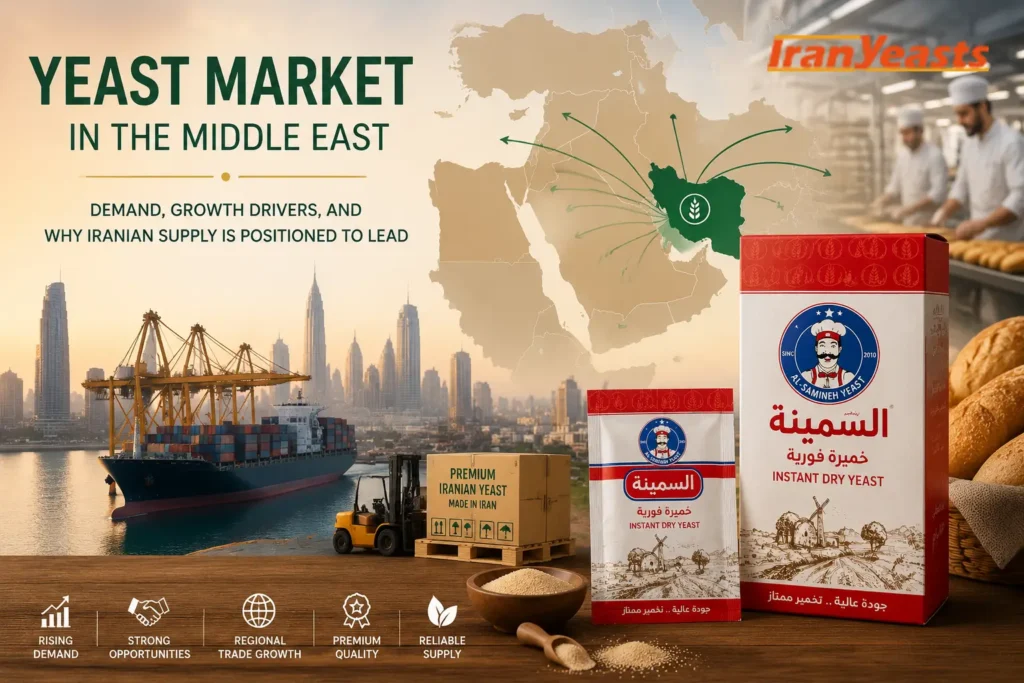
The Middle East is not a single yeast market. It is a collection of distinct national markets with different consumption volumes, different per capita demand, different Halal certification requirements, and different logistics realities , all sharing a dependence on imported food ingredients that gives external suppliers a structural role in the region’s food supply chain.
Understanding this market at the country level, rather than treating it as a single bloc, is what separates distributors who build durable regional business from those who enter a market with a one-size-fits-all approach and struggle to gain traction.
This post draws on verified trade and market data to give distributors, wholesalers, and food manufacturers a clear picture of where yeast demand in the Middle East currently stands, where it is growing fastest, what is driving that growth, and why the region’s supply geography creates a specific opportunity for Iranian producers.
Looking to Import Iranian Instant Dry Yeast at Wholesale Scale?
Get expert guidance on product selection, packaging, export documentation, pricing, and international shipping directly from our export team.
How to Evaluate a Bulk Yeast Supplier: The 8 Criteria That Separate Reliable Partners from Risk
The active yeast market across the MENA region expanded to $1.6 billion in 2024, rising 1.6 percent against the previous year.Total consumption volume across the region reached 708,000 tons in 2024, up 3.4 percent on the year before, with an average annual growth rate of 2.3 percent over the preceding decade
The Middle East and Africa yeast market was valued at $158.32 million in 2021 and is expected to reach $263.99 million by 2029, growing at a CAGR of 6.6 percent.Saudi Arabia, the United Arab Emirates, and Egypt dominate the Middle East yeast ingredient market due to their robust food and beverage sectors, high population density, and increasing urbanization
These numbers deserve context. The MENA yeast market is predominantly an import market. The region’s domestic production covers a portion of demand, primarily through large local producers in Turkey, Iran, and Egypt, but the majority of Gulf states and smaller regional markets depend heavily on imports of instant dry yeast from regional and international suppliers. For a distributor considering entering any Middle Eastern market, the underlying import dependency is a structural feature of the market, not a temporary condition.
Why Baker's Yeast Dominates Middle Eastern Demand
Baker’s yeast accounts for approximately 70 percent of the total global yeast market share, with the bakery sector alone consuming around 60 percent of baker’s yeast produced globally.In the Middle East, this concentration is even more pronounced. Bread is not a discretionary food category in this region , it is a dietary staple consumed daily across all income levels in every country from Morocco to Pakistan.
Per capita bread consumption across the Middle East and North Africa is among the highest in the world. Egypt’s per capita wheat consumption for bread production is consistently cited as one of the world’s highest. Iraq, Iran, and Afghanistan depend on flatbread as a core caloric staple. Saudi Arabia, the UAE, and Qatar have large commercial bakery sectors serving both local populations and significant expatriate communities.
This consumption pattern drives a specific demand for yeast: high-volume, consistent-specification, instant dry yeast suitable for commercial bread production at scale, rather than specialty yeast or artisan fermentation inputs. The commercial bakery clients that regional distributors serve are not looking for premium or artisan products , they are looking for reliable, Halal-certified, well-specified instant dry yeast delivered on time and priced to make their production margins work.
Understanding which yeast type those customers actually need is worth reading in detail. For a clear breakdown of how instant dry yeast differs from active dry yeast and which format commercial bakeries require, see our post on instant dry yeast vs active dry yeast for export.
Country by Country: The Highest-Consuming Yeast Markets in the Region
The countries with the highest volumes of yeast consumption in 2024 were Egypt (114,000 tons), Iran (98,000 tons), and Turkey (79,000 tons), together accounting for 41 percent of total regional consumption.
For distributors evaluating market entry or expansion, this country-level breakdown matters more than the regional aggregate. Here is what the data shows for the markets most relevant to Iranian export supply:
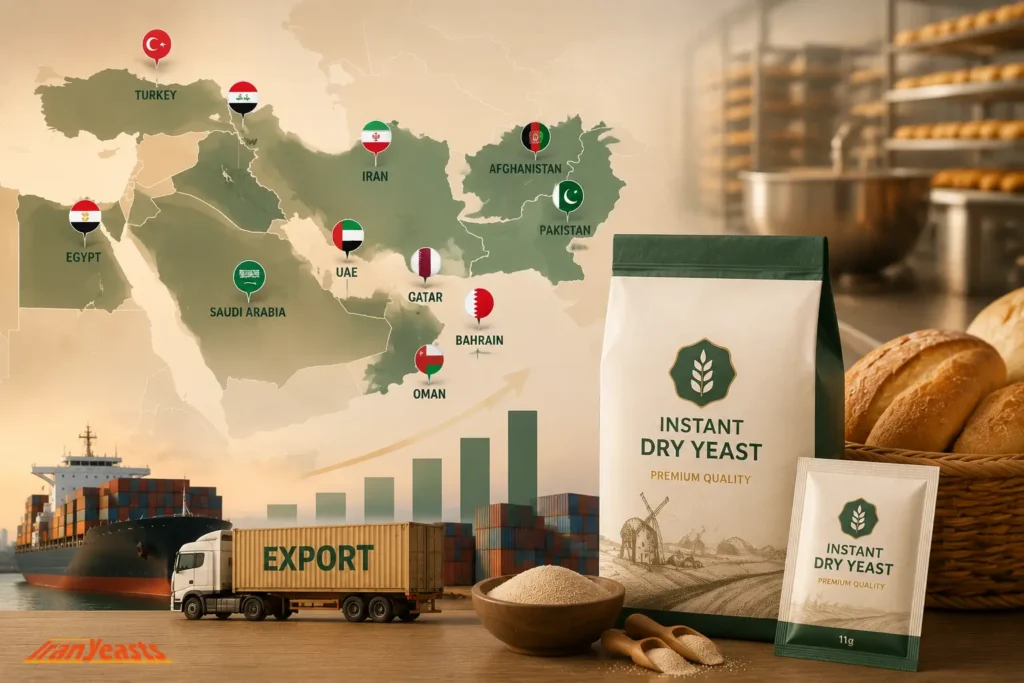
- Iraq is one of the most commercially significant markets for Iranian yeast, sitting at the intersection of high flatbread consumption, a large and growing population, and land-border access from Iran that compresses freight costs and transit times to a level no sea-freight competitor can replicate. Iraq’s yeast market is predominantly an import market. Domestic production is minimal. Halal certification is a firm requirement on all food ingredients. The 10g to 11g consumer sachet format is the dominant retail unit for households and small bakeries.
- UAE stands out on a per capita basis. The UAE led the region in per capita yeast consumption in 2024 at 2.7 kilograms per person. This reflects both the large expatriate population (which includes substantial South Asian and Arab communities with high per capita bread consumption) and the UAE’s position as a regional food distribution hub, with significant volumes imported and then re-exported to neighboring markets.
- Saudi Arabia is the Gulf’s largest single yeast market by both population and commercial bakery scale. Saudi Arabia ranked second in per capita consumption at 1.9 kilograms per person in 2024. The Saudi bakery sector is large, increasingly industrialized, and requires Halal certification from a recognized body as a non-negotiable import condition.
- Qatar, Oman, and Bahrain are smaller markets by volume but represent strong per capita demand and sophisticated food safety import requirements, given their affluence and well-regulated food sectors.
- Afghanistan and Pakistan sit outside the Gulf bloc but are critical markets for Iranian yeast distribution given overland access. Both countries have very high per capita bread consumption and a dominant demand for Halal-certified instant dry yeast at accessible price points. Private label yeast is an emerging format in both markets as regional distributors begin building their own brands.
Why the UAE and Saudi Arabia Lead on Per Capita Consumption , and What This Means for Distributors
The UAE’s position as the region’s highest per capita yeast consumer reflects something more specific than just bread eating habits. The UAE functions as a trans-shipment hub for food ingredients across the Gulf and into South Asian and East African markets. A distributor importing yeast into Jebel Ali (Dubai’s primary port) may be supplying not just UAE-based bakeries but also buyers in Oman, Qatar, Bahrain, and sometimes across to East Africa.
For an Iranian yeast supplier, the UAE serves a dual function: a direct market with strong local commercial bakery demand, and a gateway market from which product moves onward to neighboring countries through established regional distribution networks. The transit time advantage is significant here. Sea freight from Bandar Abbas to Jebel Ali runs 3 to 5 days, compared to 10 to 15 days from Turkish ports and 15 to 25 days from Chinese ports. For a distributor managing inventory for fast-moving commercial bakery clients, this shorter replenishment cycle reduces the safety stock they need to carry.
Saudi Arabia’s importance is driven by its domestic food manufacturing sector. Vision 2030’s food security initiatives have accelerated investment in domestic food processing, which in turn increases demand for food ingredients including instant dry yeast at industrial scale. In 2023, the Saudi government implemented regulations aimed at enhancing food safety standards, including stringent quality control measures for yeast production and import. This regulatory direction raises the documentation bar for all suppliers and favors those who already operate to HACCP and ISO 22000 standards.
What Halal Certification Requirements Mean for Yeast Supply Across the Region
Halal certification is not optional in this market. It is a baseline entry requirement across every Gulf state, Iraq, Afghanistan, and Pakistan , and increasingly expected, even where not legally mandated, across Central Asian markets.
The certification requirement goes beyond simply having a Halal certificate. The issuing body matters. GCC countries and Iraq require Halal certificates issued by recognized national standards bodies or bodies with demonstrated recognition in the destination market. For Iranian-origin yeast, the Halal certificate issued by ISIRI (Iran’s National Standards Organization, a Codex Alimentarius Commission-recognized competent authority) is accepted across all of IranYeasts‘ active Middle Eastern and Gulf export markets without supplementary documentation.
For distributors sourcing from multiple origins or evaluating new suppliers, the certification question is worth examining carefully before the first commercial order. For a detailed breakdown of what to check on a Halal certificate, which issuing bodies carry recognition in which markets, and what documentation to request alongside Halal certification, see our post on Halal-certified yeast export from Iran.
Why Iran Is Structurally Positioned as the Middle East's Natural Yeast Supply Source
Geography is not the only factor in a sourcing decision, but in a market where transit time directly affects inventory cost and product shelf life consumption, it is a decisive one.
Iran shares land borders or short sea routes with every high-consumption market in the extended Middle Eastern yeast market. Iraq is accessible by land freight in 5 to 10 days. The UAE, Qatar, and Oman are reached by sea from Bandar Abbas in 3 to 7 days. Afghanistan and Pakistan are accessible by land in a similar timeframe. No other major yeast exporting country , not France, not China, not Turkey , can serve this full set of markets with comparable transit speeds.
This logistics advantage translates directly into landed cost. A distributor in Baghdad, Dubai, or Karachi comparing a Turkish FOB quote against an Iranian FOB quote needs to factor in freight cost and transit time, not just the headline per-ton price. When that full calculation is done, Iranian supply often lands at a more competitive total cost for these specific markets even when FOB prices appear similar.
Beyond geography, Iranian yeast production covers the specification level the market requires. IranYeasts exports instant dry yeast at a minimum Fermentation Power of 1,350, verified by batch testing, in packaging formats from 10g consumer sachets to 20kg industrial vacuum bags. Monthly capacity runs at 150 tons, scalable to 250 tons. The product carries Halal, HACCP, and ISIRI certification. Ten brands are available for distributor selection or private label production from a 5-ton minimum order.
For pricing context , including how FOB and CIF pricing affect your landed cost calculation for Gulf and regional destinations , see our detailed breakdown in our post on bulk dry yeast price from Iran in 2026.
The Opportunity for Distributors: Where Demand Growth Is Strongest
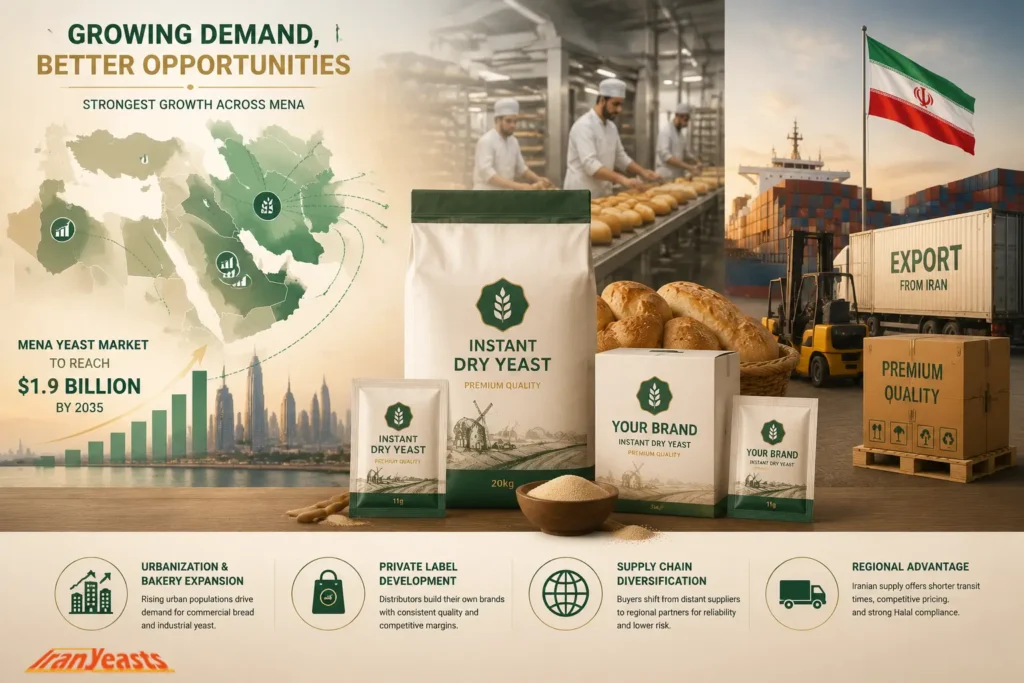
Market performance in MENA is forecast to continue growing with an anticipated CAGR of 1.7 percent in value through to 2035, bringing the total market value to $1.9 billion. Within this broader growth trajectory, the most commercially attractive opportunities for a regional yeast distributor sit at the intersection of three converging trends.
Urbanization and commercial bakery expansion. As urban populations grow across Iraq, Saudi Arabia, and the Gulf states, household bread purchasing shifts from home-baked to commercially produced. Commercial bakeries require larger, more consistent volumes of industrial-format yeast. This shift favors distributors who can supply 10kg to 20kg vacuum bags to commercial accounts rather than just retail sachet formats.
Private label development. Regional FMCG distributors across the Gulf and Iraq are increasingly building their own branded product lines rather than reselling imported brands at thin margins. Yeast is one of the ingredient categories where private label production is commercially accessible because the product is standardized, certification is achievable through established producers, and consumer brand loyalty is low relative to product performance. For a full breakdown of how private label yeast manufacturing works and what MOQs and processes look like, see our guide on private label yeast manufacturing.
Supply chain diversification. The over-reliance on Chinese yeast that characterized many Gulf and South Asian distribution businesses over the past decade is actively being reviewed. Long transit times, variable Halal certification depth across Chinese producers, and supply chain risk exposure during global disruptions have pushed buyers toward regional alternatives. Iranian supply is the natural beneficiary of this shift for buyers in the Gulf-to-Central-Asia corridor.
Final Thoughts
The Middle East yeast market in 2024 is a $1.6 billion import-dependent market growing steadily, dominated by baker’s yeast demand, structurally reliant on Halal-certified supply, and increasingly open to regional sourcing alternatives that offer shorter transit times and more accessible private label terms than the market’s traditional Chinese and European suppliers.
For a distributor with existing food ingredient relationships in the Gulf, Iraq, or Central Asian markets, the case for adding Iranian yeast to the product portfolio is grounded in market data and logistics reality, not in supplier marketing. The demand is there. The documentation framework is in place. The freight routes are established and the transit advantages are real. The question is whether your current sourcing arrangement is capturing those advantages.
References
- IndexBox. (2025, May 28). MENA's bakers' and active yeast market overview 2024: Consumption, production and trade data. IndexBox Market Intelligence.
- Data Bridge Market Research. (2022). Middle East and Africa yeast market by type, form, strains and derivatives , industry trends and forecast to 2029. Data Bridge Market Research.
- Ken Research. (2025, December 26). Middle East yeast ingredient market: Size, share, growth drivers and forecast 2019–2030. Ken Research Pvt. Ltd.
- Expert Market Research. (2025). Global yeast market size, share, industry growth and forecast 2025–2034. Expert Market Research
- Globe Newswire. (2024, April 17). Global yeast strategic industry report 2024–2030: Developed markets dominate consumption, while developing countries spearhead growth. Globe Newswire Research Intelligence.
Frequently Asked Questions
Find answers to common questions about Iranian instant dry yeast, including certifications, bulk orders, private labeling, export logistics, and delivery worldwide
What is the size of the yeast market in the Middle East?
The MENA active yeast market was valued at $1.6 billion in 2024, with total consumption reaching 708,000 tons. The market is projected to grow to $1.9 billion by 2035, driven by expanding commercial bakery production, urbanization, and rising demand for packaged and processed food products.
Which Middle Eastern countries consume the most yeast?
The highest-volume consumers in 2024 were Egypt (114,000 tons), Iran (98,000 tons), and Turkey (79,000 tons), together accounting for 41 percent of regional consumption. On a per capita basis, the UAE leads at 2.7 kilograms per person, followed by Saudi Arabia at 1.9 kilograms per person.
What type of yeast does the Middle East market primarily use?
Baker’s yeast, specifically instant dry yeast, dominates commercial demand across the region. Bread and flatbread production is the primary use case in all major Middle Eastern markets. Instant dry yeast is preferred over active dry yeast for commercial baking applications because it requires no proofing step and delivers more consistent fermentation performance at scale.
Is Halal certification required to export yeast to Middle Eastern countries?
Yes, across all Gulf Cooperation Council countries, Iraq, Afghanistan, and Pakistan. Halal certification is a baseline import requirement for food ingredients including yeast. The certification must be issued by a recognized body , for Iranian-origin yeast, the ISIRI-issued Halal certificate is accepted without supplementary documentation across all of these markets.
Why is Iranian yeast well positioned for Middle Eastern markets?
Iran’s geographic position gives it the shortest transit routes to every major Middle Eastern yeast market. Sea freight from Bandar Abbas to Gulf ports takes 3 to 5 days. Land freight to Iraq, Afghanistan, and Pakistan takes 5 to 10 days. No other major yeast exporting country can serve this specific market cluster with comparable transit times, making Iranian supply structurally competitive on landed cost regardless of headline FOB price comparisons.
What is driving yeast demand growth in the Middle East?
The primary drivers are urbanization leading to greater commercial bakery production, expanding food processing capacity across Saudi Arabia and the Gulf, population growth in high-consumption markets like Iraq and Egypt, and the shift of household bread production from home baking to commercial supply. Private label brand development by regional FMCG distributors is an additional emerging demand driver.
How do distributors enter the Middle Eastern yeast market?
Most successful market entries begin with a specific country and distribution channel focus rather than a broad regional approach. Identifying commercial bakery, foodservice, or wholesale distributor accounts in a target market, confirming Halal certification requirements for that specific country, establishing initial import volumes with a 5-ton minimum order, and testing consumer or bakery response before scaling are the standard steps. For a full walkthrough of the import process, see our guide on how to import yeast from Iran for distributors.